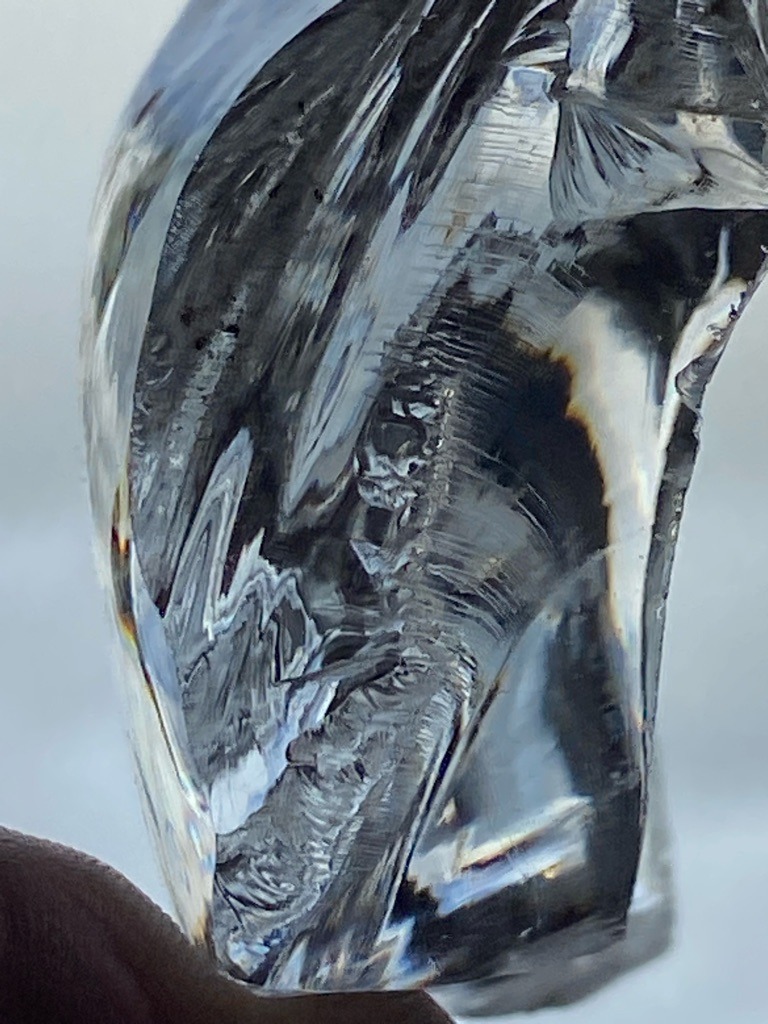
Natural rough diamond specimen
Natural rough diamond specimen · Uncut / Rough crystal form
Not applicable (Rough, unpolished crystal) Cut
Carat
Estimated 3.5 - 5.0 carats based on visual scale
Color
Near-colorless to light yellow tint (Estimated G-J range)
Clarity
Included (I1-I2 equivalent due to internal crystal structures and graining)
Shape
Uncut / Rough crystal form
Overall Assessment
This is a fascinating specimen of an uncut natural diamond crystal showing classic growth features, well-suited for a collector of raw minerals or a master cutter looking to yield a unique custom faceted gem.
Cut Quality
Not applicable (Rough, unpolished crystal)
Brilliance
Low to moderate due to rough exterior scattering light
Fire
Present along certain natural crystal edges where light refracts
Scintillation
Limited flash effect due to lack of traditional facets
Proportions
Natural crystal habit, non-standard geometric proportions
Symmetry
Natural octahedral/irregular crystal symmetry
Polish
Natural rough crystal faces with distinct striations and trigons
Fluorescence
Cannot be definitively determined without UV testing, likely Faint to Medium
Inclusions
Prominent internal crystal graining, natural feather fractures, and cloud formations visible
Blemishes
Natural surface pitting, trigons, and irregular growth lines
Origin
Likely alluvial or primary kimberlite pipe deposit (African or Canadian origin)
Treatment Detection
No evidence of artificial treatments; entirely natural state
Estimated Value
Varies widely based on potential yield after cutting, roughly $1,500 - $3,000 USD
Certification Estimate
GIA or similar major lab report for rough gem-quality diamonds
Investment Potential
Moderate, primarily valued as a collectible raw mineral specimen or custom cutting project
Similar Diamonds
Comparable to standard industrial-to-gem grade transitional rough stones
Setting Suggestions
Can be mounted raw in a custom organic bezel setting or cut and polished into a brilliant round or fancy shape
Care & Maintenance
Store separately to prevent scratching other softer stones; clean gently with warm soapy water
Interesting Facts
The striations visible on the surface are natural growth lines formed deep within the Earth's mantle under extreme pressure and temperature