Not a diamond; this appears to be quartz, glass, or another transparent crystalline mineral showing conchoidal fracture patterns rather than diamond crystal faces or cleavage.
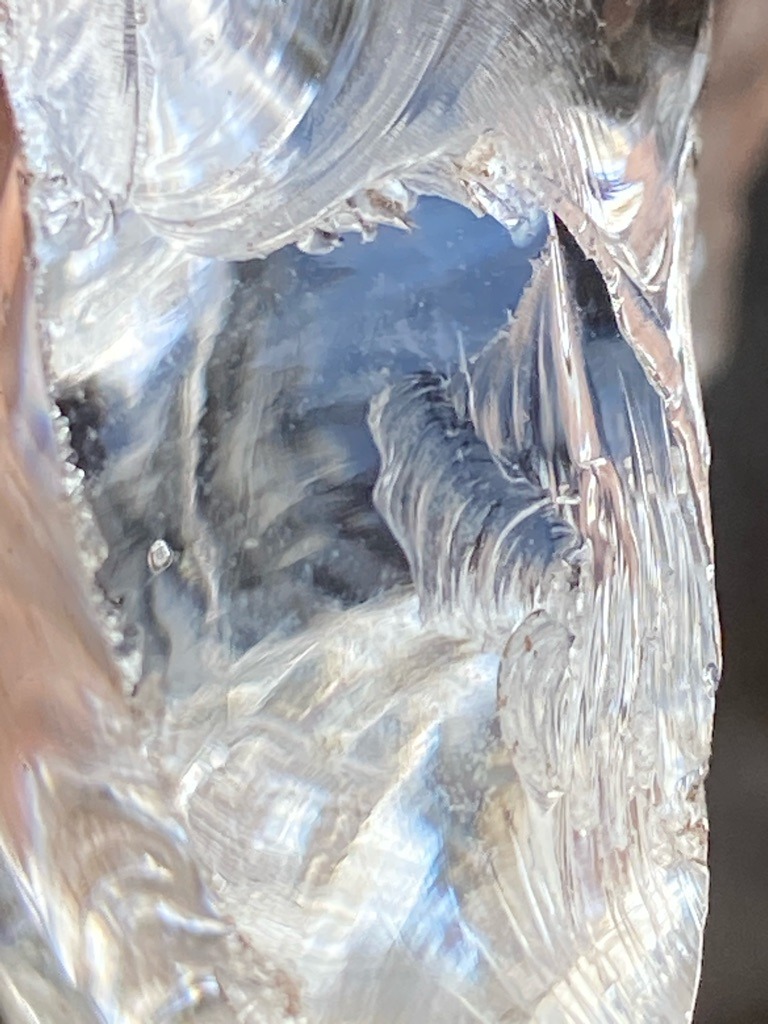
Not a diamond; this appears to be quartz, glass, or another transparent crystalline mineral showing conchoidal fracture patterns rather than diamond crystal faces or cleavage. · Uncut or raw crystalline fragment with conchoidal fracture surfaces
Not applicable (raw, uncut mineral specimen) Cut
Carat
Not applicable / Unable to accurately estimate from visual alone without exact dimensions
Color
Colorless to near-colorless
Clarity
Not applicable for a non-gem diamond; displays heavy internal fracture lines and irregular growth structures
Shape
Uncut or raw crystalline fragment with conchoidal fracture surfaces
Overall Assessment
Based on the visual evidence of conchoidal fracturing and lack of adamantine luster or standard crystal habit, this specimen is definitely not a diamond and requires physical gemological testing to determine its exact mineral composition.
Cut Quality
Not applicable (raw, uncut mineral specimen)
Brilliance
Low to moderate vitreous luster, not possessing true diamond adamantine luster
Fire
Minimal dispersion compared to diamond
Scintillation
Poor light return due to lack of standard facet alignment
Proportions
Not applicable (raw mineral piece)
Symmetry
Asymmetrical raw specimen
Polish
Unpolished, natural or fractured surface showing prominent conchoidal ripples
Fluorescence
Unable to determine visually without UV testing
Inclusions
Conchoidal fracture lines, internal stress fractures, and swirling growth features typical of glass or quartz
Blemishes
Rough surface ridges, chips, and natural fracture planes
Origin
Natural mineral or manufactured glass
Treatment Detection
No obvious enhancements, though material identity needs physical testing (refractive index, hardness test)
Estimated Value
Nominal mineral specimen value depending on exact material identification (e.g., decorative quartz or glass slag)
Certification Estimate
Not certifiable as a diamond by major labs such as GIA or IGI
Investment Potential
None as a gemstone or diamond asset
Similar Diamonds
None, as this is visually identified as non-diamond material
Setting Suggestions
Not recommended for fine jewelry settings due to material properties
Care & Maintenance
Standard handling for mineral specimens; avoid harsh impacts to prevent further fracturing
Interesting Facts
The smooth, curved fracture patterns visible are known as conchoidal fractures, commonly found in glass, quartz, and obsidian