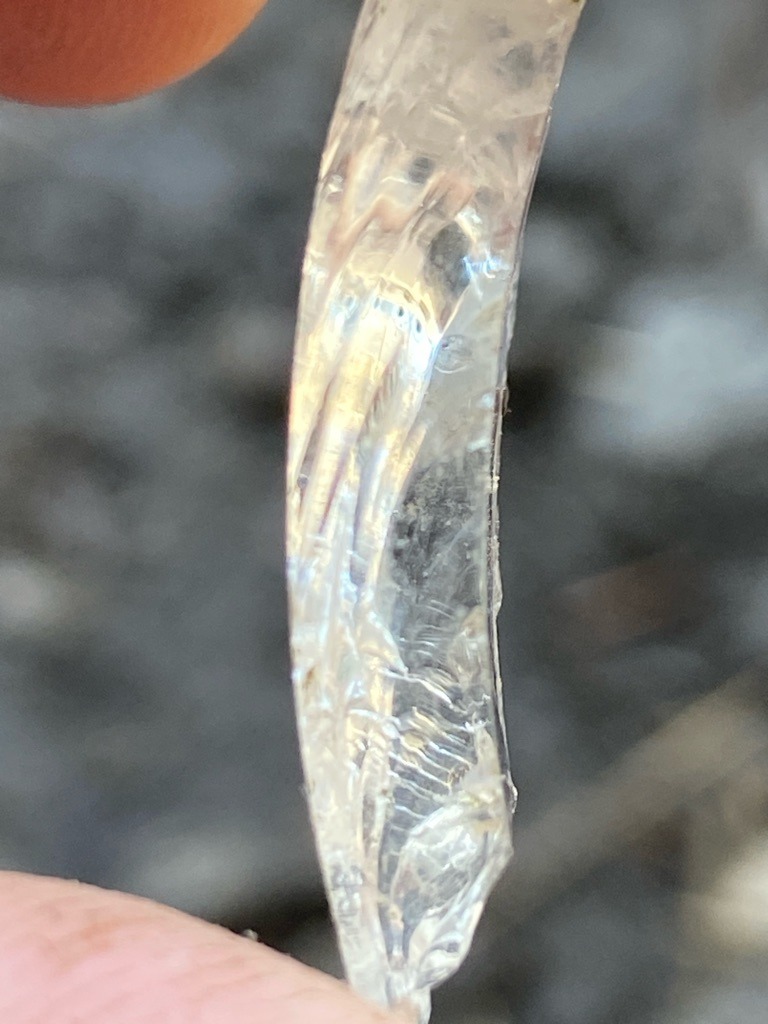
Not a diamond; this specimen appears to be raw quartz, glass, or another crystalline silicate mineral showing conchoidal fracture patterns.
Not a diamond; this specimen appears to be raw quartz, glass, or another crystalline silicate mineral showing conchoidal fracture patterns. · Irregular raw crystal fragment / Curved shard
N/A - Uncut / Raw mineral fragment with natural fracture surfaces Cut
Carat
Cannot be accurately determined by visual estimation alone due to non-standard gemstone cutting, but visually substantial as a mineral specimen.
Color
Colorless / Transparent with surface reflections
Clarity
Included / Heavily fractured with internal stress lines and surface striations
Shape
Irregular raw crystal fragment / Curved shard
Overall Assessment
The visual characteristics—specifically the prominent conchoidal fracture patterns, lack of diamond luster, and absence of standard faceting—strongly indicate that this is not a diamond, but rather a fragment of raw quartz or glass.
Cut Quality
N/A - Uncut / Raw mineral fragment with natural fracture surfaces
Brilliance
Vitreous luster visible along smooth fracture planes, though disrupted by internal flaws
Fire
Minimal to none, typical of quartz or glass rather than diamond
Scintillation
Low, limited by lack of precision faceting
Proportions
Irregular elongation with no standard pavilion or crown proportions
Symmetry
Asymmetrical due to natural breakage and irregular formation
Polish
Unpolished / Raw fracture surfaces
Fluorescence
Unknown without UV testing
Inclusions
Numerous internal fractures, feather-like structures, and growth or stress striations
Blemishes
Surface chips, natural conchoidal ripples, and rough edges
Origin
Natural mineral occurrence or manufactured glass artifact depending on exact material composition.
Treatment Detection
No obvious enhancements visible, though standard microscopic analysis is required to rule out fracture-filling if glass.
Estimated Value
Minimal commercial value as a gemstone; valued primarily as a raw mineral specimen if quartz, or negligible if glass.
Certification Estimate
Standard gemological laboratories like GIA or IGI would not grade this as a diamond, but would issue an identification report confirming it as quartz or glass.
Investment Potential
None; this specimen holds no financial investment value.
Similar Diamonds
None, as this specimen shares no optical or physical properties with diamond.
Setting Suggestions
Wire-wrapping or bespoke organic bezel settings if used in artisan jewelry.
Care & Maintenance
Handle with care to avoid further chipping along natural fracture lines; clean gently with mild soapy water and a soft brush.
Interesting Facts
The prominent curved ridges visible on the surface are classic conchoidal fractures, commonly seen when brittle materials like quartz, obsidian, or glass break.