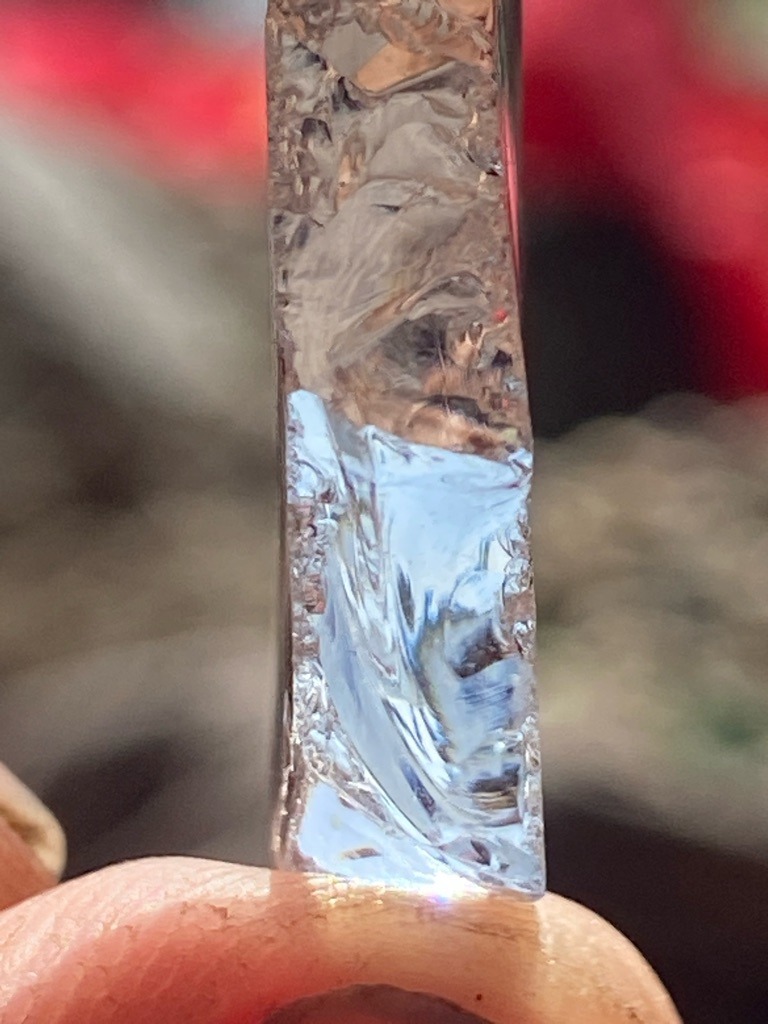
Rough diamond crystal, likely natural uncut specimen showing characteristic surface features such as trigons or striations.
Rough diamond crystal, likely natural uncut specimen showing characteristic surface features such as trigons or striations. · Rough crystal / Uncut octahedral or elongated crystal habit
Not Applicable (Rough unpolished specimen). Cut
Carat
Estimated between 1.5 to 2.5 carats based on visible scale relative to human fingers.
Color
Near-colorless to slightly tinted brownish/yellowish natural body color (Estimated G-J range if cut).
Clarity
I1 to I2 (Included rough stone showing natural internal feathers and cloud-like structures).
Shape
Rough crystal / Uncut octahedral or elongated crystal habit
Overall Assessment
An interesting, natural rough diamond crystal displaying authentic geological features, offering potential for either custom raw jewelry or a unique collector specimen.
Cut Quality
Not Applicable (Rough unpolished specimen).
Brilliance
Low to moderate due to rough unpolished surface scattering light rather than internal refraction.
Fire
Minimal dispersion visible on the rough surface; requires proper facet angles to display fire.
Scintillation
Absent in rough form; scintillation requires polished symmetrical facets.
Proportions
Not Applicable for rough crystals; irregular elongated morphology.
Symmetry
Natural crystal symmetry showing distorted or elongated growth patterns typical of natural diamond rough.
Polish
Natural crystal faces (octahedral faces or triangular growth steps like trigons), non-polished.
Fluorescence
Cannot be reliably determined without UV lamp testing (typically moderate blue in natural rough stones under LWUV).
Inclusions
Internal cleavage planes, fractures, carbon spots, and feathery inclusions common in unworked diamond rough.
Blemishes
Natural surface etch channels, trigons, and rough skin textures typical of uncut stones.
Origin
Natural rough stone, likely from an alluvial deposit or primary kimberlite pipe (Africa, Canada, or Russia).
Treatment Detection
No signs of artificial treatments; completely natural untreated crystal specimen.
Estimated Value
Ranges from $500 to $1,500 depending on cutting yield potential and exact clarity after cutting.
Certification Estimate
GIA or IDEX gemological laboratories for origin and authenticity verification certificates.
Investment Potential
Moderate; value is primarily speculative based on potential cut yield or collectible appeal as a raw mineral specimen.
Similar Diamonds
Other natural unpolished diamond crystal specimens and uncut rough gemstone jewelry pieces.
Setting Suggestions
Raw uncut diamond pendant in a secure bezel setting using yellow or white gold to highlight its natural beauty.
Care & Maintenance
Clean gently with warm soapy water and a soft brush; avoid harsh ultrasonic cleaners due to internal natural fractures.
Interesting Facts
Rough diamonds can take over a billion years to form deep within the Earth's mantle before being brought to the surface by volcanic eruptions.