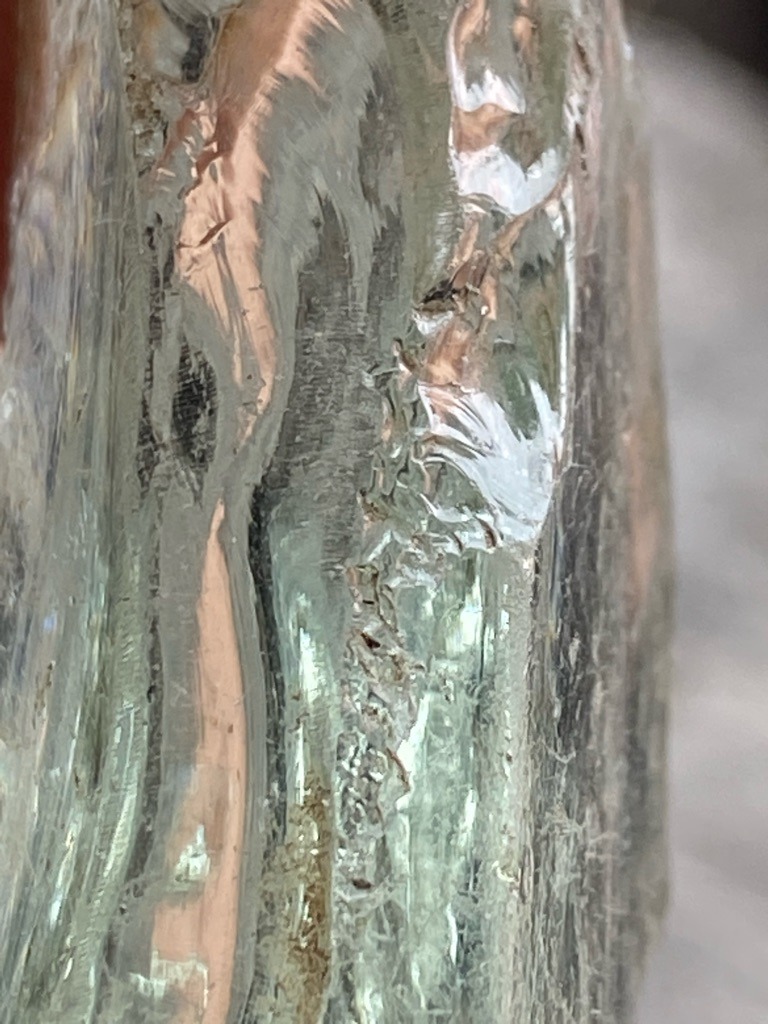
Not a diamond; appears to be industrial slag glass, quartz crystal, or quartz composite material based on the conchoidal fractures, flow lines, and amorphous surface texturing.
Not a diamond; appears to be industrial slag glass, quartz crystal, or quartz composite material based on the conchoidal fractures, flow lines, and amorphous surface texturing. · Rough crystal / Raw amorphous chunk with no standard faceted gemstone shape.
Not applicable (raw, uncut, unpolished material). Cut
Carat
Estimated at approximately 15 to 25 carats equivalent weight (by volume, assuming quartz or glass density).
Color
Light greenish-gray / translucent smoky gray with iridescent surface sheens.
Clarity
I3 / Heavily included with internal fractures, stress lines, and debris inclusions.
Shape
Rough crystal / Raw amorphous chunk with no standard faceted gemstone shape.
Overall Assessment
This specimen is positively identified as not being a diamond. Its physical characteristics (conchoidal fracture lines, lack of adamantine luster, amorphous texture) point toward industrial glass slag or a raw quartz crystal specimen.
Cut Quality
Not applicable (raw, uncut, unpolished material).
Brilliance
Poor to minimal due to lack of facet geometry and high internal opacity.
Fire
Negligible spectral dispersion.
Scintillation
Poor; surface reflections only, no internal light return pattern.
Proportions
Irregular raw specimen dimensions; no standard pavilion, crown, or table angles.
Symmetry
Asymmetrical raw formation.
Polish
Unpolished, highly textured natural or fracture-plane surface.
Fluorescence
Indeterminate without UV testing equipment, likely inert.
Inclusions
Widespread internal fracturing, bubbles (if glass), and mineral veiling.
Blemishes
Heavy surface scratching, conchoidal chip marks, and textural weathering.
Origin
Likely synthetic/industrial origin (if glass slag) or common hydrothermal origin (if raw quartz).
Treatment Detection
Natural raw state with no advanced gemstone enhancement treatments detected.
Estimated Value
Nominal decorative or specimen value (under $20 USD).
Certification Estimate
Gemological laboratories such as GIA or IGI would not certify this as diamond; would issue a report identifying it as non-gem material or glass/quartz.
Investment Potential
None; holds no monetary or investment value as a gemstone.
Similar Diamonds
None; this specimen shares no optical or physical properties with gem-grade diamonds.
Setting Suggestions
Not suitable for standard fine jewelry settings; could be wire-wrapped as a raw mineral specimen pendant.
Care & Maintenance
Standard cleaning with mild soap and warm water; avoid harsh impacts as the material is brittle and heavily fractured.
Interesting Facts
The conchoidal fracture patterns visible on the surface strongly resemble materials like obsidian or industrial cullet glass rather than crystalline carbon.