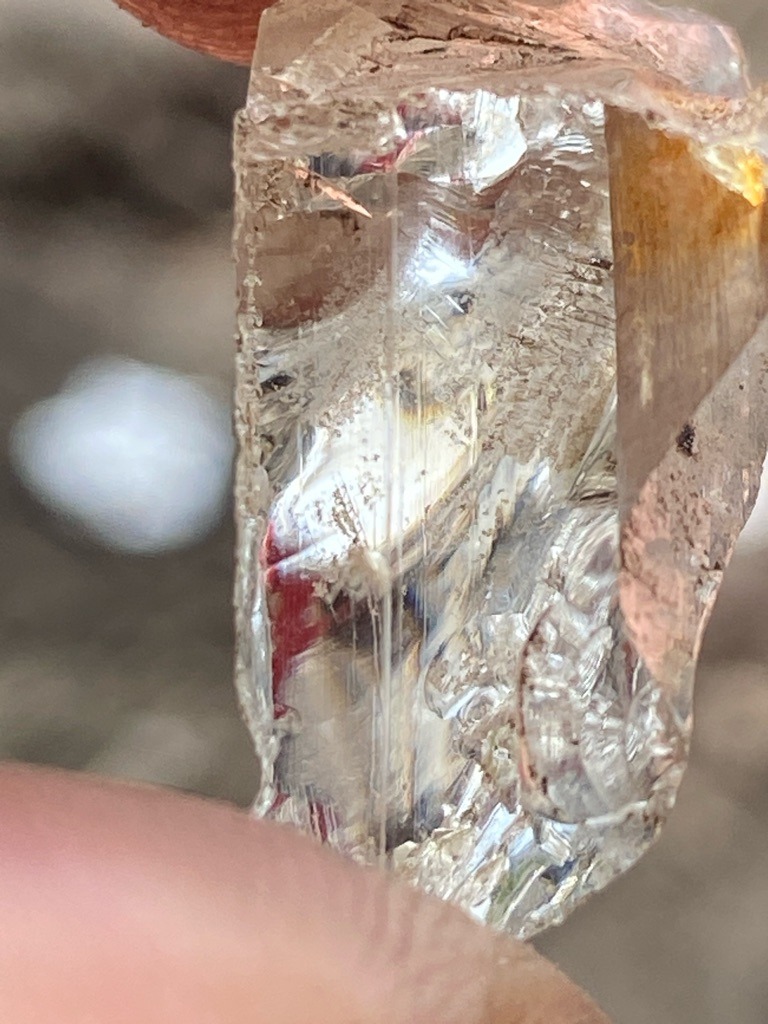
Natural rough diamond crystal, though visual characteristics strongly suggest raw quartz or beryl rather than genuine diamond due to the pronounced striations and irregular fracture patterns
Natural rough diamond crystal, though visual characteristics strongly suggest raw quartz or beryl rather than genuine diamond due to the pronounced striations and irregular fracture patterns · Rough uncut crystal, naturally terminated or broken columnar habit with irregular elongated form
Not applicable (uncut rough crystal) Cut
Carat
Estimated 15-25 carats based on rough dimensions (assuming quartz density)
Color
Colorless to brownish-clear with iron oxide (limonite/hematite) staining visible along fractures
Clarity
Included (I3 equivalent), featuring extensive internal fractures, feathering, and surface etching
Shape
Rough uncut crystal, naturally terminated or broken columnar habit with irregular elongated form
Overall Assessment
The specimen displayed is a fascinating natural rough mineral crystal, highly likely to be quartz rather than diamond due to distinct crystal habit, surface striations, and iron staining. It serves as a wonderful raw specimen for a mineral collection.
Cut Quality
Not applicable (uncut rough crystal)
Brilliance
Low to moderate due to rough, unpolished state and internal fractures obstructing light
Fire
Minimal dispersion visible in current unpolished and heavily included state
Scintillation
Poor, lacking faceted surfaces necessary for organized light return and sparkle
Proportions
Irregular elongated crystal habit; standard cut proportions do not apply
Symmetry
Natural asymmetrical crystal growth with striations typical of quartz prism faces
Polish
Raw, unpolished natural crystal surface with natural etching and growth features
Fluorescence
Unknown, requires UV testing (typically inert or faint in raw quartz/diamond rough)
Inclusions
Heavy internal fracturing, veil inclusions, liquid/gas inclusions, and mineral staining
Blemishes
Natural surface cavities, growth lines, striations, and adhering matrix material
Origin
Likely alluvial or pegmatitic rough mineral specimen
Treatment Detection
No signs of artificial treatment; appears entirely natural as-mined
Estimated Value
Nominal mineral specimen value ($10 - $50 USD) depending on exact mineral identification and locality
Certification Estimate
Not typically certified by major gem labs (GIA/AGS) in raw mineral form unless for specific provenance verification
Investment Potential
Low investment value; valued primarily as an educational mineral specimen or rough crystal curio
Similar Diamonds
Comparable to low-grade industrial diamond rough or, more accurately, raw Herkimer diamond quartz crystals
Setting Suggestions
Wire-wrapped pendant, organic rustic bezel setting, or kept as a raw mineral specimen
Care & Maintenance
Clean gently with warm soapy water and a soft brush; avoid harsh ultrasonic cleaners due to internal fracturing
Interesting Facts
Raw crystals often display striations (growth lines) perpendicular to the c-axis, which is a key diagnostic feature separating quartz from diamond rough