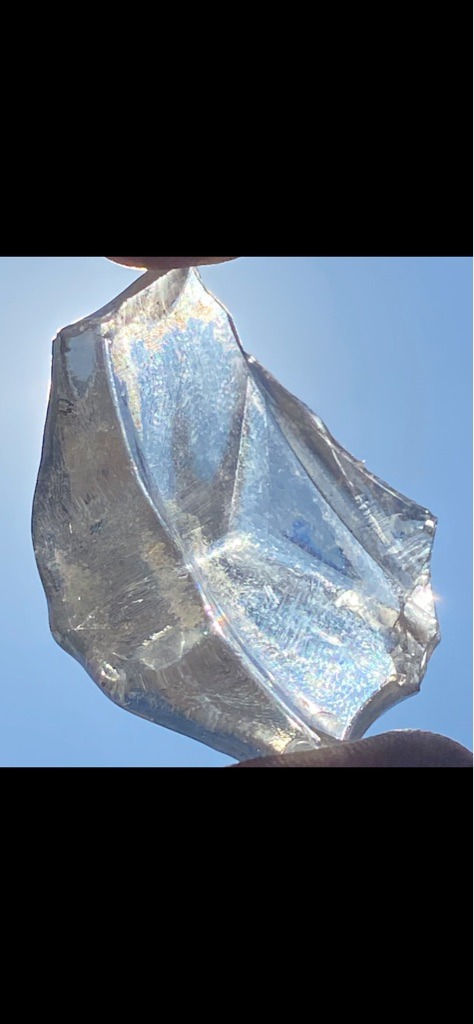
Indeterminate / Potential Rough Mineral (Glass or Quartz)
Indeterminate / Potential Rough Mineral (Glass or Quartz) · Rough / Uncut Unformed
N/A (Rough stone) Cut
Carat
Estimated 20-40 carats (Highly speculative based on size relative to fingers)
Color
Colorless with subtle blue/grey undertones
Clarity
Poor (I1-I3 equivalent if considered diamond)
Shape
Rough / Uncut Unformed
Overall Assessment
The specimen lacks the adamantine luster and specific crystal habit expected of a high-value rough diamond. It is most likely a piece of decorative glass or quartz, requiring lab testing for definitive identification.
Cut Quality
N/A (Rough stone)
Brilliance
Low (Refraction inconsistent with high-quality diamond)
Fire
Moderate spectral dispersion visible on flat planes
Scintillation
Negligible
Proportions
N/A
Symmetry
N/A
Polish
N/A (Natural/Raw surface)
Fluorescence
Indeterminate under sunlight
Inclusions
Heavy internal fracturing, cleavage planes, and surface pitting visible
Blemishes
Irregular growth markings, conchoidal fractures, and jagged edges
Origin
Indeterminate (Visual characteristics suggest quartz or glass cullet over diamond)
Treatment Detection
N/A
Estimated Value
$5 - $50 (If identified as industrial grade stone or glass); potentially higher if proven natural rough diamond
Certification Estimate
Likely ineligible for standard GIA/AGS diamond grading; would require a Physical Mineral ID report
Investment Potential
Low; lacks the crystalline structure and clarity for gem-quality investment
Similar Diamonds
Industrial grade Boart or large Quartz fragments
Setting Suggestions
Wire wrapping or bezel setting as an organic specimen piece
Care & Maintenance
Avoid impact; the visible fractures suggest the stone could easily shatter
Interesting Facts
The conchoidal (shell-like) fracture patterns on the surface are more typical of silica-based materials than the octahedral cleavage of diamonds