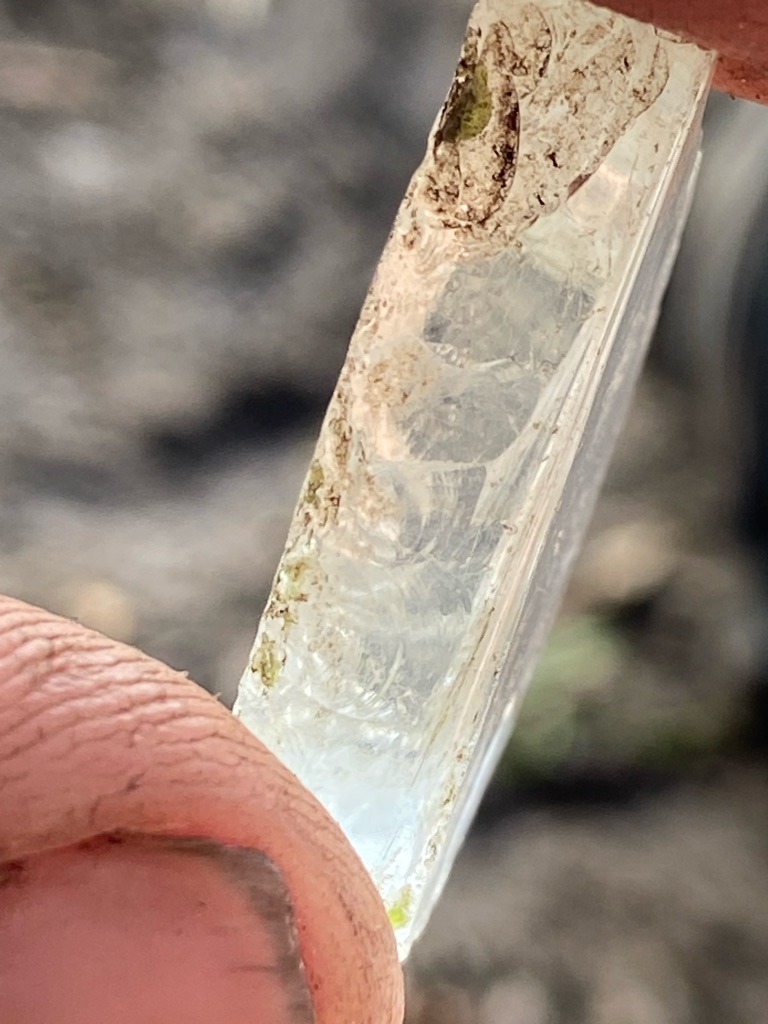
The image shows a raw mineral specimen, likely quartz, beryl, or a similar silicate crystal rather than a diamond. It displays conchoidal fractures, uneven surface textures, and mineral/dirt inclusions, which are inconsistent with natural diamond rough (octahedrons or dodecahedrons with curved faces).
The image shows a raw mineral specimen, likely quartz, beryl, or a similar silicate crystal rather than a diamond. It displays conchoidal fractures, uneven surface textures, and mineral/dirt inclusions, which are inconsistent with natural diamond rough (octahedrons or dodecahedrons with curved faces). · Rough crystal / Irregular elongated fragment with flat cleavage or fractured planes
Not applicable / Uncut raw specimen Cut
Carat
Estimated around 15-25 carats based on visible dimensions, though mineral density differs from diamond
Color
Colorless to slightly brownish-white due to surface matrix and inclusions
Clarity
I3 (Heavy inclusions, internal fractures, feathers, and surface impurities visible throughout)
Shape
Rough crystal / Irregular elongated fragment with flat cleavage or fractured planes
Overall Assessment
This specimen is a raw, heavily included mineral crystal (likely quartz or beryl) rather than a diamond. It features significant internal fracturing and surface matrix, making it suitable for mineral collection rather than jewelry use.
Cut Quality
Not applicable / Uncut raw specimen
Brilliance
Low to minimal due to heavy internal fracturing and lack of precision faceting
Fire
Negligible dispersion visible in the raw, unpolished state
Scintillation
Poor, as internal fractures scatter light rather than returning it uniformly
Proportions
Irregular raw crystal structure with no standard facet proportions
Symmetry
Poor / Natural irregular growth and fracture pattern
Polish
Unpolished / Raw natural surface with rough edges and matrix adherence
Fluorescence
Unknown (requires UV testing)
Inclusions
Extensive internal fracturing, feathering, and trapped mineral/dirt matrix along the edges and fissures
Blemishes
Rough natural surface, chipping, abrasion, and matrix staining
Origin
Likely mined from a pegmatite pocket or secondary alluvial deposit
Treatment Detection
Untreated natural mineral specimen
Estimated Value
Minimal commercial value as a gemstone; primarily of mineral specimen or educational value (under $50)
Certification Estimate
Not eligible for diamond certification by major labs like GIA or AGS; would require basic mineralogical identification (e.g., GIA colored stone or rough ID service)
Investment Potential
None as an investment asset
Similar Diamonds
None, as this specimen is not a diamond
Setting Suggestions
Wire-wrapped raw crystal pendant or specimen display mount
Care & Maintenance
Handle with care to prevent further chipping along internal fracture planes; clean gently with warm soapy water and a soft brush
Interesting Facts
Raw mineral specimens like this are often mistaken for rough diamonds by untrained finders due to their transparency and vitreous luster