Natural Fancy Colored Diamond (likely Type Ia with nitrogen aggregation, though ruby/corundum or garnet cannot be entirely ruled out visually without gemological testing)
Natural Fancy Colored Diamond (likely Type Ia with nitrogen aggregation, though ruby/corundum or garnet cannot be entirely ruled out visually without gemological testing) · Rough crystal / Uncut gemstone fragment
Not Applicable (Rough un-faceted stone) Cut
Carat
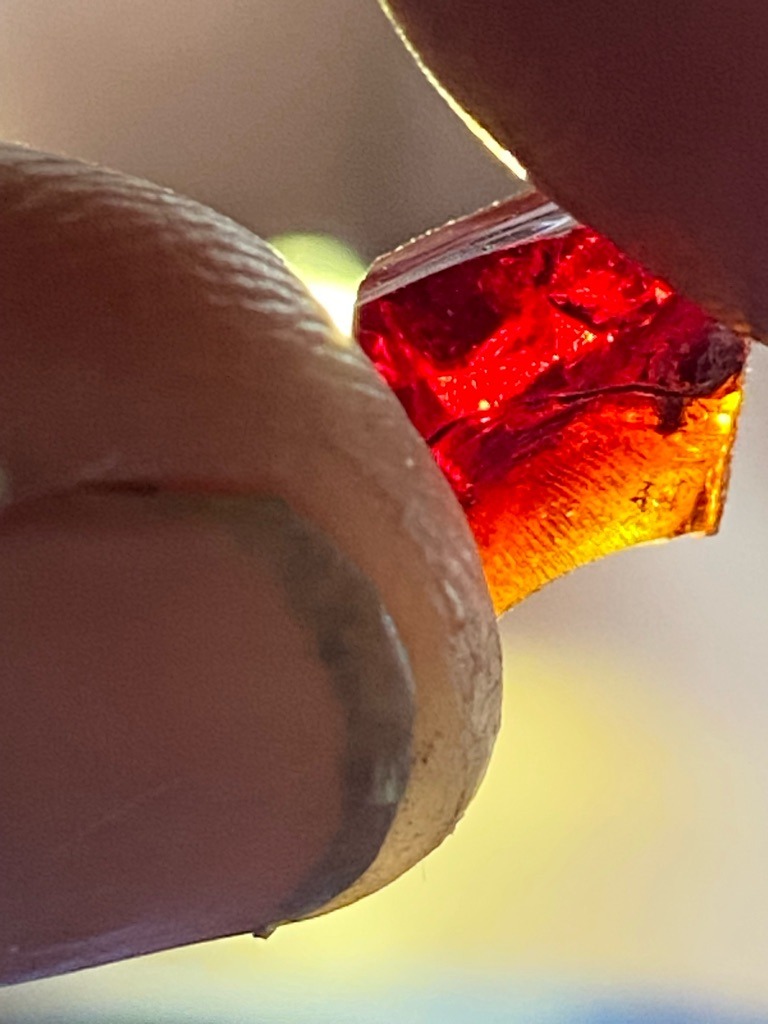
Estimated 1.50 - 2.50 carats based on visual comparison with human fingers
Color
Fancy Deep Orangy Red / Fancy Dark Red
Clarity
Included (I1-I2 equivalent due to prominent internal fractures and feather-like inclusions visible)
Shape
Rough crystal / Uncut gemstone fragment
Overall Assessment
A striking, deeply colored rough gemstone fragment displaying vibrant red-to-orange hues and visible internal character. Gemological testing (such as Raman spectroscopy or refractometer testing) is strongly recommended to definitively separate a colored diamond from alternative red gemstones like ruby or spinel.
Cut Quality
Not Applicable (Rough un-faceted stone)
Brilliance
Low due to lack of facets and dense internal inclusions, though strong back-lighting reveals intense internal glow
Fire
Limited dispersion visible in raw form; would improve significantly if properly cut and faceted
Scintillation
Minimal play of light in its current rough, unpolished state
Proportions
Irregular raw crystal geometry; standard table, depth, and angles do not apply
Symmetry
Natural crystal morphology, highly asymmetrical due to being a raw, fractured fragment
Polish
Raw crystal surface, no artificial polish applied
Fluorescence
Cannot be determined visually without UV light testing (typically inert to moderate yellow/orange in natural colored rough)
Inclusions
Prominent internal fractures, feather-like cleavage planes, and dark mineral inclusions visible
Blemishes
Natural surface roughness, uneven growth lines, and potential chipping along fracture lines
Origin
Alluvial or primary kimberlitic/lamproitic rough deposit (Africa, Australia, or Russia typical for colored rough)
Treatment Detection
No obvious signs of artificial treatments, appears entirely natural in its rough state
Estimated Value
$500 - $2,500 depending on final verification of gem material (diamond vs. ruby/garnet) and exact weight
Certification Estimate
GIA Colored Diamond Report (or GRS if determined to be Ruby) confirming natural origin and color grade
Investment Potential
High niche collector appeal, especially if confirmed as a natural fancy red diamond, which is exceptionally rare
Similar Diamonds
Natural rough fancy red or orange-red diamonds, or high-end collector fancy colored crystal specimens
Setting Suggestions
Custom organic or rustic bezel setting in yellow or rose gold to embrace its natural, raw crystal aesthetic
Care & Maintenance
Store separately to prevent scratching other stones; avoid harsh ultrasonic cleaners due to prominent internal fractures
Interesting Facts
Natural red diamonds are among the rarest in the world, often deriving their color from plastic deformation in the crystal lattice rather than chemical impurities