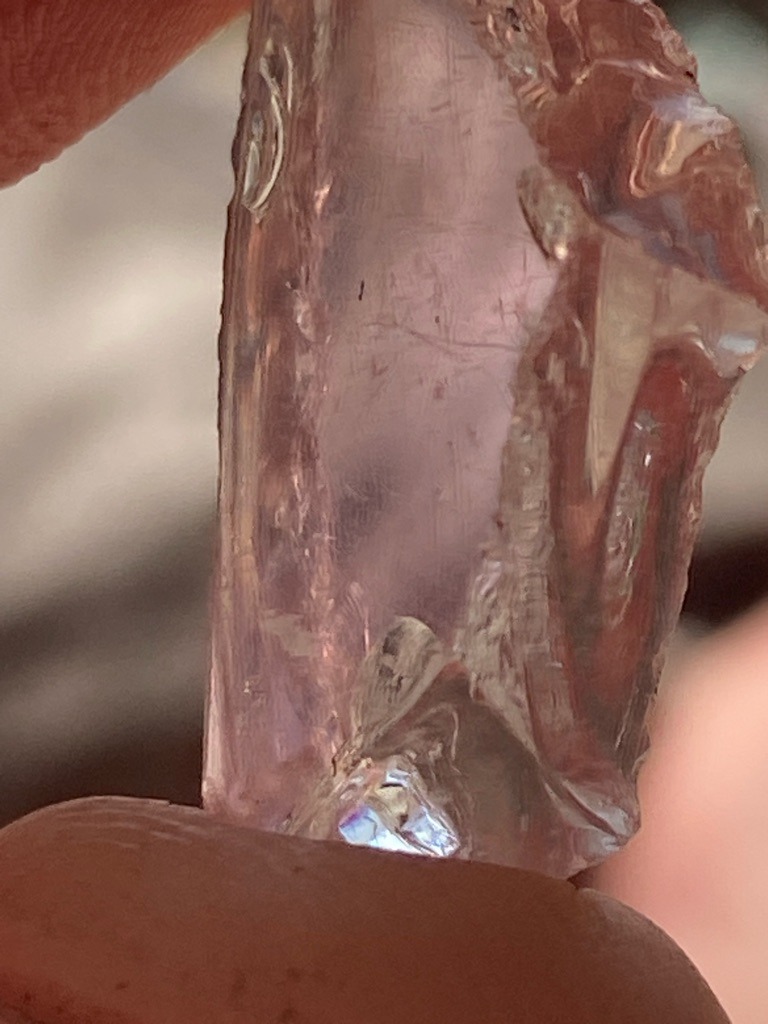
Rough natural crystal, though visual appearance strongly suggests a crystalline quartz, possibly rose quartz or a glass/slag simulant rather than a genuine diamond due to conchoidal fractures and lack of adamantine luster.
Rough natural crystal, though visual appearance strongly suggests a crystalline quartz, possibly rose quartz or a glass/slag simulant rather than a genuine diamond due to conchoidal fractures and lack of adamantine luster. · Rough uncut crystal/peice with irregular natural or fractured facets
Not applicable (uncut raw specimen) Cut
Carat
Estimated around 15-20 carats based on physical size relative to fingers (if diamond, though likely lighter if quartz/glass)
Color
Light pink / pale rose tint
Clarity
Included (contains internal fractures, striations, and cloudiness)
Shape
Rough uncut crystal/peice with irregular natural or fractured facets
Overall Assessment
The specimen shown lacks the characteristic crystal habit, high refractive index, and adamantine luster of a rough diamond. It is most likely a piece of rough rose quartz, tourmaline, or colored glass, requiring formal gemological testing for definitive identification.
Cut Quality
Not applicable (uncut raw specimen)
Brilliance
Low to moderate, typical of raw quartz or glass rather than diamond
Fire
Minimal dispersion, lacking the strong fire of a cut diamond
Scintillation
Poor, due to lack of standard facet arrangement
Proportions
Not applicable for raw rough material
Symmetry
Asymmetrical raw crystal form
Polish
Unpolished natural or fractured surface showing vitreous to greasy luster
Fluorescence
Indeterminate from visual image alone
Inclusions
Internal feather fractures, planes, and slight cloudiness
Blemishes
Surface scratches, chips, and irregular growth lines or conchoidal fracture marks
Origin
Unknown natural mineral specimen or synthetic ornamental glass
Treatment Detection
No obvious artificial treatments visible, though material identity must first be established
Estimated Value
Minimal monetary value if quartz or glass (under $50); high value only if authenticated as a rare natural pink diamond, which is visually unlikely
Certification Estimate
Not recommended for formal diamond grading labs (GIA/AGS); would require basic gemological testing (refractive index, specific gravity) to confirm identity
Investment Potential
None as an investment piece; strictly a decorative or mineral specimen
Similar Diamonds
None, as this visually resembles raw quartz or pink beryl/morganite rather than diamond rough
Setting Suggestions
Wire-wrapped pendant or organic bezel setting if kept as a raw mineral specimen
Care & Maintenance
Avoid harsh chemicals, ultrasonic cleaners, and hard impacts which could worsen internal fractures
Interesting Facts
Raw diamond crystals typically exhibit octahedral or dodecahedral shapes with curved faces and greasy adamantine luster, unlike the conchoidal fracture patterns seen here