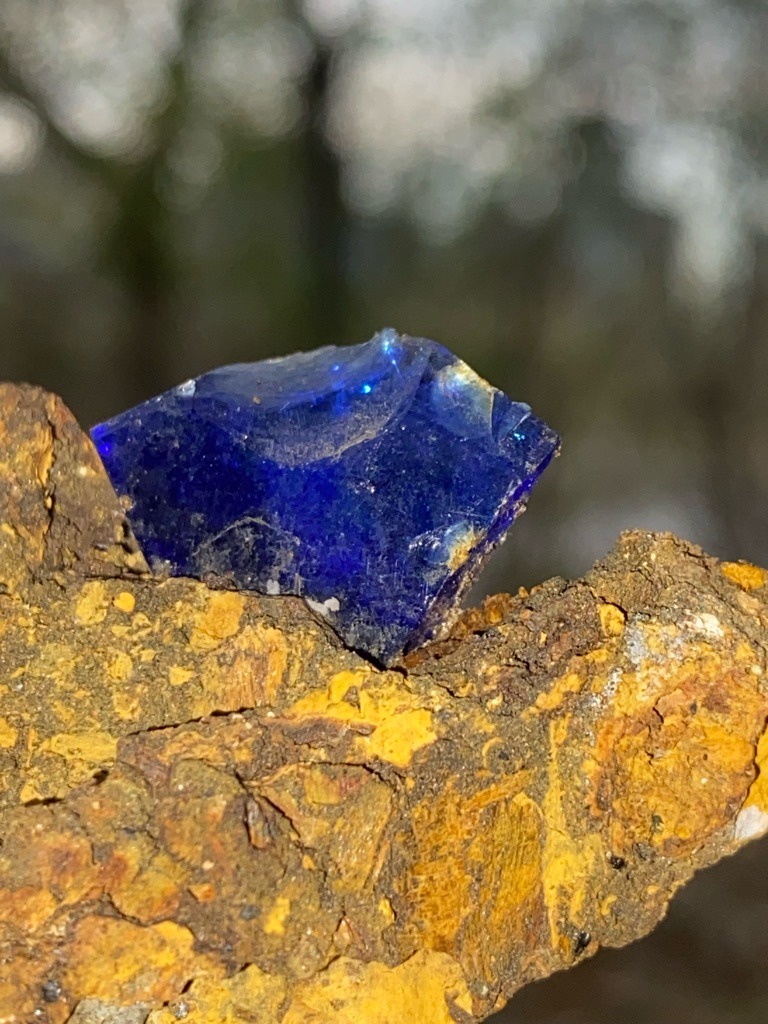
Not a diamond; likely Cobalt Glass or Slag Glass
Not a diamond; likely Cobalt Glass or Slag Glass · Rough / Amorphous with conchoidal fracturing
N/A (Uncut rough/shards) Cut
Carat
Estimated 10-20 carats based on visual scale against matrix
Color
Vivid Cobalt Blue (Non-standard diamond color)
Clarity
Translucent with heavy internal swirling and bubbles
Shape
Rough / Amorphous with conchoidal fracturing
Overall Assessment
This specimen is a piece of blue glass, often mistaken for blue sapphire or diamond rough. Its vibrant 'electric' blue and fracture pattern are diagnostic of glass.
Cut Quality
N/A (Uncut rough/shards)
Brilliance
Low; glassy vitreous luster only
Fire
None; lacks the refractive index for spectral dispersion
Scintillation
None; surface reflections only
Proportions
Irregular jagged edges, no geometric table or pavilion
Symmetry
N/A (Indeterminate rough)
Polish
Natural glassy luster with conchoidal fracture scars
Fluorescence
Likely None (Glass does not typically fluoresce like diamond)
Inclusions
Internal gas bubbles and flow lines (swirl striae) consistent with glass
Blemishes
Severe surface abrasions and impact chipping
Origin
Industrial byproduct (Slag) or discarded glassware
Treatment Detection
Man-made material; color derived from cobalt additives
Estimated Value
Minimal ($1 - $5) as a curiosity or decorative specimen
Certification Estimate
Would not be certified by GIA/AGS as a diamond; identifiable as glass by any gem lab
Investment Potential
None; this is a common synthetic/manufactured material
Similar Diamonds
None; does not resemble natural blue diamonds (which are typically grayish-blue)
Setting Suggestions
Wire wrapping for decorative hobbyist use only
Care & Maintenance
Avoid impact as it is brittle and prone to shattering like glass
Interesting Facts
The conchoidal (shell-like) fractures at the top edge are a definitive indicator of glass or quartz, not diamond.