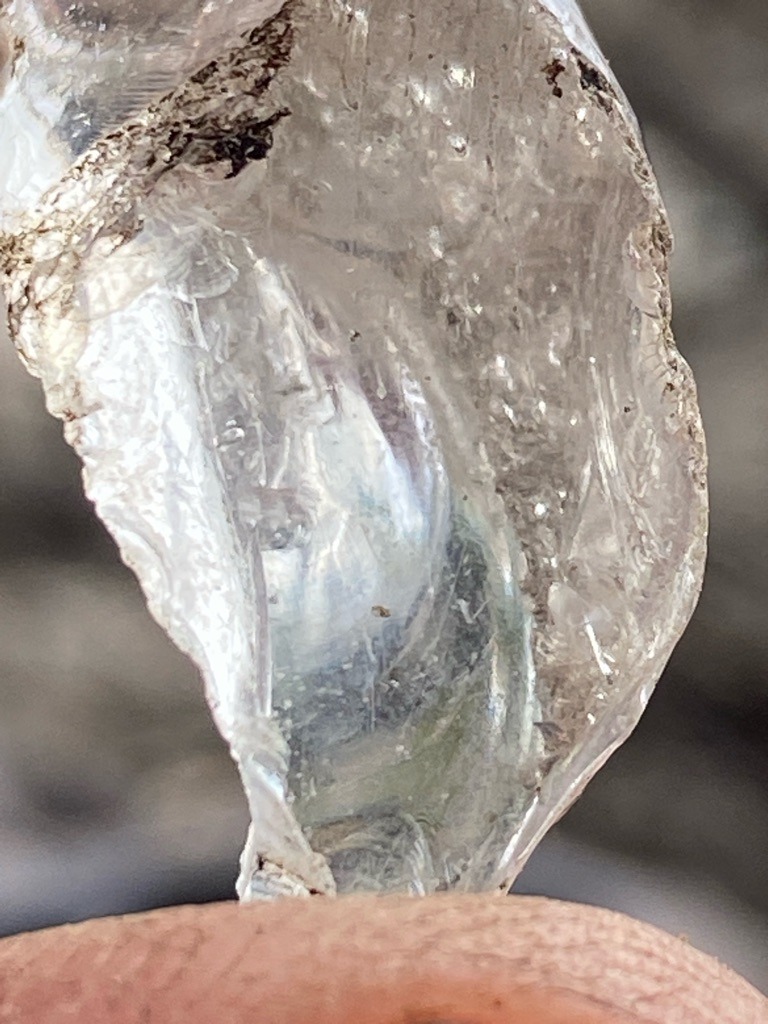
Rough Quartz / Glass / Non-Diamond Material (Visual assessment suggests this is likely natural quartz crystal or slag glass rather than diamond due to conchoidal fracture patterns and lack of crystal faces)
Rough Quartz / Glass / Non-Diamond Material (Visual assessment suggests this is likely natural quartz crystal or slag glass rather than diamond due to conchoidal fracture patterns and lack of crystal faces) · Uncut / Rough irregular fragment with conchoidal fracture
Not Applicable (Uncut rough specimen) Cut
Carat
Cannot accurately determine carat weight without specific dimensions and density testing; estimated rough mass appears substantial
Color
Colorless / Near-colorless with minor surface inclusions
Clarity
Included (Contains internal fractures and particulate inclusions)
Shape
Uncut / Rough irregular fragment with conchoidal fracture
Overall Assessment
The specimen displayed lacks the characteristic adamantine luster, crystal habit, and high refractive index of a diamond. Visual indicators strongly point toward an unworked quartz crystal or a piece of slag glass featuring prominent conchoidal fracturing. Professional gemological testing (such as a thermal conductivity probe or refractive index reading) is recommended for definitive confirmation.
Cut Quality
Not Applicable (Uncut rough specimen)
Brilliance
Low to moderate vitreous luster typical of quartz or glass rather than diamond adamantine luster
Fire
Minimal dispersion compared to diamond
Scintillation
Limited flash due to irregular, unfaceted surfaces
Proportions
Not Applicable for rough material
Symmetry
Not Applicable (Natural asymmetrical rough form)
Polish
Natural unpolished fracture surfaces
Fluorescence
Cannot determine without UV light testing
Inclusions
Internal micro-fractures, trapped gas bubbles (if glass), or mineral inclusions
Blemishes
Surface chips, weathering, and adhering matrix material
Origin
Natural geological formation (if quartz) or industrial byproduct (if slag glass)
Treatment Detection
No obvious signs of artificial treatments, though further spectroscopic testing is required
Estimated Value
Nominal to low value as a mineral specimen or decorative glass piece
Certification Estimate
Standard gemological labs (GIA, IGI) would issue a gemstone identification report rather than a diamond grading report, likely identifying it as quartz or glass
Investment Potential
Low; primarily valued as a raw mineral specimen or curiosity
Similar Diamonds
None, as this specimen lacks the optical and physical properties of a diamond
Setting Suggestions
Wire-wrapping or custom bezel setting suited for raw mineral specimens
Care & Maintenance
Standard care for quartz or glass; avoid harsh impacts to prevent chipping along conchoidal fracture lines
Interesting Facts
The smooth, curved surfaces visible on the specimen are classic conchoidal fractures, commonly found in brittle materials like glass and quartz