Non-diamond (Likely Glass or Quartz)
Non-diamond (Likely Glass or Quartz) · Rough / Uncut / Fragment
None (Rough fragment) Cut
Carat
Indeterminate (Visual suggests a large fragment, potentially 20+ carats if significant)
Color
Colorless/Transparent
Clarity
Included (I3 or lower equivalent)
Shape
Rough / Uncut / Fragment
Overall Assessment
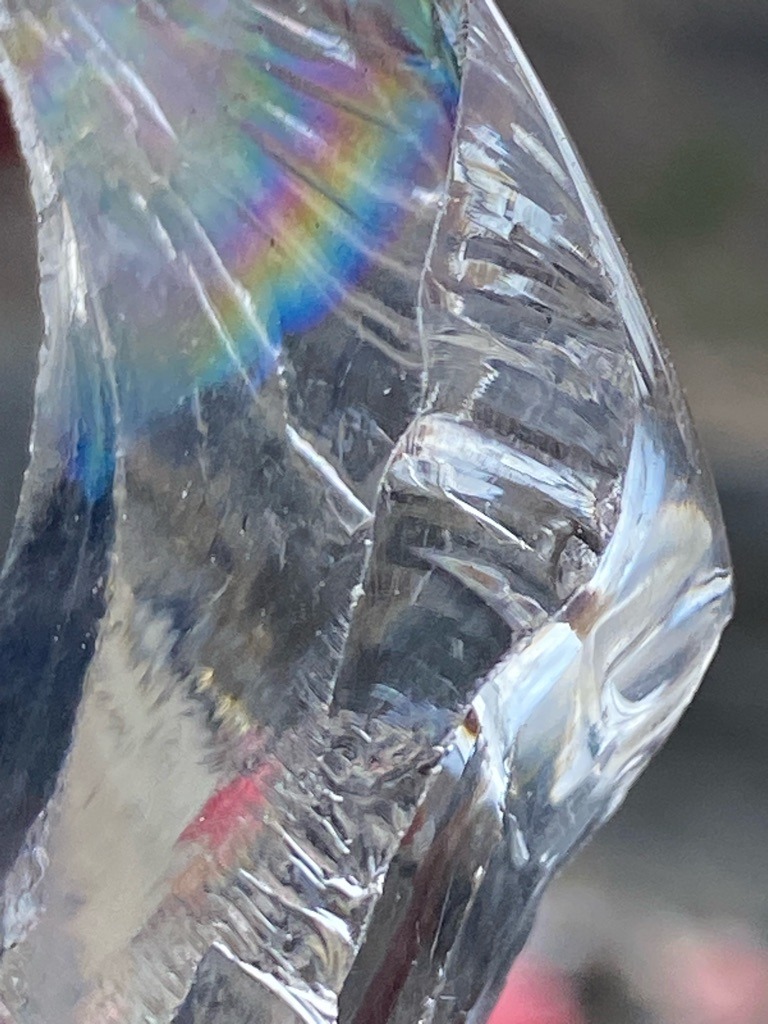
The specimen is not a diamond. The conchoidal (shell-like) fracture pattern and the specific type of luster and internal striations strongly indicate decorative glass or a common crystal like quartz rather than a gemstone diamond.
Cut Quality
None (Rough fragment)
Brilliance
Low (Surface reflection only)
Fire
High (Strong spectral dispersion visible via thin-film interference or refraction through the fracture)
Scintillation
Poor (Lacks patterned light return)
Proportions
N/A (No geometric facial structure)
Symmetry
N/A (Irregular fragment)
Polish
N/A (Natural/Fracture surfaces)
Fluorescence
Not observable
Inclusions
Extensive internal fracturing, heavy striations, and potential bubbles or flow lines typical of glass.
Blemishes
Conchoidal fractures, sharp jagged edges, and surface scuffing.
Origin
Anthropogenic (Glass) or common silicate mineral (Quartz)
Treatment Detection
N/A
Estimated Value
Minimal (Decorative/Specimen value only)
Certification Estimate
Unlikely to be graded by major diamond labs (GIA/IGI) as a diamond.
Investment Potential
None
Similar Diamonds
None (This specimen lacks the lattice structure and refractive index of diamond)
Setting Suggestions
Not suitable for traditional jewelry settings; could be used in a wire-wrapped decorative piece.
Care & Maintenance
Handle with care as the sharp conchoidal edges are prone to further chipping and can cause injury.
Interesting Facts
The rainbow effect seen is a result of light interference or refraction through thin layers of the fracture, often seen in high-lead glass or clear quartz.