Natural Ruby (Often mistaken for a colored diamond in rough form, but chemically a corundum)
Natural Ruby (Often mistaken for a colored diamond in rough form, but chemically a corundum) · Raw / Rough / Uncut Crystal Specimen
Not Applicable (Rough, uncut stone) Cut
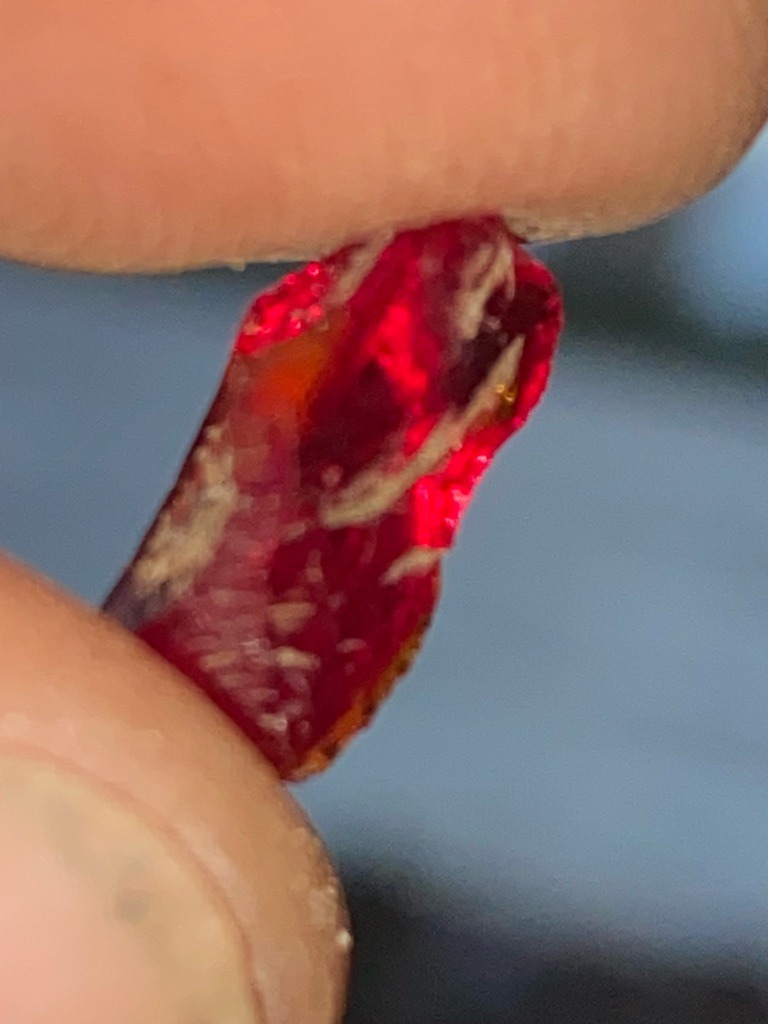
Carat
Estimated at 1.5 - 2.5 carats based on visual scale
Color
Fancy Vivid Red (Natural deep pigeon's blood red hue)
Clarity
Included (I1 - typical for untreated rough corundum with internal silk and fissures)
Shape
Raw / Rough / Uncut Crystal Specimen
Overall Assessment
This is a vibrant, deeply colored natural red corundum (ruby) rough specimen. It exhibits characteristic vivid red fluorescence potential and classic natural inclusion structures, making it a wonderful piece for a mineral collector or a lapidary artist looking to custom cut a gemstone.
Cut Quality
Not Applicable (Rough, uncut stone)
Brilliance
Vitreous to sub-adamantine luster on crystal faces, limited internal light return due to rough state
Fire
Low dispersion (corundum has lower fire than diamond)
Scintillation
Flashes of deep red from internal reflections within the rough crystal windows
Proportions
Natural uncut crystal habit with barrel-shaped hexagonal prismatic form indications
Symmetry
Natural asymmetric crystal growth habit
Polish
Raw crystal faces and natural fracture surfaces
Fluorescence
Strong red fluorescence under UV light (typical for high-chromium rubies)
Inclusions
Heavy internal silk, rutile needles, and internal fracture planes (feathers)
Blemishes
Natural surface etching, rough skin, and adhering matrix minerals
Origin
Likely of Myanmar (Burmese), East African (Mozambique), or Southeast Asian origin based on red fluorescence and inclusion patterns
Treatment Detection
No obvious glass-filling visible in this raw state, appears as natural rough requiring laboratory testing for thermal enhancement (heat treatment)
Estimated Value
Depends heavily on exact origin and heating status, roughly $200 - $800 as a mineral specimen / cuttable rough
Certification Estimate
GIA or SSEF Report for Natural Ruby, unheated indication likely
Investment Potential
Good potential if certified as unheated Burmese ruby of high transparency, otherwise moderate as a collectible mineral specimen
Similar Diamonds
Fancy intense red natural colored diamonds (which are vastly rarer and more expensive), though this is scientifically a corundum gemstone
Setting Suggestions
Wire-wrapped pendant, custom organic bezel setting to preserve the raw, natural crystal aesthetic
Care & Maintenance
Avoid harsh chemicals, ultrasonic cleaners if fractures reach the surface, and store separately to prevent scratching softer stones
Interesting Facts
Red corundum is classified as a ruby, while all other gem-quality colors of corundum are called sapphires. The red color is caused by trace amounts of chromium.