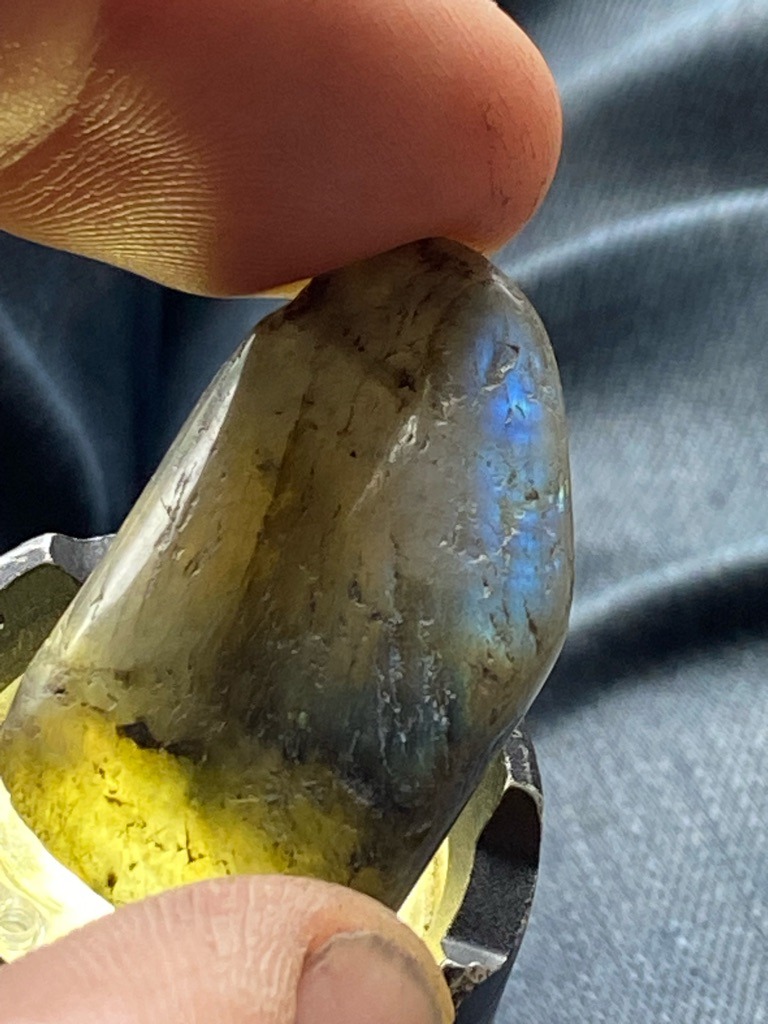
Not a diamond; this is a mineral specimen, specifically Labradorite (feldspar mineral displaying labradorescence).
Not a diamond; this is a mineral specimen, specifically Labradorite (feldspar mineral displaying labradorescence). · Tumbled, partially polished freeform / irregular cabochon.
N/A (Mineral specimen / freeform tumble polish, not faceted). Cut
Carat
N/A (Measured in grams for rough/mineral specimens, estimated around 25-35 carats weight equivalent if measured in gemstone weight units, but not applicable as a gemstone).
Color
Dark smoky gray to greenish-brown body color with iridescent blue/yellow flash (Labradorescence).
Clarity
Opaque to translucent with internal cleavage planes and inclusions typical of feldspar.
Shape
Tumbled, partially polished freeform / irregular cabochon.
Overall Assessment
An attractive raw/tumbled specimen of Labradorite showcasing characteristic optical iridescence, suitable for mineral collections or artisan jewelry, but definitively not a diamond.
Cut Quality
N/A (Mineral specimen / freeform tumble polish, not faceted).
Brilliance
Low (vitreous to pearly luster on cleavage planes, non-adamantine).
Fire
None (exhibits spectral iridescence/labradorescence rather than diamond dispersion).
Scintillation
Flashes of blue and yellow light restricted to specific angles of observation due to light interference in micro-layers.
Proportions
Irregular organic shape, depth and table percentages do not apply.
Symmetry
Asymmetrical natural crystal / tumbled form.
Polish
Partial polish with visible surface pitting, natural fissures, and uneven texture.
Fluorescence
Inert to moderate under UV, though exhibits optical interference phenomena (labradorescence) in daylight.
Inclusions
Internal lamellar twinning planes, feather fractures, and mineral impurities.
Blemishes
Surface pits, natural cracks, and abrasion marks from tumbling.
Origin
Commonly found in Canada (Labrador), Madagascar, Finland, Australia, and Russia.
Treatment Detection
No signs of artificial treatments; appears entirely natural.
Estimated Value
Low commercial value ($10 - $50 USD depending on specimen quality and size as a lapidary/mineral specimen).
Certification Estimate
Gemological laboratories (like GIA or IGI) would issue a mineral identification report for Labradorite rather than a diamond grading report.
Investment Potential
Minimal; collected primarily for mineral display, crystal healing, or lapidary arts rather than financial investment.
Similar Diamonds
None (labradorite is a feldspar and shares no optical or physical properties with diamond).
Setting Suggestions
Wire-wrapped in sterling silver or copper, or set in a custom organic bezel setting.
Care & Maintenance
Soft mineral (Mohs hardness 6-6.5); avoid harsh chemicals, ultrasonic cleaners, and hard impacts to prevent cleavage fracture.
Interesting Facts
Labradorescence is caused by light diffraction through microscopic lamellae (intergrown layers) of albite and anorthite feldspar.