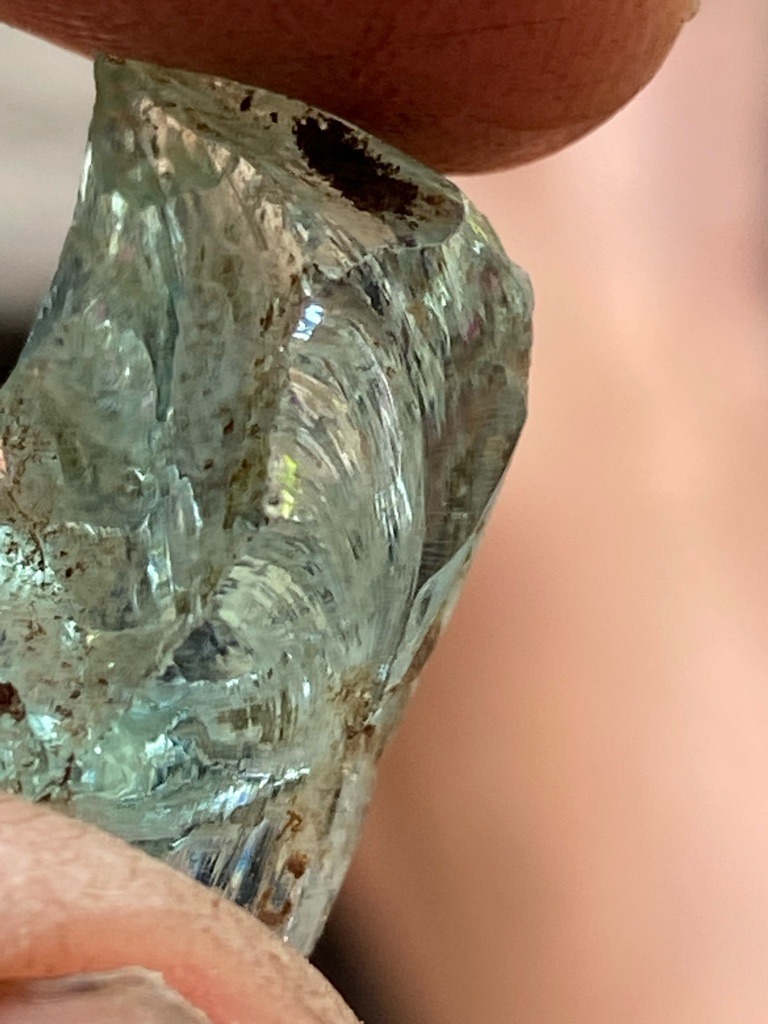
Not a diamond; this is a rough mineral crystal, likely a green-blue beryl (aquamarine) or tourmaline, displaying characteristic conchoidal fractures and striations.
Not a diamond; this is a rough mineral crystal, likely a green-blue beryl (aquamarine) or tourmaline, displaying characteristic conchoidal fractures and striations. · Rough uncut crystal / Native crystal form
N/A (Rough stone, not faceted) Cut
Carat
Estimated 15 - 25 carats based on visual size relative to fingers (approximate weight for rough gemstone material)
Color
Greenish-blue / Light aqua
Clarity
Included / Heavily included with internal fractures, typical of raw crystal material
Shape
Rough uncut crystal / Native crystal form
Overall Assessment
An interesting raw mineral specimen showing natural crystal texture and fracture patterns, definitively identified as a non-diamond rough gemstone material.
Cut Quality
N/A (Rough stone, not faceted)
Brilliance
Low to moderate due to rough surfaces and internal inclusions
Fire
Low, masked by rough surface scattering and body color
Scintillation
Minimal, as light is scattered rather than reflected systematically
Proportions
Irregular raw crystal proportions
Symmetry
Asymmetrical natural crystal formation
Polish
Unpolished, raw natural crystal faces and fracture surfaces
Fluorescence
Unknown / Untested without UV light source
Inclusions
Heavy internal fractures, feather inclusions, and dark mineral spots/matrix attachments near the top surface
Blemishes
Rough surface pitting, natural growth striations, and conchoidal fracture marks
Origin
Typical of pegmatite gemstone deposits (e.g., Brazil, Madagascar, Pakistan)
Treatment Detection
No obvious treatments detected visually; appears to be in its completely natural, untreated rough state.
Estimated Value
Nominal value as a mineral specimen; low value for gem cutting due to heavy fracturing.
Certification Estimate
Gemological testing laboratory (such as GIA or local gem labs) would issue a colored stone identification report rather than a diamond grading report.
Investment Potential
Low investment value, primarily of interest to mineral collectors or lapidary hobbyists.
Similar Diamonds
None, as this specimen is not a diamond.
Setting Suggestions
Best suited for a wire-wrapped organic jewelry setting or kept as a mineral specimen in a collection.
Care & Maintenance
Handle with care to prevent further breakage along natural fracture planes. Clean gently with warm soapy water and a soft brush.
Interesting Facts
The curved ripple-like marks visible on the surface are conchoidal fractures, which are commonly found in quartz, beryl, and glass when broken.