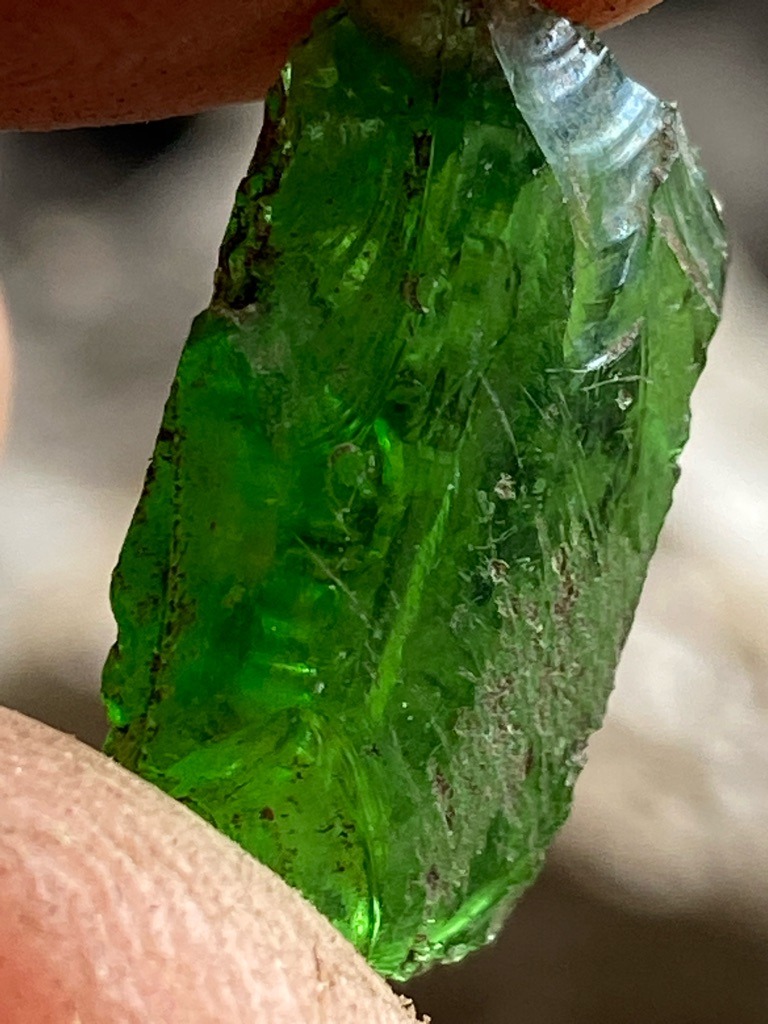
Not a diamond; this specimen appears to be green glass or synthetic green slag material, lacking the crystalline structure, hardness, and thermal properties of diamond.
Not a diamond; this specimen appears to be green glass or synthetic green slag material, lacking the crystalline structure, hardness, and thermal properties of diamond. · Rough or unformed crystal habit / raw fragment with concoidal fracture
Not applicable (raw, uncut, unpolished fragment with conchoidal fracturing) Cut
Carat
Cannot be precisely determined without specific density testing, but visually appears to be approximately 10-15 carats equivalent weight in gem material.
Color
Vivid Green (Fancy Intense Green appearance, though characteristic of colored glass rather than a natural fancy diamond)
Clarity
Not applicable to standard diamond grading; contains internal bubbles and flow lines typical of manufactured glass.
Shape
Rough or unformed crystal habit / raw fragment with concoidal fracture
Overall Assessment
The specimen shown in the image is definitively not a diamond. Based on visual characteristics such as conchoidal fractures, surface texture, and vitreous appearance, it is identified as a piece of green glass or synthetic slag. Professional gemological testing (such as a thermal tester or refractometer) would immediately confirm it is a glass simulant rather than a precious gemstone.
Cut Quality
Not applicable (raw, uncut, unpolished fragment with conchoidal fracturing)
Brilliance
Low to moderate vitreous luster, lacks the distinct adamantine luster and high refractive index of a diamond.
Fire
Minimal to none; lacks the strong dispersion (fire) seen in faceted diamond or high-index simulants.
Scintillation
Poor, as the material is raw and lacks precise facets to return light effectively.
Proportions
Irregular raw shape; no standard table, depth, or pavilion angles applicable.
Symmetry
Not applicable due to amorphous/raw nature
Polish
Raw and untreated surface showing fracture lines and possible manufacturing striations
Fluorescence
Unknown without UV testing, though typical green glass may show inert or weak chalky reactions.
Inclusions
Gas bubbles and flow lines characteristic of glass manufacturing, lacking natural mineral inclusions.
Blemishes
Surface abrasions, scratches, and chips along the conchoidal fracture edges.
Origin
Man-made / Manufactured (Glass or industrial slag)
Treatment Detection
Produced entirely through artificial manufacturing processes rather than natural geological formation.
Estimated Value
Nominal decorative or craft value (under $10 USD), as it holds no intrinsic gemstone value.
Certification Estimate
Not eligible for certification by major gemological laboratories (GIA, AGS, IGI) as a diamond; would be identified simply as 'Green Glass'.
Investment Potential
None; this item has no resale or investment value.
Similar Diamonds
None, as genuine green diamonds of this saturation are exceptionally rare and valuable, whereas this is a common glass simulant.
Setting Suggestions
Not recommended for fine jewelry due to softness and fragile nature; suitable only for novelty craft or wire-wrapping projects.
Care & Maintenance
Handle with care to avoid scratching surfaces or chipping edges; clean with mild soapy water and a soft cloth.
Interesting Facts
Green-colored glass is frequently mistaken by novices for rough emerald, peridot, or green diamond due to its appealing vibrant color, but it can be easily distinguished by its lower hardness (Mohs ~5.5) and internal gas bubbles.