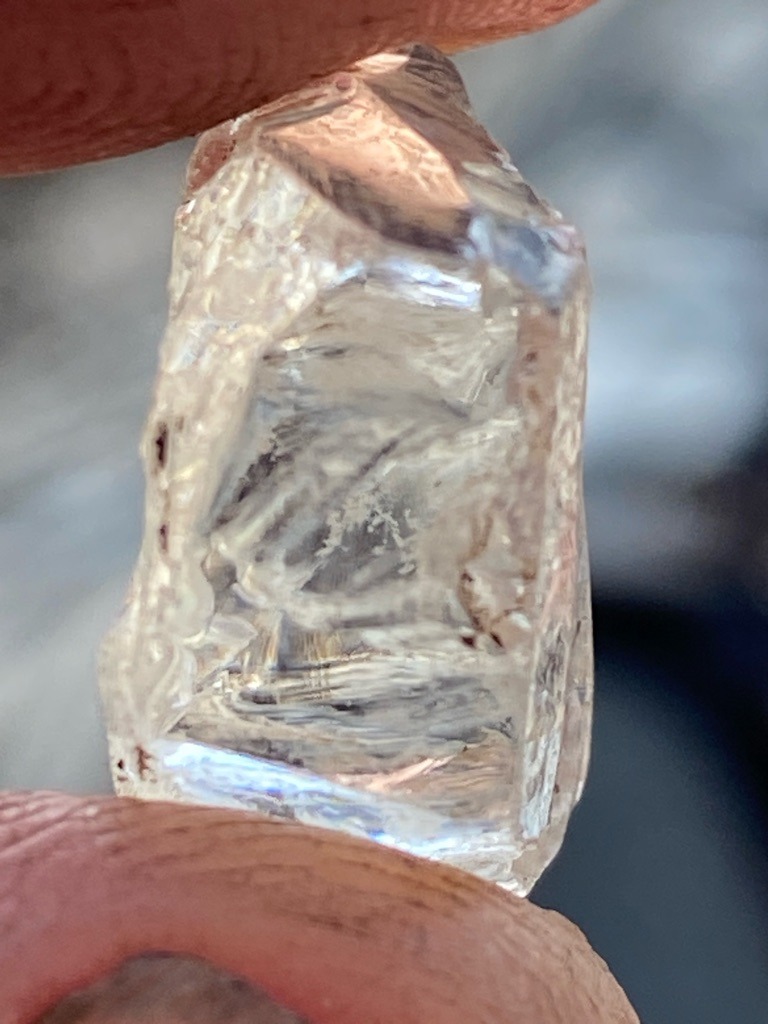
Natural rough diamond crystal
Natural rough diamond crystal · Rough crystal (uncut, octahedral/irregular elongated form)
Not applicable (uncut rough crystal) Cut
Carat
Estimated 2.0 - 3.5 carats based on visual proportions held between fingers
Color
Estimated near-colorless to faint yellow/brown tint (approx. K-M range)
Clarity
Estimated SI1 - SI2 (contains internal feathering, cloud formations, and surface trigons typical of rough stones)
Shape
Rough crystal (uncut, octahedral/irregular elongated form)
Overall Assessment
An intriguing, high-potential natural rough diamond crystal displaying classic geological growth marks, offering a rewarding project for an expert lapidary or a unique organic jewelry piece
Cut Quality
Not applicable (uncut rough crystal)
Brilliance
Limited in rough form; exhibits vitreous to adamantine luster on raw crystal faces
Fire
Minimal dispersion in rough state; fire will develop significantly once faceted and polished
Scintillation
Low in rough state; depends entirely on future faceting angles and symmetry
Proportions
Natural rough proportions; requires professional mapping to determine optimal cutting yield
Symmetry
Natural crystal symmetry (distorted octahedral/dodecahedral growth forms)
Polish
Natural rough crystal faces (some trigons and striations visible)
Fluorescence
Cannot be determined without UV testing (likely none to medium blue)
Inclusions
Internal clouds, feathers, and potential pinpoint inclusions visible within the matrix
Blemishes
Natural surface etchings, trigons, and surface pitting characteristic of rough diamond skin
Origin
Likely alluvial or primary kimberlite pipe origin (Africa, Canada, or Russia), verified via Kimberley Process certification
Treatment Detection
No signs of artificial treatment; appears completely untreated and natural in rough state
Estimated Value
Rough market value estimated between $1,500 to $4,000 depending on final cut yield and clarity retention
Certification Estimate
GIA or similar major laboratory would issue a Rough Diamond Description Report or Kimberley Process origin documentation before cutting
Investment Potential
Moderate to high speculative value depending on the cutter's skill to maximize yield and post-cut clarity grade
Similar Diamonds
Comparable natural run-of-mine gem-quality rough diamond crystals of similar carat weight
Setting Suggestions
Can be set raw/uncut in an organic, rustic gold bezel setting, or professionally cut into an Emerald, Radiant, or Cushion shape
Care & Maintenance
Store separately to avoid scratching other jewelry; clean with mild soapy water and a soft brush
Interesting Facts
The surface features often display natural triangular etch markings called trigons, which are formed by the dissolution of the diamond surface during its ascent to the Earth's surface