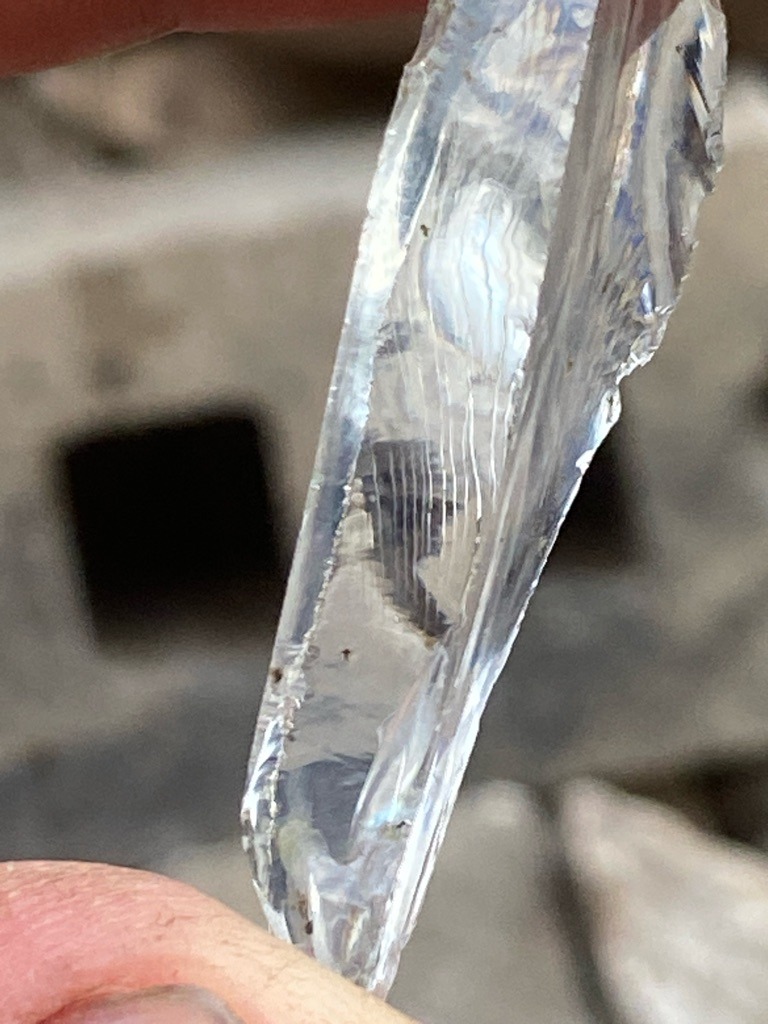
Not a diamond; this specimen appears to be optical or architectural glass, or potentially quartz/silica crystal with conchoidal fractures, displaying characteristic internal flow lines and melt features rather than diamond crystal faces or cleavage.
Not a diamond; this specimen appears to be optical or architectural glass, or potentially quartz/silica crystal with conchoidal fractures, displaying characteristic internal flow lines and melt features rather than diamond crystal faces or cleavage. · Irregular raw shard or fragment (uncut and unpolished, showing conchoidal fracture patterns).
Not applicable (Raw, unworked fragment with natural or accidental fracture surfaces) Cut
Carat
Cannot be reliably determined as diamond, but visual mass suggests roughly 15-25 carats equivalent if dense glass or mineral.
Color
Colorless / Transparent
Clarity
Not applicable under diamond standards; contains internal flow lines, bubbles, and particulate inclusions typical of glass manufacture.
Shape
Irregular raw shard or fragment (uncut and unpolished, showing conchoidal fracture patterns).
Overall Assessment
Visual inspection indicates this specimen is not a diamond, but rather a fragment of glass or quartz showing distinct conchoidal fracture lines and internal flow structures. Professional testing (such as a thermal conductivity probe or refractometer) is recommended for definitive identification.
Cut Quality
Not applicable (Raw, unworked fragment with natural or accidental fracture surfaces)
Brilliance
Poor to Moderate vitreous luster; lacks the high refractive index and dispersion of genuine diamond.
Fire
Minimal to none; lacks strong optical dispersion.
Scintillation
Negligible; lacks facet arrangement necessary for proper light return and sparkle.
Proportions
Not applicable for faceted gems; elongated shard morphology
Symmetry
Not applicable (Asymmetrical fracture shard)
Polish
Not applicable (Unpolished raw fracture surfaces)
Fluorescence
Cannot be determined without UV testing
Inclusions
Internal flow lines, striations, and trapped micro-bubbles visible, strongly indicating synthetic vitreous material (glass).
Blemishes
Chipped edges, conchoidal ripple marks, and surface abrasions.
Origin
Man-made glass or common silicate mineral
Treatment Detection
No gemstone treatments applicable; standard material identification required.
Estimated Value
Nominal value as decorative or industrial glass/mineral specimen (under $10).
Certification Estimate
Standard gemological laboratories (GIA, IGI) would issue a report identifying this as non-diamond glass or mineral substitute.
Investment Potential
None as a gemstone asset.
Similar Diamonds
None; physically and chemically unrelated to diamond.
Setting Suggestions
Not recommended for jewelry due to low hardness and fragile edges.
Care & Maintenance
Standard handling; avoid impacts as glass/quartz fragments can chip or shatter easily.
Interesting Facts
The prominent curved lines visible inside the material are known as conchoidal fracture ripples, commonly seen when brittle amorphous materials like glass break.