Likely Non-Diamond (Potential Glass, Quartz, or Slag)
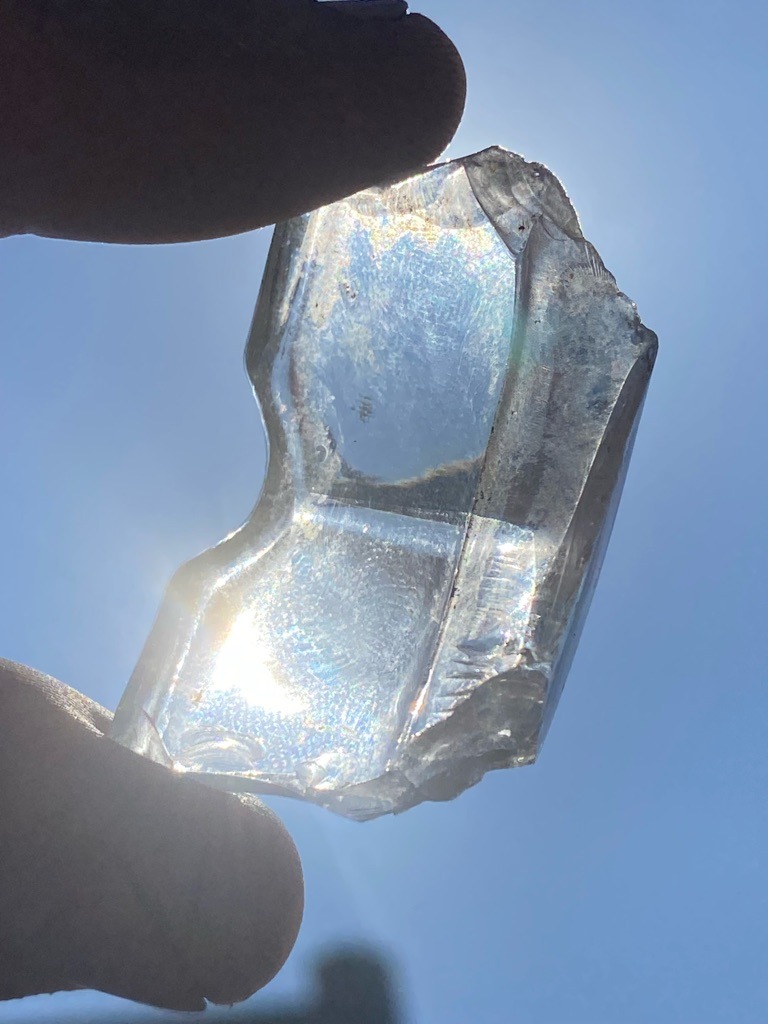
Likely Non-Diamond (Potential Glass, Quartz, or Slag) · Rough / Irregular fragment
Uncut / Raw fragment Cut
Carat
Estimated 20-40 carats based on finger scale
Color
Colorless with slight grayish/blue tinting likely from sky reflection
Clarity
Included (equivalent to I2-I3 if it were diamond)
Shape
Rough / Irregular fragment
Overall Assessment
The specimen lacks the adamantine luster and octahedral or dodecahedral crystal habit typical of rough diamonds. The transparency and fracture patterns strongly suggest it is a piece of industrial glass or a common crystalline mineral.
Cut Quality
Uncut / Raw fragment
Brilliance
Low (translucent to transparent but lacks diamond's high refractive index)
Fire
Very Low (minimal spectral dispersion visible)
Scintillation
None (lacks facet structure to create sparkle)
Proportions
N/A (No geometric facets)
Symmetry
N/A (Rough)
Polish
Poor / Natural surface texture
Fluorescence
Indeterminable from image
Inclusions
Heavy internal fracturing, flow lines, and possible surface-reaching pits
Blemishes
Large chips, conchoidal fractures, and heavy abrasions
Origin
Likely anthropogenic (glass slag) or common mineral such as Rock Crystal Quartz
Treatment Detection
N/A
Estimated Value
Minimal individual value ($0 - $10) as a curious stone or glass fragment
Certification Estimate
Unlikely to be certified by GIA/AGS as a diamond; would be identified as glass or mineral specimen
Investment Potential
None
Similar Diamonds
None (does not exhibit the crystal habit of rough diamond)
Setting Suggestions
Wire wrapping for decorative/hobbyist use
Care & Maintenance
Avoid impact, as the conchoidal fractures indicate brittleness
Interesting Facts
The conchoidal (shell-like) fracture pattern on the edges is a primary indicator of glass or quartz rather than diamond, which cleaves in flat planes.