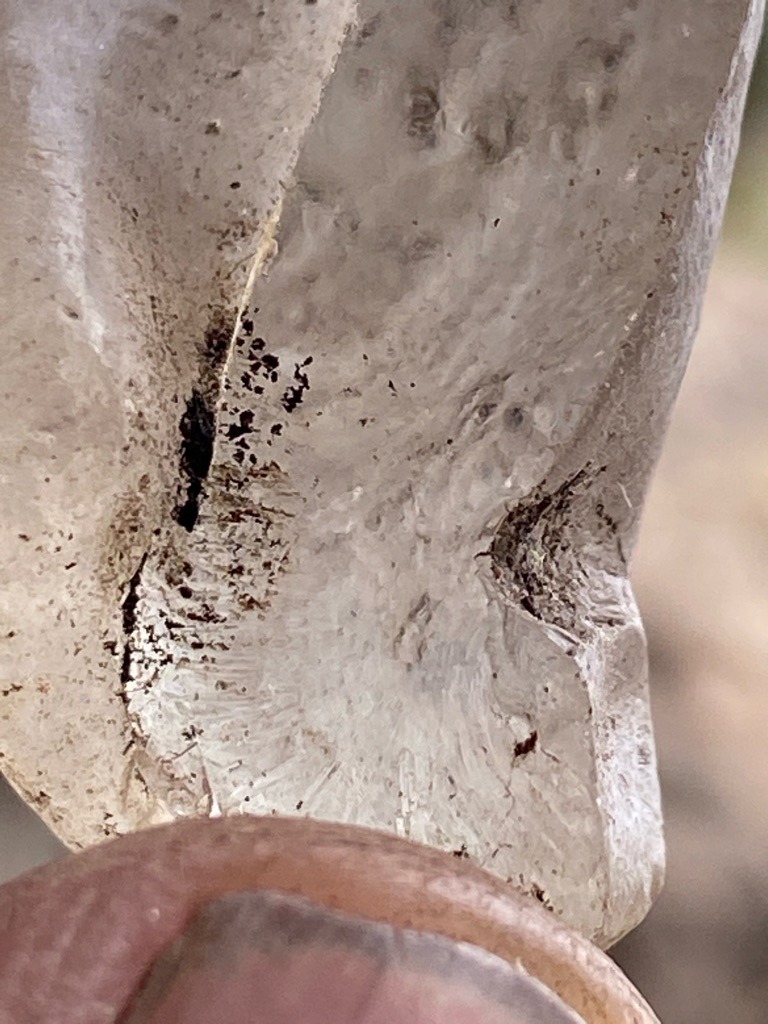
Natural rough mineral crystal (likely quartz or similar silicate rather than a gem-grade diamond based on crystal habit, surface features, and lack of cubic/octahedral diamond crystallization)
Natural rough mineral crystal (likely quartz or similar silicate rather than a gem-grade diamond based on crystal habit, surface features, and lack of cubic/octahedral diamond crystallization) · Uncut raw crystal fragment / Irregular rough
Not applicable (Rough uncut specimen) Cut
Carat
Difficult to estimate precisely from a macro close-up view, but appears to be a substantial specimen exceeding 5-10 carats
Color
Colorless to slightly milky white with surface staining
Clarity
Included / Industrial or specimen grade (I3 equivalent if faceted due to internal fractures, inclusions, and inclusions of foreign material)
Shape
Uncut raw crystal fragment / Irregular rough
Overall Assessment
Based on visual characteristics, surface features, and crystal morphology, this specimen is a natural rough mineral fragment rather than a cut diamond. It exhibits significant natural inclusions, surface weathering, and internal structural irregularities typical of raw silicate or quartz formations.
Cut Quality
Not applicable (Rough uncut specimen)
Brilliance
Low to moderate due to internal fractures and lack of precision faceting
Fire
Minimal dispersion observed in current rough state
Scintillation
Limited, as the surface is unpolished and light scatters rather than reflecting internally through precision facets
Proportions
Not applicable to raw mineral specimens
Symmetry
Asymmetrical natural crystal form
Polish
Unpolished natural surface
Fluorescence
Cannot be determined without UV light testing
Inclusions
Heavy internal fracturing, cleavage planes, and dark particulate mineral inclusions trapped within the crystal matrix
Blemishes
Surface weathering, pitting, natural growth etch marks, and trapped debris/dirt in surface fissures
Origin
Terrestrial mineral deposit, likely recovered from an alluvial or primary pegmatite/quartz matrix source
Treatment Detection
No evidence of artificial treatments; appears entirely natural as-mined
Estimated Value
Nominal mineral specimen or educational value ($10 - $50 USD depending on exact mineral composition and locality)
Certification Estimate
Not applicable for major gem labs (GIA/AGS) as this is not a traditional faceted diamond or standard gemstone, but could be analyzed by a mineralogical institute
Investment Potential
Low investment potential for resale; primarily of interest to mineral collectors or geology enthusiasts
Similar Diamonds
Not comparable to standard gem diamonds; comparable to raw quartz, industrial diamond bort, or unrefined mineral specimens
Setting Suggestions
Wire-wrapped pendant, raw mineral display piece, or unmounted mineral collection specimen
Care & Maintenance
Clean gently with warm soapy water and a soft brush; avoid harsh ultrasonic cleaners if internal fractures are unstable
Interesting Facts
Raw mineral specimens like this showcase natural crystal growth patterns, striations, and environmental interactions before human lapidary work transforms them