Potential Diamond Simulant (e.g., Cubic Zirconia or Moissanite)
Potential Diamond Simulant (e.g., Cubic Zirconia or Moissanite) · Round Brilliant
Good to Very Good Cut
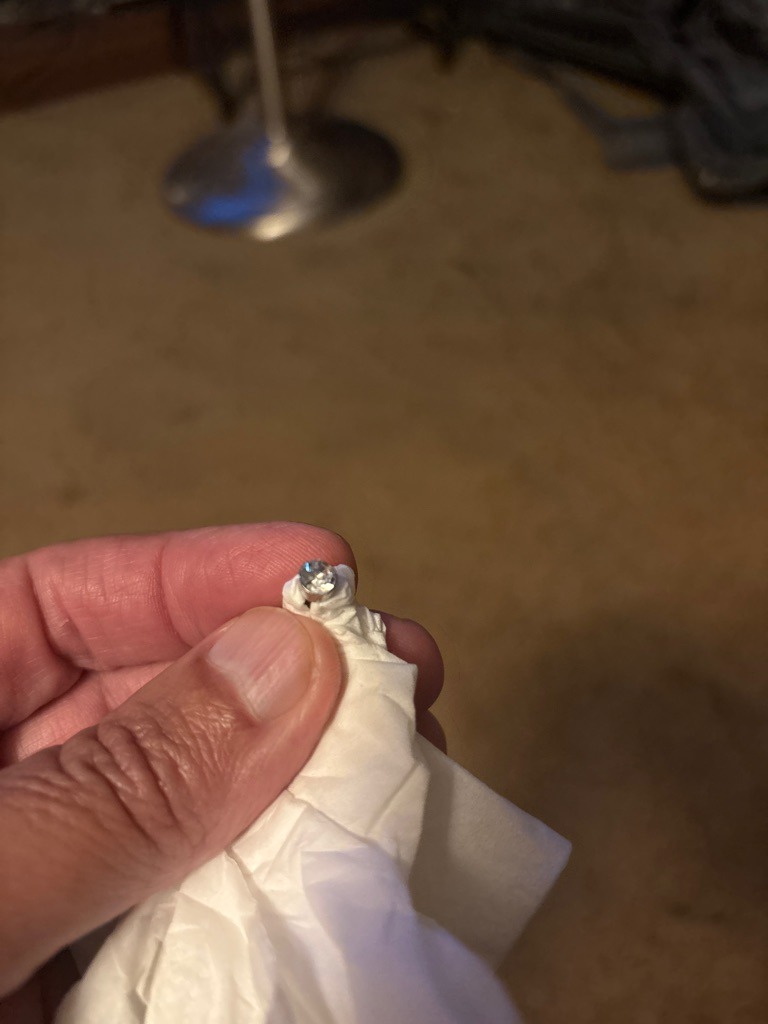
Carat
Estimated between 0.25 to 0.40 carats
Color
Estimated F-G (Colorless to Near Colorless range)
Clarity
Estimated VS1 or better based on visual surface clarity
Shape
Round Brilliant
Overall Assessment
The stone exhibits high dispersion and luster but requires professional testing (thermal conductivity) to confirm if it is a natural diamond or a simulant like Cubic Zirconia.
Cut Quality
Good to Very Good
Brilliance
Moderate return of white light
Fire
High dispersion visible, characteristic of high-RI simulants
Scintillation
Rapid flash pattern, although somewhat muted by environmental lighting
Proportions
Standard round proportions, table size appears slightly large relative to total diameter
Symmetry
Fair to Good
Polish
Good
Fluorescence
None visible under current lighting conditions
Inclusions
No major internal flaws visible to the naked eye at this magnification
Blemishes
Minor surface abrasions possibly present on facet edges
Origin
Likely manufactured/synthetic (Simulant)
Treatment Detection
None visible; surface facet edges appear slightly rounded suggesting non-diamond hardness
Estimated Value
$5 - $50 (if simulant) to $400 - $800 (if natural SI/H diamond)
Certification Estimate
Likely GIA or IGI if natural/lab, but item appears more consistent with non-certified fashion jewelry
Investment Potential
Low; retail-style simulants do not typically hold resale value
Similar Diamonds
Comparable to standard 4mm round brilliant cut stones found in accent jewelry
Setting Suggestions
Four-prong or six-prong solitaire setting in 14k White Gold or Sterling Silver
Care & Maintenance
Clean with mild soap and warm water; use a soft brush to remove oils and lint from the pavilion
Interesting Facts
The 'Round Brilliant' cut was engineered specifically to maximize light return using mathematical formulas