Natural or Lab-Grown Diamond (requires testing to differentiate definitively)
Natural or Lab-Grown Diamond (requires testing to differentiate definitively) · Round Brilliant
Very Good to Excellent Cut
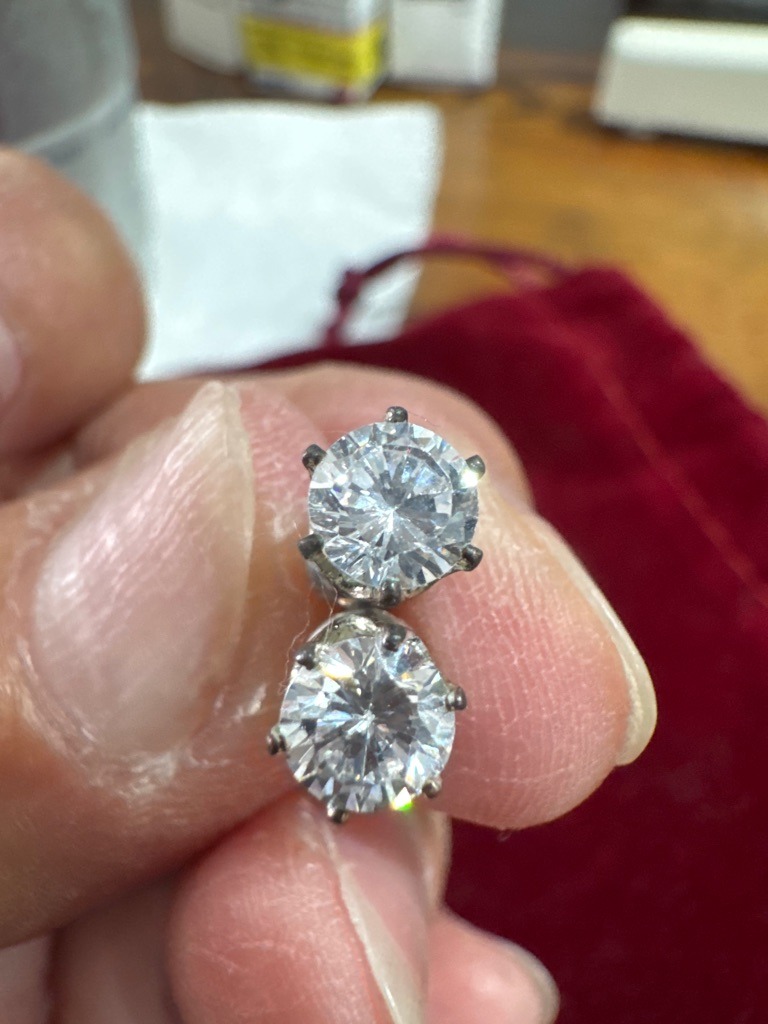
Carat
Estimated approx. 0.50 to 0.75 carats each (1.00 to 1.50 ctw for the pair)
Color
Estimated G-H (near colorless)
Clarity
Estimated SI1-SI2 (slightly included)
Shape
Round Brilliant
Overall Assessment
Attractive matching pair of round brilliant diamond earrings with good brilliance and classic presentation suitable for everyday wear or special occasions
Cut Quality
Very Good to Excellent
Brilliance
High white light return, bright appearance
Fire
Good spectral dispersion visible in favorable lighting
Scintillation
Active sparkle with balanced pattern of light and dark areas
Proportions
Standard modern round brilliant proportions with balanced table and depth percentages
Symmetry
Good to Very Good
Polish
Good
Fluorescence
None to Faint
Inclusions
Possible small feather or crystal inclusions visible under magnification
Blemishes
Minor surface abrasions on facets consistent with wear
Origin
Unknown without advanced spectroscopic testing
Treatment Detection
No obvious signs of laser drilling, fracture filling, or coating observed visually
Estimated Value
Varies significantly depending on natural vs. lab-grown origin and exact certification grades, roughly $1,500 - $4,000 for the pair
Certification Estimate
GIA or IGI grading likely if formally submitted
Investment Potential
Moderate for natural diamonds; lab-grown alternatives tend to depreciate over time
Similar Diamonds
Standard commercial-grade round brilliant diamond pairs of comparable carat weight
Setting Suggestions
Classic six-prong basket or solitaire stud settings in white gold, platinum, or yellow gold
Care & Maintenance
Clean regularly with warm soapy water and a soft-bristled brush; have prongs checked annually by a jeweler
Interesting Facts
The six-prong setting maximizes the security of the stones while exposing maximum surface area for light return