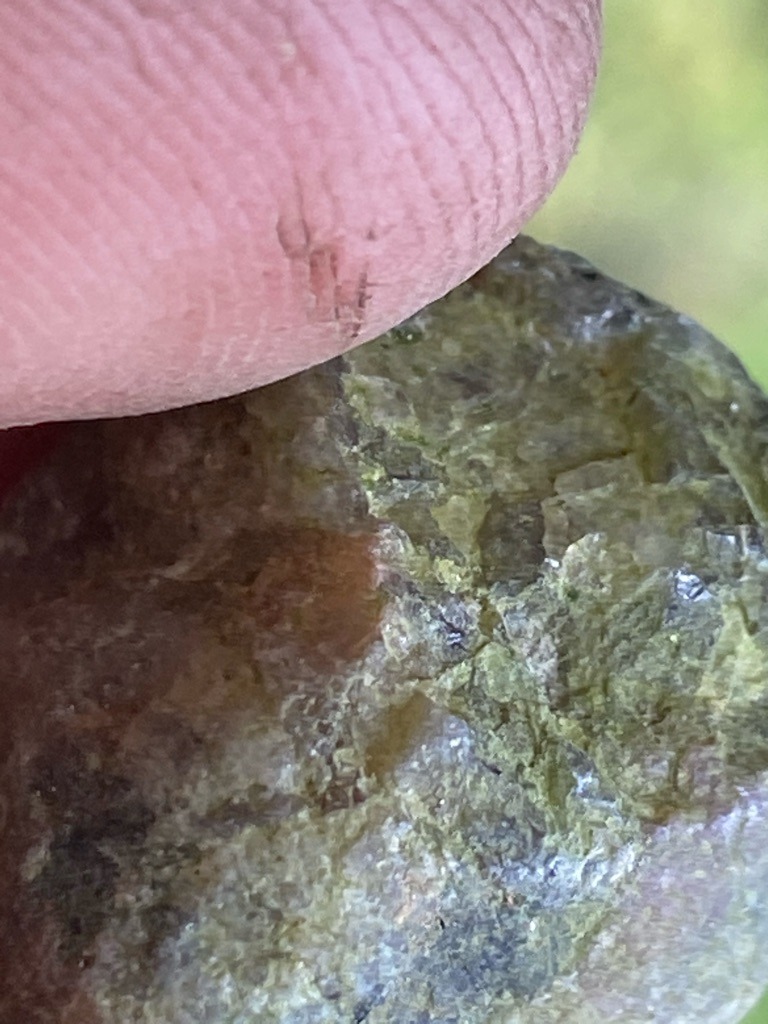
Not a diamond; appears to be a rough mineral specimen, possibly peridot, olivine, or altered silicate rock, lacking gem-grade diamond crystal habits.
Not a diamond; appears to be a rough mineral specimen, possibly peridot, olivine, or altered silicate rock, lacking gem-grade diamond crystal habits. · Irregular rough specimen, unpolished and uncut
Not applicable (uncut rough mineral) Cut
Carat
Cannot be accurately determined by visual estimation alone due to irregular matrix and attachment, roughly estimated over 5 carats in total mass.
Color
Olive green to brownish-green, not applicable to standard white diamond GIA D-Z scale.
Clarity
Included / heavily fractured, characteristic of rough mineral formations.
Shape
Irregular rough specimen, unpolished and uncut
Overall Assessment
The specimen shown in the image is not a diamond. It is a rough, unpolished mineral aggregate featuring olive-green coloration and natural internal fracturing, typical of olivine/peridot or a related silicate rock matrix.
Cut Quality
Not applicable (uncut rough mineral)
Brilliance
Minimal to none due to lack of faceting and opaque/translucent rough nature
Fire
None
Scintillation
None
Proportions
Not applicable to raw mineral aggregates
Symmetry
Natural asymmetric rough formation
Polish
Unpolished, raw natural texture
Fluorescence
Unknown without UV testing
Inclusions
Abundant natural mineral inclusions, micro-fractures, and matrix attachments visible throughout.
Blemishes
Natural surface pitting, rough texture, and fractures
Origin
Natural geological formation, likely from an ultramafic or metamorphic rock matrix.
Treatment Detection
No signs of artificial treatment; appears entirely natural and untreated.
Estimated Value
Nominal mineral specimen value, generally low unless specific rare mineral composition is confirmed.
Certification Estimate
Not eligible for diamond certification (GIA/AGS); would require mineralogical identification by institutions like GIA colored stone or university geology departments.
Investment Potential
Low; valuable primarily as a study specimen for mineralogy rather than an investment gem.
Similar Diamonds
None, as this specimen is not a diamond.
Setting Suggestions
Wire-wrapped or custom bezel settings if polished into a cabochon, though currently unsuitable for standard jewelry without significant lapidary work.
Care & Maintenance
Handle with care to prevent crumbling along natural fracture lines; avoid harsh chemicals and ultrasonic cleaners.
Interesting Facts
Many rough green minerals are frequently mistaken for gemstones or diamonds by untrained observers due to weathering and surface luster.