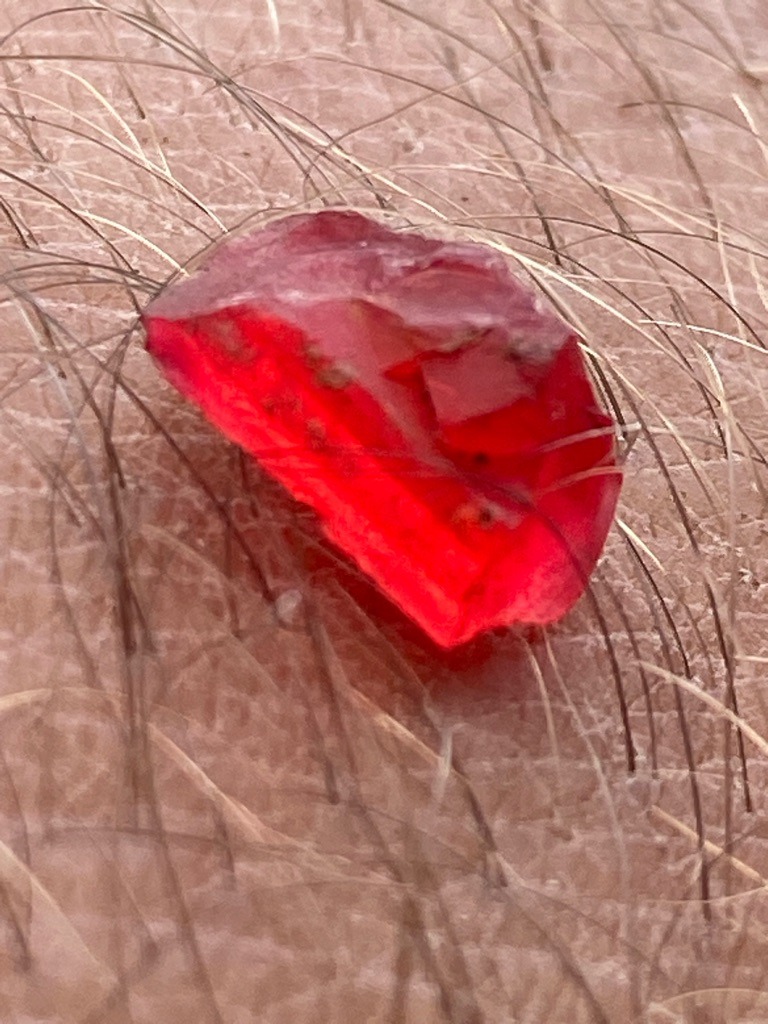
Not a diamond; visual characteristics strongly suggest a rough ruby or red spinel, likely a corundum or spinel crystal, or potentially a red glass/synthetic simulant. Pure red natural diamonds are extremely rare and typically show octahedral crystal forms rather than this irregular rough crystal morphology.
Not a diamond; visual characteristics strongly suggest a rough ruby or red spinel, likely a corundum or spinel crystal, or potentially a red glass/synthetic simulant. Pure red natural diamonds are extremely rare and typically show octahedral crystal forms rather than this irregular rough crystal morphology. · Rough crystal / Natural uncut form (Irregular nugget-like habit)
Not Applicable (uncut rough stone) Cut
Carat
Estimated at approximately 1.5 to 2.5 carats based on visual scale against skin textures
Color
Fancy Vivid Red (saturated rich red hue)
Clarity
Included / SI2-I1 equivalent due to visible internal fractures and dark inclusions
Shape
Rough crystal / Natural uncut form (Irregular nugget-like habit)
Overall Assessment
The specimen displayed is a vibrant red rough crystal resting on skin, appearing more consistent with a ruby, spinel, or colored mineral simulant than a diamond. Professional physical and chemical laboratory testing is strongly advised to confirm its true identity and value.
Cut Quality
Not Applicable (uncut rough stone)
Brilliance
Low due to lack of standard facet geometry and uncut rough state
Fire
Minimal dispersion visible in its current rough, unpolished state
Scintillation
Negligible until properly cut and faceted by a lapidary
Proportions
Not Applicable for rough stones lacking standard facet proportions
Symmetry
Natural asymmetric rough crystal form
Polish
Unpolished natural crystal faces and fracture surfaces
Fluorescence
Cannot be definitively determined without UV testing, though typical rubies often show strong red fluorescence under long-wave UV due to chromium content
Inclusions
Visible dark mineral spots and internal feather fractures typical of natural corundum or similar rough gemstone material
Blemishes
Surface pitting, natural growth lines, and rough fracture edges
Origin
Uncertain without spectroscopic analysis; typical natural corundum origins include Myanmar, Mozambique, or Madagascar, though synthetic lab-grown variants are common
Treatment Detection
Potential fracture filling or heat treatment common in lower clarity rough rubies; microscopic examination required
Estimated Value
Highly variable depending on exact mineral composition; if natural untreated ruby of this clarity, could range from moderate to high, but if glass or synthetic, value is negligible
Certification Estimate
GIA or SSEF if verified as a natural ruby, though preliminary testing with a refractometer or thermal probe is needed first
Investment Potential
Dependent entirely on gemological identification; rough colored stones carry higher speculative risk
Similar Diamonds
None, as this is visually a colored gemstone rough rather than a diamond
Setting Suggestions
Custom organic bezel setting or wire-wrap style to preserve and highlight the natural rough crystal aesthetic
Care & Maintenance
Avoid harsh ultrasonic cleaners if treated with fracture filling; clean gently with warm soapy water and a soft brush
Interesting Facts
Natural red gem materials owe their vibrant color primarily to trace elements of chromium replacing aluminum in the crystal lattice