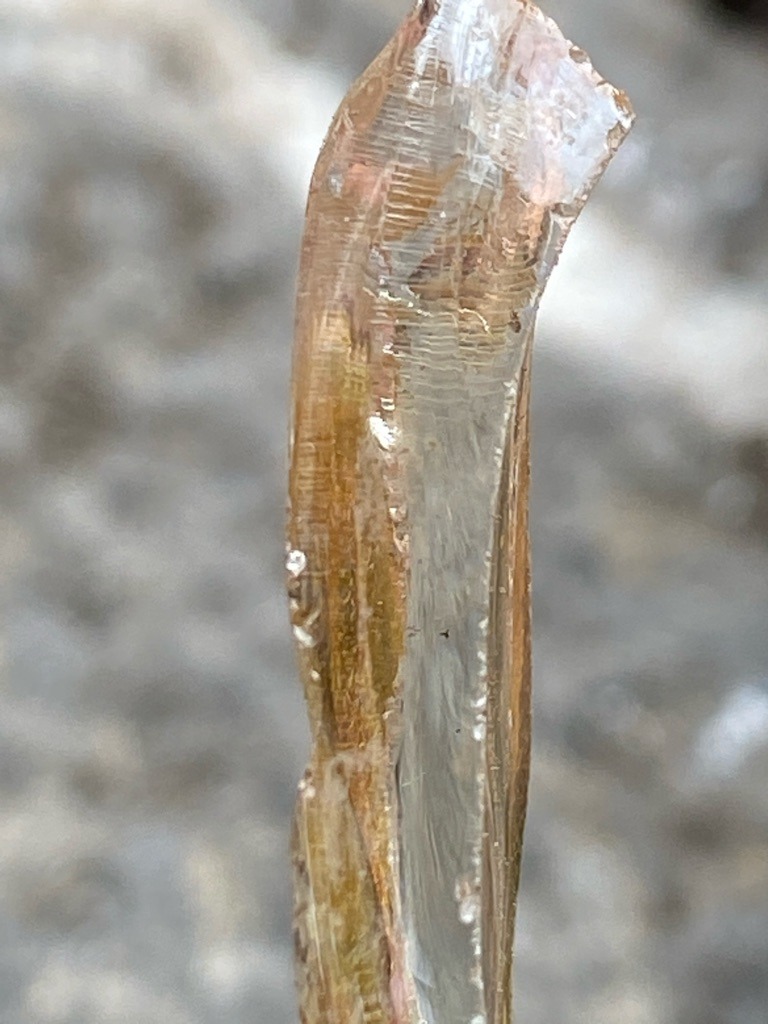
Not a diamond; this is a rough mineral crystal, likely quartz or tourmaline based on the striations and elongation.
Not a diamond; this is a rough mineral crystal, likely quartz or tourmaline based on the striations and elongation. · Rough crystal form (uncut, natural crystal habit)
Not Applicable (Uncut rough crystal) Cut
Carat
Cannot be precisely determined without measurements and density testing, rough estimation approx. 1-2 carats.
Color
Brownish to translucent/clear with surface iron staining
Clarity
Included (Contains visible internal fractures, striations, and matrix material)
Shape
Rough crystal form (uncut, natural crystal habit)
Overall Assessment
This specimen is a naturally formed rough crystal mineral rather than a diamond. Its distinct striated prism structure indicates it belongs to another mineral species entirely, requiring physical gemological testing for definitive identification.
Cut Quality
Not Applicable (Uncut rough crystal)
Brilliance
Low due to lack of standard facet angles and rough surface texture
Fire
Minimal to none due to crystal habit and material properties
Scintillation
Poor, lacking faceted surfaces to return light in patterns
Proportions
Elongated crystal habit; proportions are entirely natural rather than precision-cut
Symmetry
Natural crystal symmetry (elongated prismatic form with characteristic striations)
Polish
Unpolished natural crystal faces
Fluorescence
Unknown (requires UV light testing)
Inclusions
Heavy natural crystal inclusions, growth lines, and internal fractures
Blemishes
Natural surface etching, striations, and adhering matrix minerals
Origin
Natural geologic origin, typical of pegmatite or hydrothermal vein formations.
Treatment Detection
No obvious signs of artificial enhancement; appears completely untreated and natural.
Estimated Value
Nominal mineral specimen value, highly dependent on exact mineral identification and locality.
Certification Estimate
Gemological laboratories (like GIA or IGI) would issue a colored stone or mineral identification report rather than a diamond grading report.
Investment Potential
Low investment potential unless valued as a rare collector's mineral specimen.
Similar Diamonds
None, as this is a rough crystal of a non-diamond mineral.
Setting Suggestions
Best suited for wire-wrapping, organic raw jewelry designs, or kept as a mineral specimen.
Care & Maintenance
Handle with care to prevent chipping along cleavage or fracture planes; clean gently with mild soapy water.
Interesting Facts
The distinct horizontal or vertical striations visible on the surface are classic growth features commonly found on minerals like tourmaline and quartz.