Moissanite
Moissanite · Fancy/Geometric
Fair to Good Cut
Carat
3.90 carats
Color
D-E-F (Colorless range)
Clarity
VVS1 (Estimated)
Shape
Fancy/Geometric
Overall Assessment
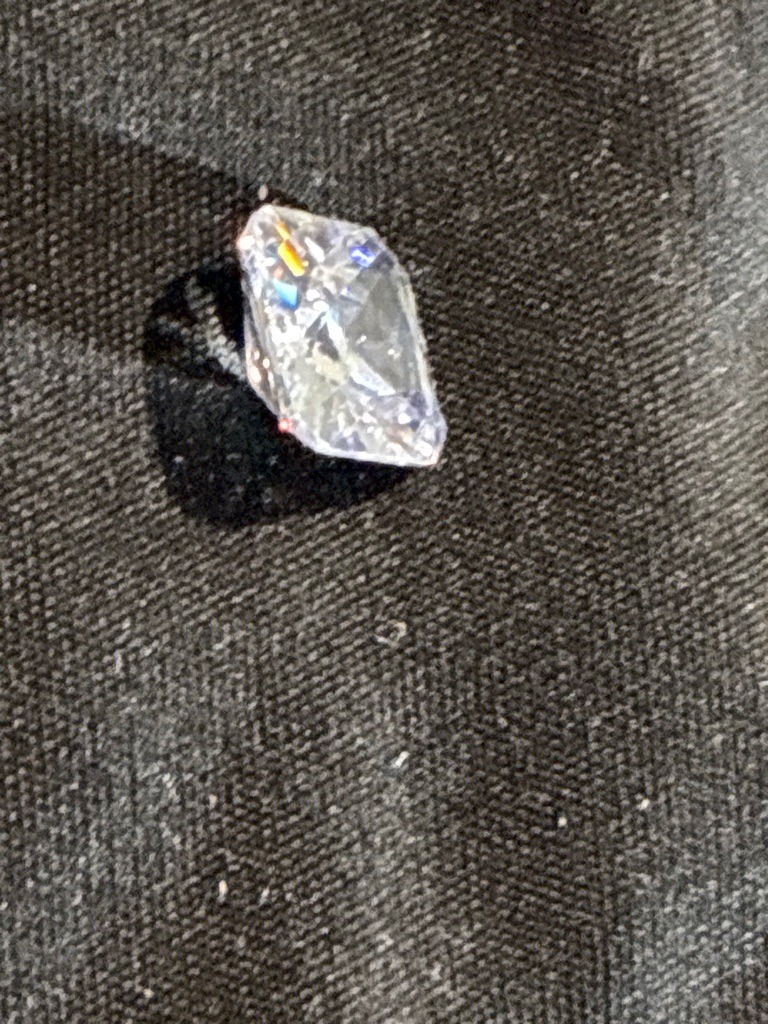
The stone exhibits the high level of double refraction (birefringence) and 'fire' characteristic of lab-grown moissanite rather than natural diamond. While beautiful and durable (9.25 on Mohs scale), it is a synthetic stimulant.
Cut Quality
Fair to Good
Brilliance
Very High; high refractive index leading to strong white light return.
Fire
Exceptional; the prism effect and rainbow dispersion seen in the facets strongly suggest moissanite over diamond.
Scintillation
High flash scintillation with a distinct 'disco ball' effect.
Proportions
High crown with steep pavilion; the stone appears deep with sharp geometric faceting.
Symmetry
Good
Polish
Very Good
Fluorescence
None
Inclusions
No visible carbon spots; possible needle-like inclusions typical of silicon carbide.
Blemishes
None visible at this magnification.
Origin
Laboratory-created
Treatment Detection
None; synthetic creation process and likely CVD/HPHT growth for the silicon carbide structure.
Estimated Value
$100 - $350 USD
Certification Estimate
GRA (Global Gemological Research Academy) is common for this material; D Color, VVS1.
Investment Potential
Low; moissanite is a synthetic gemstone with high production volume and low resale value compared to natural diamonds.
Similar Diamonds
Comparable to a 4-carat pear or marquise diamond in terms of surface area but with much higher fire.
Setting Suggestions
A six-prong platinum or white gold solitaire setting to securely hold the stone and maximize light intake.
Care & Maintenance
Clean with mild soap and a soft brush; avoid harsh ultrasonic cleaners if the stone has surface-reaching fractures.
Interesting Facts
Moissanite has a higher refractive index than diamond (2.65 vs 2.42), making it actually more sparkly than a real diamond.
Notes
3.90 carats