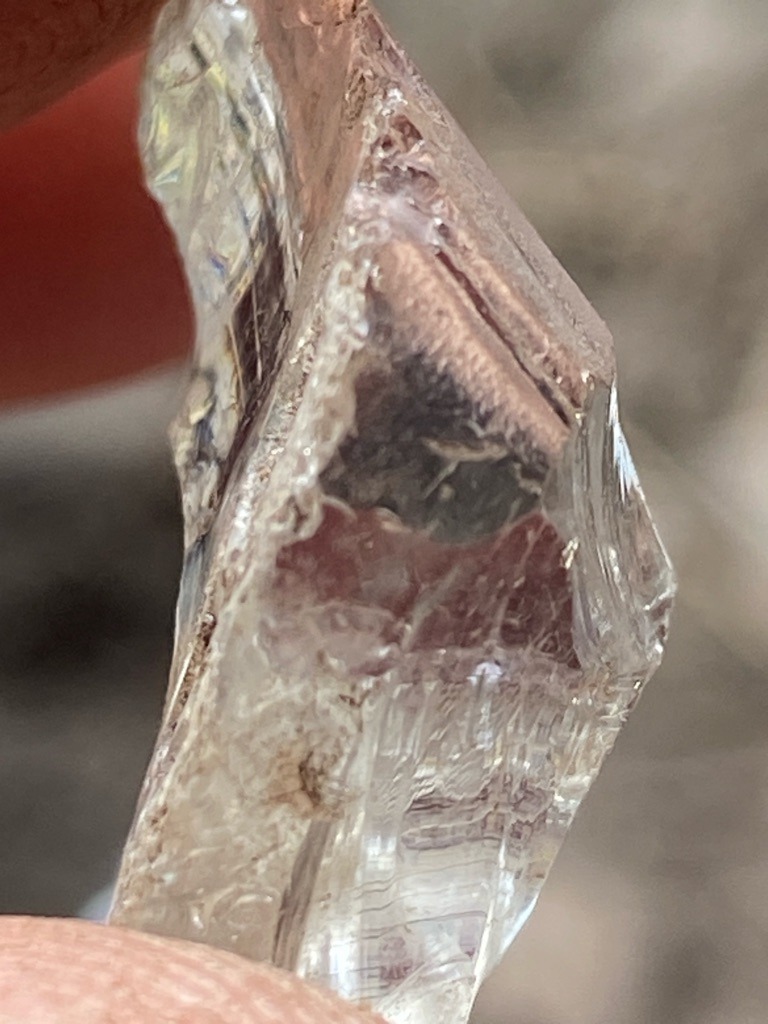
Natural diamond crystal (rough specimen)
Natural diamond crystal (rough specimen) · Rough / Uncut Octahedral / Irregular Fragment
Not Applicable (Rough un-faceted crystal) Cut
Carat
Estimated 3.5 - 5.0 carats based on visual scale relative to fingers
Color
Near colorless to faint brown tint (K-M range)
Clarity
Included (I1 - I3 range due to visible internal fractures and striations)
Shape
Rough / Uncut Octahedral / Irregular Fragment
Overall Assessment
This is an interesting, natural rough diamond specimen displaying classic crystal growth lines and geological features, best preserved in its raw state as a collector's mineral specimen rather than cut into a polished gem.
Cut Quality
Not Applicable (Rough un-faceted crystal)
Brilliance
Low to moderate due to rough surfaces and internal fractures
Fire
Limited dispersion visible through raw windows
Scintillation
Minimal due to lack of standard facet patterns
Proportions
Natural rough geometry; deep, irregular pavilion and crown proportions
Symmetry
Natural crystal asymmetry with distorted growth features
Polish
Natural crystal faces (trigons and striations visible)
Fluorescence
Indeterminate from visual inspection (typically inert to moderate blue in rough stones)
Inclusions
Heavy internal feathers, cleavage planes, and dark mineral inclusions
Blemishes
Natural surface pitting, rough skin, and irregular growth lines
Origin
Alluvial or primary kimberlite deposit origin
Treatment Detection
No signs of artificial enhancement; completely untreated natural rough
Estimated Value
Low to moderate commercial value as a mineral specimen rather than a cut gemstone
Certification Estimate
GIA or similar major laboratory would issue a rough diamond report or origin certification
Investment Potential
Valued primarily as a unique geological specimen or collector piece rather than a liquid investment
Similar Diamonds
Other industrial or specimen-grade rough diamond crystals
Setting Suggestions
Raw mineral pendant setting in yellow gold or platinum, showcasing the natural crystal form
Care & Maintenance
Store separately to prevent scratching other stones; avoid harsh chemicals and ultrasonic cleaning due to internal fractures
Interesting Facts
The striations on the surface are growth lines characteristic of natural diamond crystallization deep within the Earth's mantle