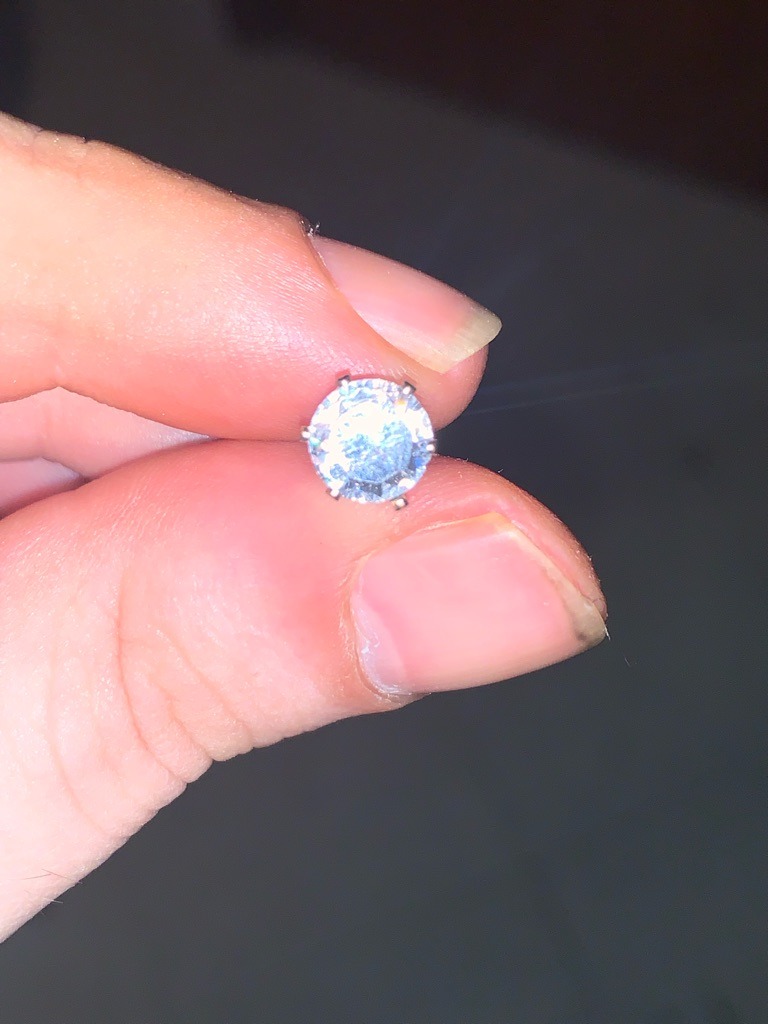
Diamond Simulant (Likely Cubic Zirconia or Moissanite)
Diamond Simulant (Likely Cubic Zirconia or Moissanite) · Round Brilliant
Good to Very Good Cut
Carat
1.00 - 1.25 carats (estimated by size relative to fingers)
Color
D - E (Colorless range)
Clarity
VVS1 - IF (Internally Flawless appearance)
Shape
Round Brilliant
Overall Assessment
The specimen presents as a high-clarity, colorless round brilliant. The extreme dispersion (rainbow fire) and lack of natural inclusions strongly suggest it is a high-grade simulant such as Cubic Zirconia or Moissanite rather than a natural earth-mined diamond.
Cut Quality
Good to Very Good
Brilliance
High surface reflectivity, but shows some 'glassy' transparency in the center
Fire
Very High / Dispersion exceeds natural diamond (typical of high-refraction simulants)
Scintillation
Sharp and repetitive patterns; lacks the deep contrast of a natural diamond
Proportions
Standard round brilliant proportions with a slightly high crown and flat table
Symmetry
Good
Polish
Good
Fluorescence
None / Not observable
Inclusions
No visible inclusions at 1x magnification; indicative of a synthetic simulant
Blemishes
Minor surface abrasions on facet edges (typical of CZ wear)
Origin
Laboratory created simulant
Treatment Detection
N/A (Crystals are manufactured to be clear)
Estimated Value
$10 - $150 USD (depending on whether it is CZ or Moissanite)
Certification Estimate
Unlikely to be graded by GIA as a natural diamond; possibly IGI as lab-grown or simulant
Investment Potential
Low; simulants generally do not retain resale value
Similar Diamonds
Comparable to high-grade lab-grown diamonds or designer moissanite
Setting Suggestions
Six-prong solitaire earring setting in sterling silver or white gold
Care & Maintenance
Clean with warm soapy water and a soft brush; avoid abrasive cleaners that can scratch the surface
Interesting Facts
High-quality simulants like this are often virtually indistinguishable from diamonds to the untrained eye without specialized tools like a thermal tester