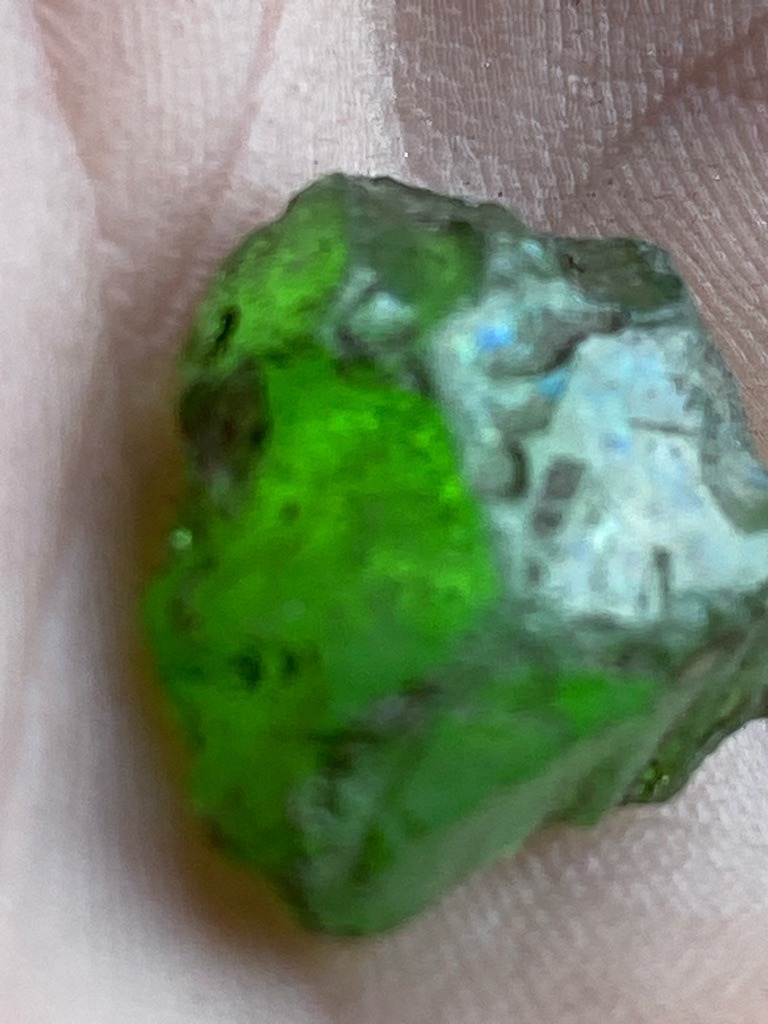
The specimen shown in the image is not a diamond; it appears to be a raw, unpolished mineral crystal, likely green tourmaline, peridot, or a similar green gemstone matrix, as diamonds do not naturally occur in this rough, opaque green crystal habit with this texture.
The specimen shown in the image is not a diamond; it appears to be a raw, unpolished mineral crystal, likely green tourmaline, peridot, or a similar green gemstone matrix, as diamonds do not naturally occur in this rough, opaque green crystal habit with this texture. · Rough crystal / Natural unshaped form
Not Applicable (Rough, uncut crystal) Cut
Carat
Estimated roughly 15-25 carats based on visual volume relative to standard hand sizing, though accurate weight requires a scale for non-diamond rough.
Color
Vivid Green (Natural Fancy Color appearance)
Clarity
Opaque to Included (Not applicable in standard diamond grading due to rough state)
Shape
Rough crystal / Natural unshaped form
Overall Assessment
This is a fascinating and vibrant green raw mineral specimen rather than a diamond. Its appeal lies in its natural, earthy crystal structure and intense color, making it a wonderful display piece for mineral enthusiasts.
Cut Quality
Not Applicable (Rough, uncut crystal)
Brilliance
Low to none in current rough state due to lack of facets and opacity
Fire
Minimal to none due to opacity and lack of facet dispersion
Scintillation
None in current rough, uncut condition
Proportions
Not applicable to rough uncut crystals
Symmetry
Natural crystal symmetry (Asymmetrical rough form)
Polish
Unpolished (Natural crystal faces and rough fracture surfaces)
Fluorescence
Cannot be definitively determined without UV testing, though some green stones show inert to moderate reactions.
Inclusions
Heavy internal natural mineral inclusions, feather fractures, and opaque matrix patches
Blemishes
Natural surface etching, striations, and rough patches typical of raw crystal growth
Origin
Likely pegmatite or metamorphic origin depending on the exact mineral species (e.g., Brazil, Pakistan, or Africa for green tourmaline/peridot).
Treatment Detection
No obvious signs of artificial enhancement; appears completely natural in rough form.
Estimated Value
Nominal value as a mineral specimen; significantly lower than a faceted diamond of comparable size.
Certification Estimate
Gemological laboratories like GIA or GRS would issue gemstone identification reports rather than diamond grading reports for this mineral.
Investment Potential
Low for investment purposes; valued primarily as a decorative mineral specimen or collector piece.
Similar Diamonds
None, as this is a colored rough mineral specimen and not a diamond.
Setting Suggestions
Wire-wrapped or custom bezel settings designed for raw mineral specimens, paired with yellow or white gold for a bohemian look.
Care & Maintenance
Avoid ultrasonic cleaners and harsh chemicals; clean gently with warm soapy water and a soft brush.
Interesting Facts
Raw gemstones in their natural matrix are highly sought after by mineral collectors for their organic, untouched beauty.