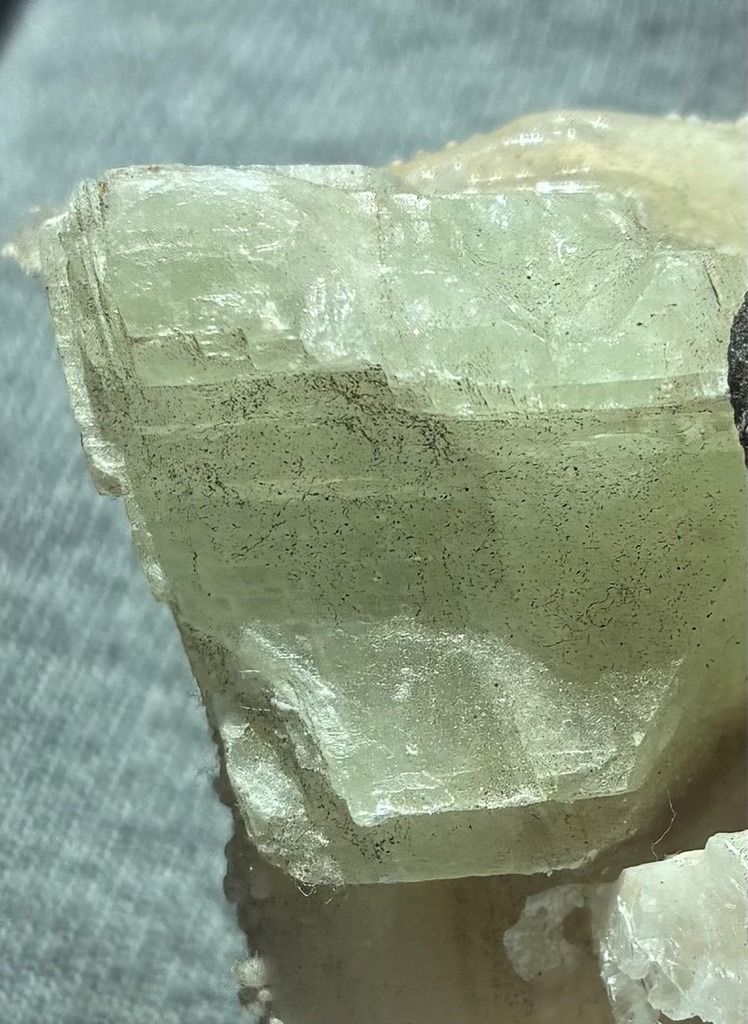
Not a diamond; this image depicts a rough mineral crystal specimen, likely apophyllite or prehnite on matrix, lacking gemological characteristics of a faceted diamond.
Not a diamond; this image depicts a rough mineral crystal specimen, likely apophyllite or prehnite on matrix, lacking gemological characteristics of a faceted diamond. · Rough crystal form (uncut, raw mineral specimen with natural tabular or prismatic habits)
Not applicable (uncut raw crystal matrix) Cut
Carat
Not applicable (specimen is measured in grams/carats as rough mineral, visually substantial but un-gem-grade)
Color
Light pale green to translucent white (fancy color description for mineral specimen, not applicable to D-Z scale)
Clarity
Included / Included 3 (substantial internal fractures, cleavage planes, and mineral inclusions typical of raw matrix specimens)
Shape
Rough crystal form (uncut, raw mineral specimen with natural tabular or prismatic habits)
Overall Assessment
The uploaded image does not contain a diamond. It shows a natural, rough mineral crystal specimen on matrix, likely belonging to the silicate group (such as apophyllite or prehnite). It is of interest to mineral collectors rather than the gem diamond market.
Cut Quality
Not applicable (uncut raw crystal matrix)
Brilliance
Vitreous to pearly luster on cleavage planes, differing sharply from adamantine diamond brilliance
Fire
Low dispersion, characteristic of silicate minerals rather than high-dispersion diamond
Scintillation
Limited to flashes from natural crystal faces and cleavage planes
Proportions
Irregular natural crystal habit; depth and table percentages do not apply
Symmetry
Natural crystal symmetry (monoclinic or tetragonal crystal system characteristics)
Polish
Raw, unpolished natural crystal faces and cleavage planes
Fluorescence
Unknown / Not tested under UV light
Inclusions
Heavy internal fractures, veils, and trapped mineral particulate inclusions characteristic of pegmatite or hydrothermal vein minerals
Blemishes
Natural growth steps, surface etching, and rough edges on matrix
Origin
Natural mineral specimen, likely sourced from hydrothermal vein deposits (e.g., India, Brazil, or South Africa depending on exact mineral species)
Treatment Detection
No signs of artificial enhancement; appears to be completely natural as-mined mineral matrix
Estimated Value
Mineral specimen market value (dependent on aesthetics and locality), ranging from $20 to $150 USD for collector display
Certification Estimate
Gemological laboratories (like GIA or IGI) do not certify raw mineral matrix specimens; mineralogical identification requires XRD or Raman spectroscopy.
Investment Potential
Low investment liquidity; primarily valued as a decorative or educational mineral specimen for collectors
Similar Diamonds
None (this is not a diamond, comparable only to other collector mineral specimens such as zeolites or prehnite)
Setting Suggestions
Display as a raw mineral specimen on a custom acrylic stand rather than traditional jewelry setting
Care & Maintenance
Handle with care to avoid chipping soft cleavage planes; avoid harsh chemical cleaning, ultrasonic cleaners, and prolonged exposure to direct sunlight
Interesting Facts
The specimen exhibits classic stepped growth features and natural tabular crystallization common in hydrothermal silicate minerals.