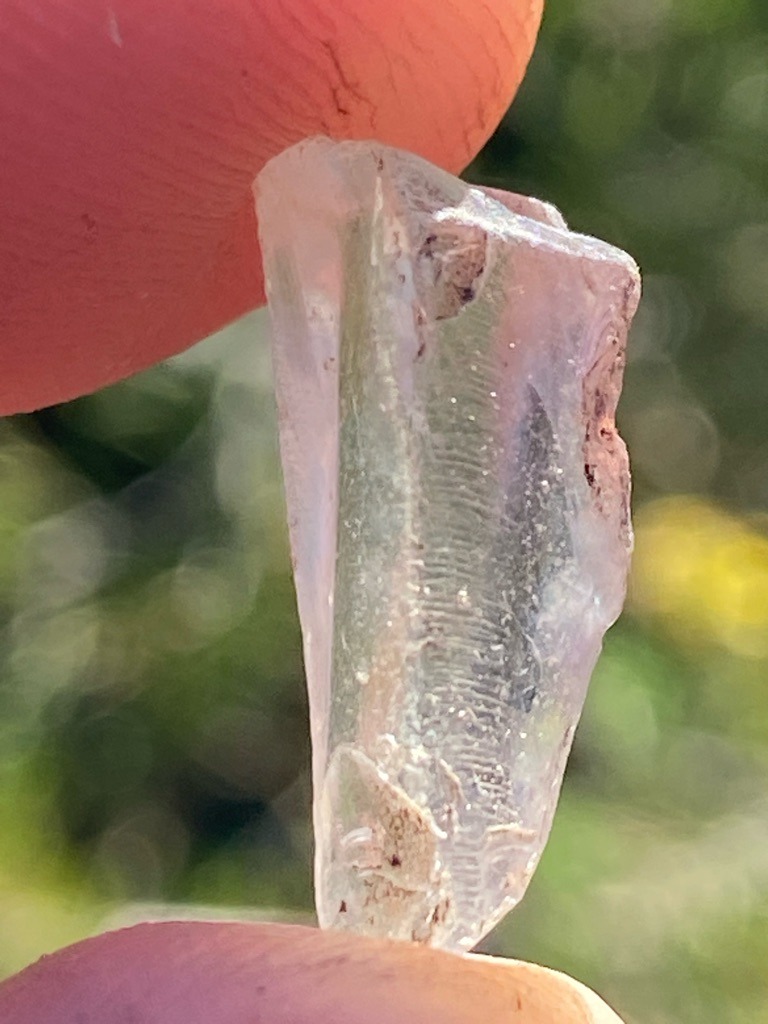
Not a diamond; this specimen appears to be an unpolished or raw crystal fragment of quartz, glass, or potentially a silicate mineral, exhibiting natural conchoidal or irregular rough surface features rather than diamond crystal faces.
Not a diamond; this specimen appears to be an unpolished or raw crystal fragment of quartz, glass, or potentially a silicate mineral, exhibiting natural conchoidal or irregular rough surface features rather than diamond crystal faces. · Raw, uncut, irregular elongated crystal fragment.
Not Applicable (Uncut / Raw Rough Specimen). Cut
Carat
Estimated at approximately 1.5 to 2.5 carats based on typical density and visual proportions for a rough quartz/mineral fragment of this size.
Color
Colorless with a very faint pinkish/purplish hue or surface reflection.
Clarity
Included / Imperfect (contains internal fracturing, striations, and surface matrix attachments).
Shape
Raw, uncut, irregular elongated crystal fragment.
Overall Assessment
An interesting raw mineral or quartz crystal fragment. It lacks the hardness, dispersion, and crystal habit of a true diamond and is best appreciated as a raw geological specimen rather than a gemstone.
Cut Quality
Not Applicable (Uncut / Raw Rough Specimen).
Brilliance
Low to moderate vitreous luster, constrained by lack of facet polish and internal fractures.
Fire
Minimal to none; typical of quartz or similar silicate minerals rather than diamond dispersion.
Scintillation
Poor, as the rough, unfaceted surfaces scatter light randomly instead of creating structured flash patterns.
Proportions
Irregular elongated geometry; standard table, depth, crown, and pavilion angles do not apply.
Symmetry
Asymmetrical due to natural, unformed, or fractured rough crystal growth.
Polish
Raw and unpolished; exhibits natural fracture patterns, striations, and rough surface textures.
Fluorescence
Indeterminate without UV testing, likely inert.
Inclusions
Heavy internal fracturing, feather-like stress cracks, and internal striations visible throughout the body.
Blemishes
Rough surface pitting, minor chips, adhering matrix material, and uneven texture.
Origin
Natural terrestrial mineral specimen, likely surface-collected or found in alluvial deposits.
Treatment Detection
No obvious signs of artificial treatments; appears completely natural.
Estimated Value
Minimal monetary value as a gem or jewelry stone; primarily of interest as a mineral specimen or educational piece (estimated under $10).
Certification Estimate
Not eligible for standard diamond grading laboratories (GIA, AGS, IGI). Requires testing by a gemological institute (like GIA or GRS) for precise mineral identification.
Investment Potential
None; this specimen holds no financial investment or resale value as a gemstone.
Similar Diamonds
None, as this specimen is not a diamond.
Setting Suggestions
Not recommended for fine jewelry due to lack of durability and unpolished state; if used, wire-wrapping in sterling silver or copper for a rustic, organic look.
Care & Maintenance
Handle gently to prevent further chipping along existing internal fractures; clean with mild soapy water and a soft brush.
Interesting Facts
Raw mineral fragments are frequently mistaken for rough diamonds by untrained observers due to their clarity and glassy luster, though true diamonds typically exhibit octahedral or dodecahedral crystal habits.