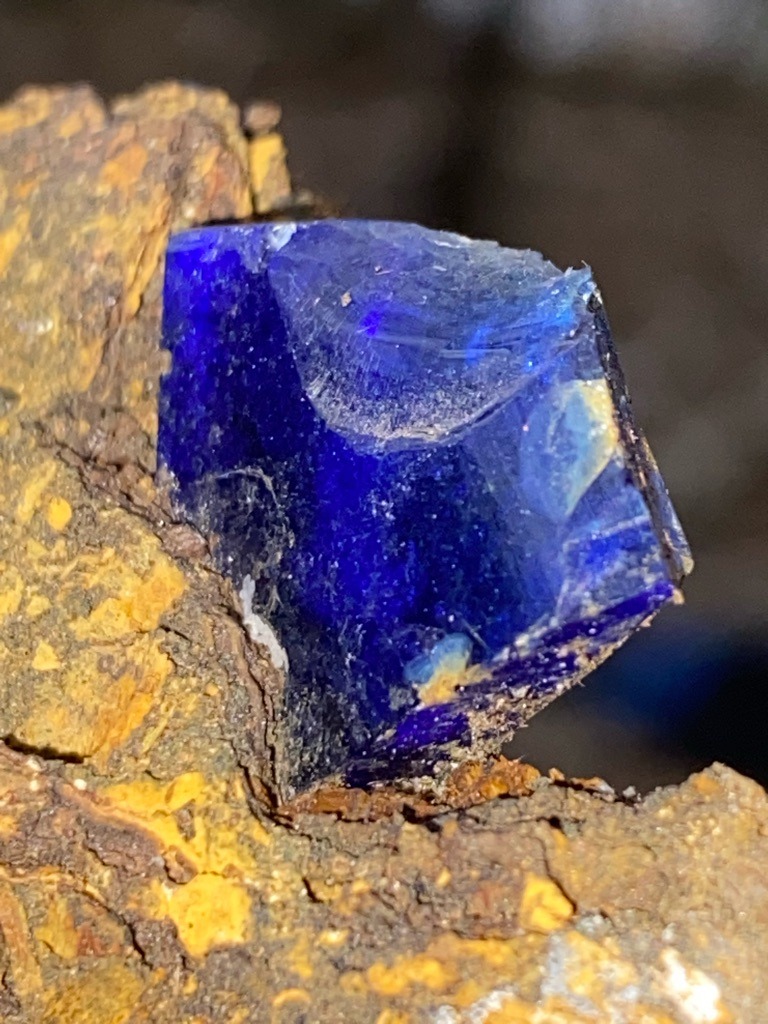
The specimen in the image is not a diamond; it appears to be a natural mineral specimen, likely Linarite or Azurite embedded in a limonite/ironstone matrix. If it were a diamond, it would be classified as a 'Fancy Deep Blue' natural diamond, though the crystal structure shown (monoclinic or orthorhombic appearance) is inconsistent with diamond's cubic system.
The specimen in the image is not a diamond; it appears to be a natural mineral specimen, likely Linarite or Azurite embedded in a limonite/ironstone matrix. If it were a diamond, it would be classified as a 'Fancy Deep Blue' natural diamond, though the crystal structure shown (monoclinic or orthorhombic appearance) is inconsistent with diamond's cubic system. · Rough / Uncut crystal (subhedral to euhedral crystal form).
Not applicable (Uncut specimen). Cut
Carat
Estimated at 5.0 to 10.0 carats based on typical matrix specimen sizes.
Color
Fancy Vivid to Fancy Deep Blue (highly saturated electric blue).
Clarity
I1-I3 (Included/Opaque) - The specimen shows significant internal fractures, veining, and surface reaching inclusions.
Shape
Rough / Uncut crystal (subhedral to euhedral crystal form).
Overall Assessment
This is a beautiful mineralogical specimen but is not a diamond. Its crystal habit, color saturation, and host rock (matrix) are characteristic of secondary copper minerals rather than carbon-based gemstones.
Cut Quality
Not applicable (Uncut specimen).
Brilliance
Low; the specimen is mostly translucent to opaque with vitreous surface luster.
Fire
Low to None; minimal light dispersion due to high absorption and lack of facets.
Scintillation
Low; limited to reflections from natural crystal faces.
Proportions
Not applicable for a rough mineral specimen.
Symmetry
Poor (asymmetric natural crystal growth).
Polish
None (Natural matte and vitreous luster surface).
Fluorescence
None typically expected for a mineral of this saturation and copper-based chemistry.
Inclusions
Heavy internal fracturing, color zoning, and matrix attachments.
Blemishes
Natural etching, bruising on crystal faces, and iron oxide staining.
Origin
Likely Arizona (USA), Tsumeb (Namibia), or Morocco (common localities for Linarite/Azurite).
Treatment Detection
None visible; appears to be an untreated natural mineral specimen in original matrix.
Estimated Value
$50 - $300 as a mineral specimen; if it were a natural blue diamond of this size, it would be worth millions, which confirms this is a different mineral.
Certification Estimate
GIA (Colored Stone Report) or specialized mineralogical lab (e.g., SSEF) to identify mineral species.
Investment Potential
Low (as a collector mineral); zero as a gemstone for jewelry.
Similar Diamonds
None typically. It most resembles high-saturation Azurite or Linarite.
Setting Suggestions
Collection display specimen; not suitable for jewelry due to low hardness (vulnerable to scratching/breakage).
Care & Maintenance
Keep away from acids and high heat; handle with care as these minerals are often soft (3.5-4 on Mohs scale) compared to diamond (10).
Interesting Facts
The vibrant blue is likely caused by copper content within the mineral structure rather than boron (which colors blue diamonds).