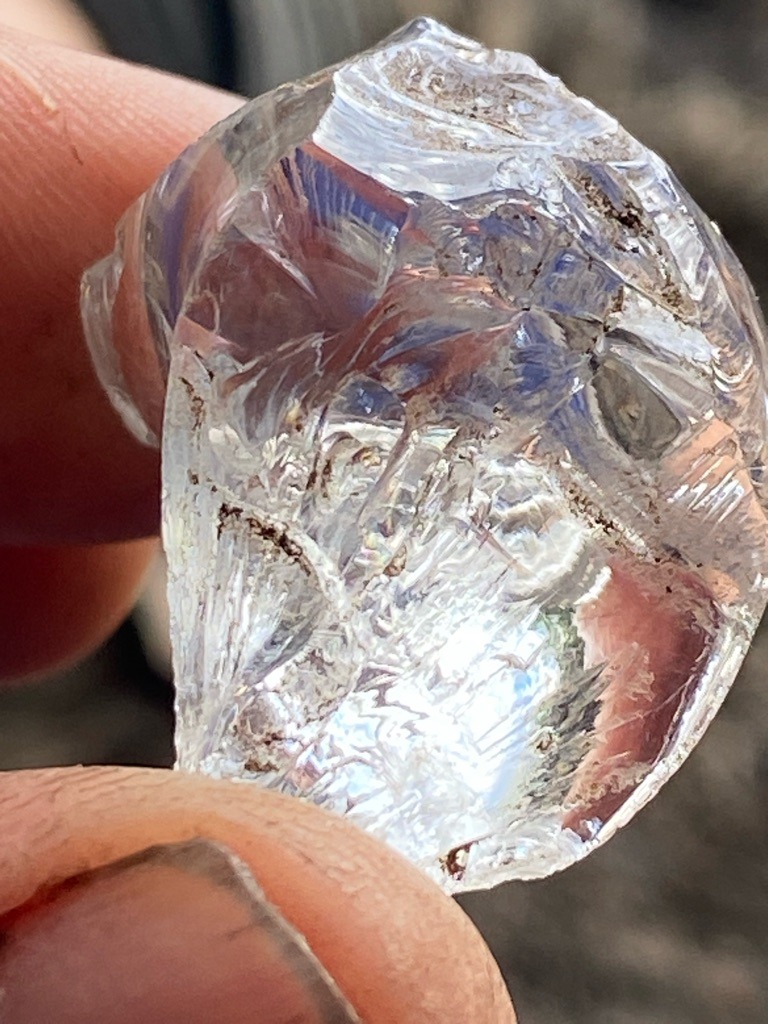
Not a diamond; visual characteristics strongly suggest raw quartz, glass, or a synthetic simulacrum (such as quartz or glass slag), characterized by conchoidal fracture patterns rather than crystalline diamond octahedron/dodecahedron faces.
Not a diamond; visual characteristics strongly suggest raw quartz, glass, or a synthetic simulacrum (such as quartz or glass slag), characterized by conchoidal fracture patterns rather than crystalline diamond octahedron/dodecahedron faces. · Rough, uncut, irregular natural crystal or tumbled chunk, non-standard shape.
Uncut / Raw (Not applicable for faceted gemstones). Cut
Carat
Estimated around 15-25 carats based on size relative to human fingers.
Color
Colorless / Near Colorless (equivalent to J-K range if graded as gemstone material, though material is non-diamond).
Clarity
Included (Contains visible fractures, internal inclusions, and surface dirt trapped in crevices).
Shape
Rough, uncut, irregular natural crystal or tumbled chunk, non-standard shape.
Overall Assessment
The specimen shown in the image is definitively not a diamond. It displays the conchoidal fracture and surface texture typical of quartz or glass rather than the octahedral cleavage and adamantine luster characteristic of rough diamond crystals. Professional gemological testing (such as a thermal conductivity or refractive index test) is strongly advised to confirm the exact mineral species.
Cut Quality
Uncut / Raw (Not applicable for faceted gemstones).
Brilliance
Low to moderate, limited by lack of precision faceting and internal fracturing.
Fire
Minimal dispersion/fire due to material composition and lack of optical cut angles.
Scintillation
Poor, lacking standard facet reflections and light return patterns.
Proportions
Non-standard; raw unpolished mineral specimen with no table, depth, crown, or pavilion measurements.
Symmetry
Asymmetrical due to raw, unshaped, natural or fractured state.
Polish
Unpolished, rough surface with natural crystal texture and conchoidal fracture ripples.
Fluorescence
Cannot be definitively determined without UV testing; likely None or Faint.
Inclusions
Heavy internal fracturing, feather-like fissures, and entrapped mineral/dirt debris.
Blemishes
Natural rough surface pitting, chips, and adhering matrix material.
Origin
Natural mineral specimen (likely quartz or pegmatite pocket find) or potentially man-made glass slag.
Treatment Detection
No obvious enhancements or treatments detected; Appears in its raw, untreated state.
Estimated Value
Nominal value as a mineral specimen or decorative rock (under $50 USD), zero value as a gemstone.
Certification Estimate
Not eligible for GIA/AGS diamond grading reports; would require identification report from a gemological institute (e.g., GIA Identification Report confirming mineral species).
Investment Potential
None; holds no investment value as a gemstone or precious asset.
Similar Diamonds
None, as this specimen is not a diamond.
Setting Suggestions
Not recommended for fine jewelry settings due to softness (if quartz) or fragility, but could be wire-wrapped as an organic raw mineral pendant.
Care & Maintenance
Standard mineral care; clean with mild soapy water and a soft brush, avoid harsh acids or thermal shock.
Interesting Facts
Many untrained individuals mistake raw quartz crystals or glass slag found in nature for rough diamonds due to their vitreous luster and transparency.