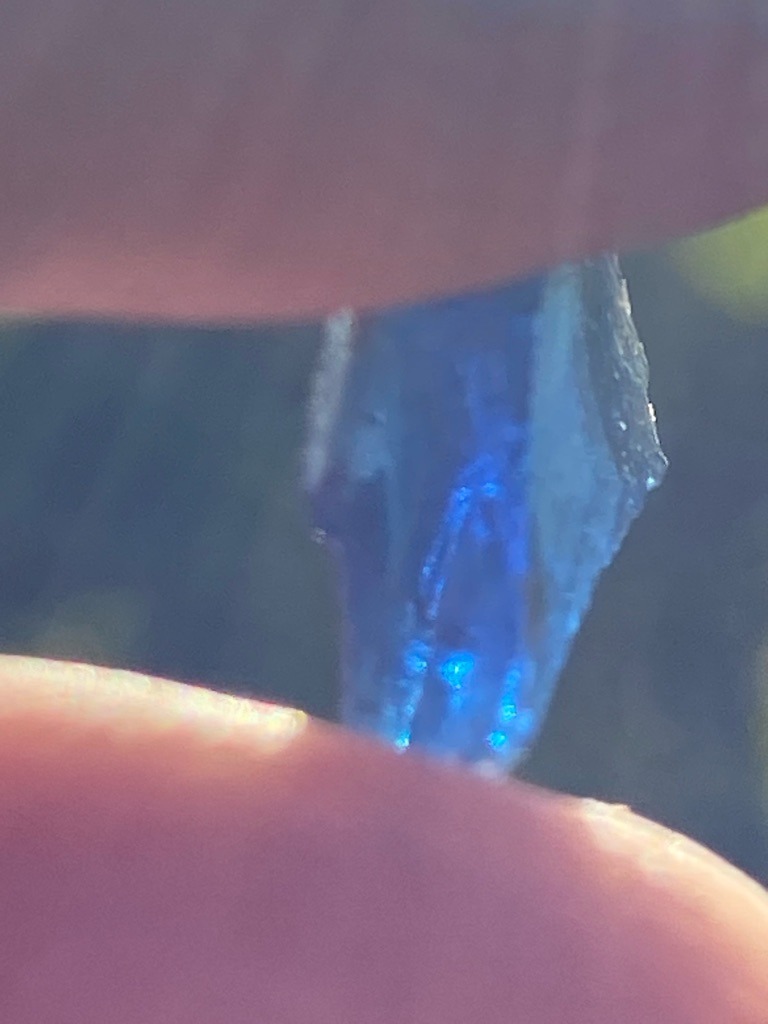
Natural Rough Diamond (or heavily irradiated/coated simulant)
Natural Rough Diamond (or heavily irradiated/coated simulant) · Rough crystal octahedral / irregular elongated
Not Applicable (Rough un-cut crystal) Cut
Carat
Estimated 0.50 to 1.00 carats
Color
Fancy Deep Blue (likely artificial coloration or surface treatment based on strong localized fluorescence/luminescence)
Clarity
Included (I1-I2)
Shape
Rough crystal octahedral / irregular elongated
Overall Assessment
An intriguing raw diamond crystal displaying an unusual vivid blue luminescence under light, though professional gemological testing is required to verify natural versus treated coloration.
Cut Quality
Not Applicable (Rough un-cut crystal)
Brilliance
Low due to rough surface and opacity
Fire
Minimal visible fire in current rough state
Scintillation
Poor, restricted to surface light reflections
Proportions
Natural rough form, unoptimized
Symmetry
Natural crystal symmetry (distorted octahedron)
Polish
Unpolished natural crystal faces
Fluorescence
Strong Blue
Inclusions
Cloudy internal structures, feather fractures
Blemishes
Natural surface trigons and pitting
Origin
Natural alluvial or primary pipe deposit with possible post-recovery treatment
Treatment Detection
Potential surface coating, irradiation, or HPHT color enhancement indicated by the vivid, localized blue patches
Estimated Value
$50 - $200 (highly dependent on whether the blue color is natural Type IIb or treated)
Certification Estimate
GIA or IGI (would likely require advanced spectroscopic testing to confirm blue coloration origin)
Investment Potential
Low as an investment; primarily of mineralogical or novelty interest
Similar Diamonds
Other low-gem-quality or industrial-grade rough blue diamonds
Setting Suggestions
Wire-wrapped pendant or rustic bezel setting to preserve the raw, organic crystal aesthetic
Care & Maintenance
Avoid harsh chemicals, ultrasonic cleaners, and protect from impacts that could fracture the rough crystal along cleavage planes
Interesting Facts
Natural blue diamonds get their color from trace amounts of boron trapped in the carbon crystal lattice during formation