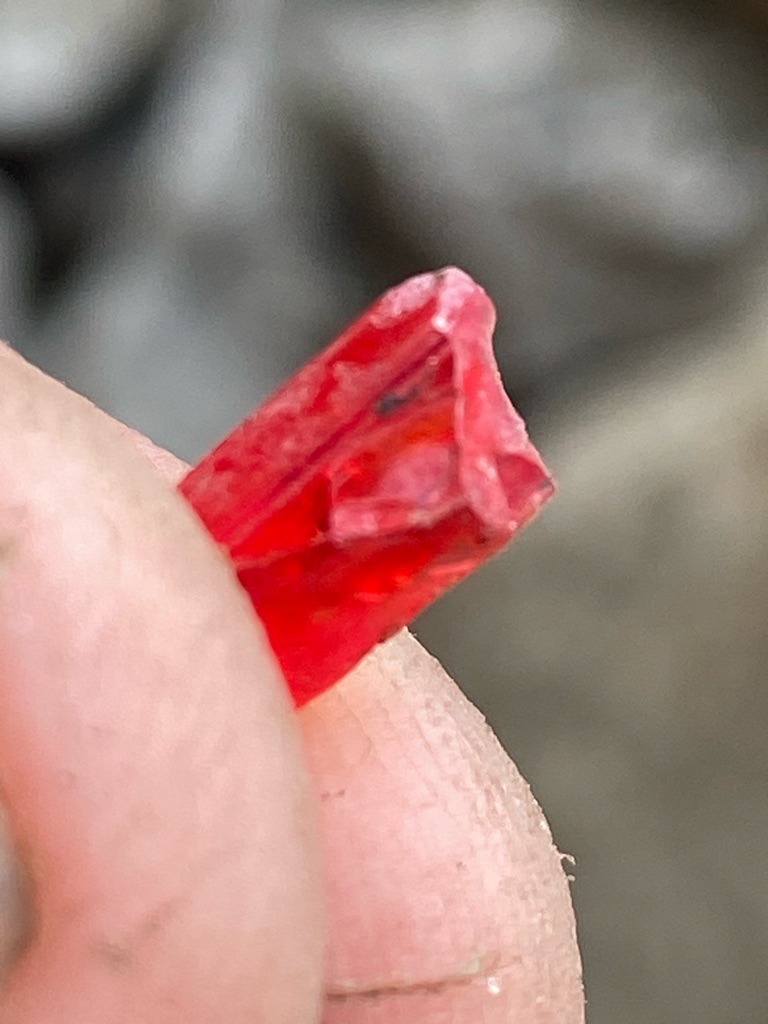
Not a diamond (appears to be a colored crystal, possibly ruby, tourmaline, or colored glass/resin given the rough, elongated prismatic crystal habit and vibrant red coloration)
Not a diamond (appears to be a colored crystal, possibly ruby, tourmaline, or colored glass/resin given the rough, elongated prismatic crystal habit and vibrant red coloration) · Rough / Raw crystal form
Uncut / Raw (Not applicable for faceted diamonds) Cut
Carat
Estimated 1.5 - 2.5 carats based on visual dimensions
Color
Vibrant Red (Fancy Intense to Vivid Red if gemstone quality)
Clarity
Included / Imperfect (visible internal fractures and cloudiness)
Shape
Rough / Raw crystal form
Overall Assessment
The specimen displayed in the image is not a diamond. It is a raw, red-colored crystal fragment with visible internal fractures and irregular shape. Professional gemological testing (such as refractometry and spectroscopy) is necessary to determine the exact mineral species.
Cut Quality
Uncut / Raw (Not applicable for faceted diamonds)
Brilliance
Low due to lack of standard facet angles and rough surface
Fire
Low to moderate dispersion depending on refractive index
Scintillation
Minimal to none due to lack of standard faceting
Proportions
Irregular elongated rough crystal habit
Symmetry
Natural crystal symmetry (prismatic elongation)
Polish
Raw, unpolished surface with natural crystal faces and fracture terminations
Fluorescence
Unknown / Untested visually
Inclusions
Internal feather fractures and potential mineral inclusions visible
Blemishes
Surface abrasions, natural growth lines, and rough fracture terminations
Origin
Natural rough mineral specimen
Treatment Detection
Visual inspection suggests raw natural state, but advanced lab testing (FTIR, Raman spectroscopy) is required to rule out fracture filling or synthetic origin
Estimated Value
Nominal value as a mineral specimen ($10 - $50 USD depending on exact mineral composition)
Certification Estimate
GIA or GRS (if evaluated as a colored gemstone rather than a diamond)
Investment Potential
Low, purely decorative or for mineral collectors
Similar Diamonds
None (this specimen does not share diamond properties)
Setting Suggestions
Wire-wrapped pendant or rustic prong setting to showcase its raw crystal form
Care & Maintenance
Avoid harsh chemicals, ultrasonic cleaners, and sudden temperature changes as raw crystals can easily fracture along cleavage planes
Interesting Facts
Natural red rough crystals are often mistaken for rubies or red diamonds, but red diamonds are among the rarest colored diamonds in the world, usually possessing a different crystal system than the specimen shown.