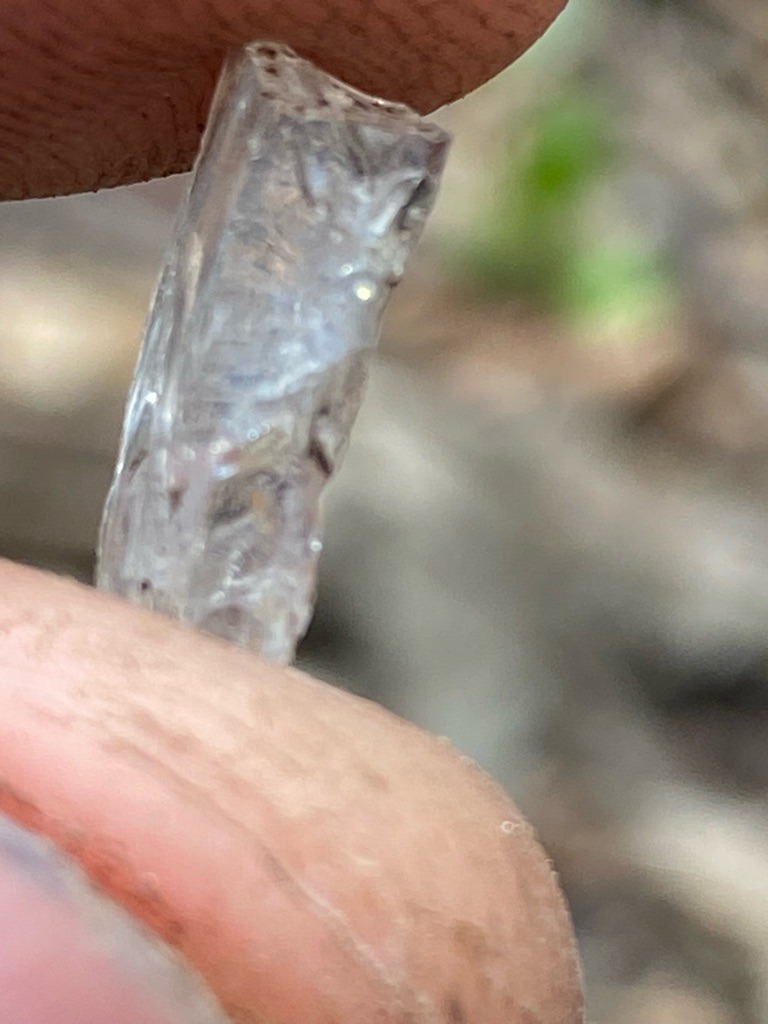
Natural Rough Crystal (Likely Quartz or Topaz, limited visual evidence of Diamond)
Natural Rough Crystal (Likely Quartz or Topaz, limited visual evidence of Diamond) · Rough/Uncut
Not Applicable (Uncut Rough) Cut
Carat
Estimated 1.5 to 3.0 carats based on size relative to fingertip
Color
Near-colorless to Faint Gray/Lavender
Clarity
Slightly Included (SI) to Included (I1) based on visible fractures
Shape
Rough/Uncut
Overall Assessment
The specimen lacks the adamantine luster and octahedral habit typical of high-quality rough diamonds. It appears to be a naturally occurring silicate crystal.
Cut Quality
Not Applicable (Uncut Rough)
Brilliance
Low (Surface reflection only; no internal light return due to lack of facets)
Fire
None (Requires facets for dispersion)
Scintillation
Low (Limited to surface highlights)
Proportions
Characteristic of an elongated monoclinic or orthorhombic crystal habit rather than octahedral diamond habit
Symmetry
Poor (Natural asymmetric growth)
Polish
Natural (Unaltered surface)
Fluorescence
Cannot be determined from image
Inclusions
Internal cleavage planes, feathers, and potential fluid inclusions
Blemishes
Surface pitting and conchoidal fracture marks
Origin
Likely alluvial or secondary deposit based on rounded edges
Treatment Detection
None apparent; looks to be in a raw state
Estimated Value
$10 - $50 (if quartz/topaz); $200 - $800 (if diamond rough)
Certification Estimate
GIA Rough Diamond Report (if confirmed diamond)
Investment Potential
Low; high risk without laboratory confirmation of mineral species
Similar Diamonds
Uncut alluvial macles or industrials
Setting Suggestions
Rough diamond specimen setting or custom bezel wrap
Care & Maintenance
Ultrasonic cleaning is discouraged due to visible internal fractures
Interesting Facts
The elongated shape is more characteristic of minerals like Topaz or Quartz; most diamonds form as octahedrons