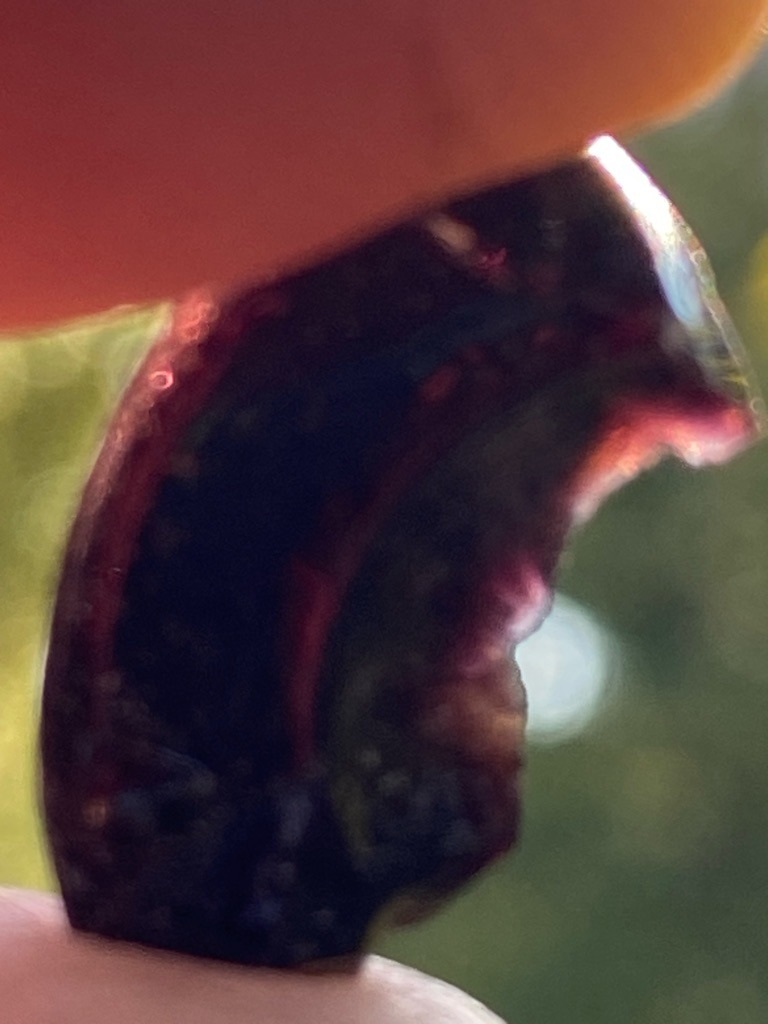
Not a diamond; this specimen appears to be an irregular or fractured dark gemstone/crystal material, possibly garnet, tourmaline, or a synthetic resin/glass fragment rather than a true crystalline diamond.
Not a diamond; this specimen appears to be an irregular or fractured dark gemstone/crystal material, possibly garnet, tourmaline, or a synthetic resin/glass fragment rather than a true crystalline diamond. · Irregular rough fragment / Freeform raw piece
Not Applicable (Uncut, raw, or fractured rough specimen) Cut
Carat
Estimated 1.50 - 2.50 carats (based purely on visual bulk scale, though material identity is unconfirmed)
Color
Dark Reddish-Black / Deep Burgundy to Opaque Dark Tones
Clarity
I3 (Included / Heavily Opaque with multiple internal fractures and inclusions)
Shape
Irregular rough fragment / Freeform raw piece
Overall Assessment
The specimen displayed in the image is not a diamond. It appears to be an irregular, dark, fractured rough gemstone or mineral fragment lacking the optical properties, crystal habit, and standardization of a cut diamond.
Cut Quality
Not Applicable (Uncut, raw, or fractured rough specimen)
Brilliance
Very Low to None due to deep coloration, opacity, and lack of standard faceting
Fire
None visible due to opaque and dark material body
Scintillation
Negligible to None
Proportions
Not Applicable for uncut or irregularly fractured raw stones
Symmetry
Poor / Asymmetrical due to irregular natural or fractured shape
Polish
Rough/Unpolished surface texture with possible fracture planes
Fluorescence
Cannot be reliably determined without UV testing, likely Inert
Inclusions
Heavy internal clouding, deep structural fractures, and opaque matrix spots
Blemishes
Surface chips, rough edges, and uneven natural or fractured contours
Origin
Uncertain; potentially alluvial or matrix-hosted depending on exact mineral species
Treatment Detection
Visual inspection shows natural or raw fracture characteristics; no obvious modern enhancements detected without microscopic analysis
Estimated Value
Minimal monetary value as a gem-grade stone ($10 - $50 depending on exact mineral composition)
Certification Estimate
Standard gemological labs (GIA, IGI) would likely issue a gemstone identification report rather than a diamond grading report, likely identifying it as a non-diamond mineral or organic/synthetic fragment.
Investment Potential
None; purely a mineral specimen or low-value collectable
Similar Diamonds
None, as this specimen does not exhibit diamond characteristics
Setting Suggestions
Wire-wrapping or custom bezel setting if used as an organic/raw mineral jewelry piece
Care & Maintenance
Store carefully away from harder gemstones to prevent chipping; clean gently with warm soapy water if mineral hardness permits
Interesting Facts
Raw and irregularly shaped mineral fragments are often mistaken for precious gemstones by casual observers before proper gemological testing.