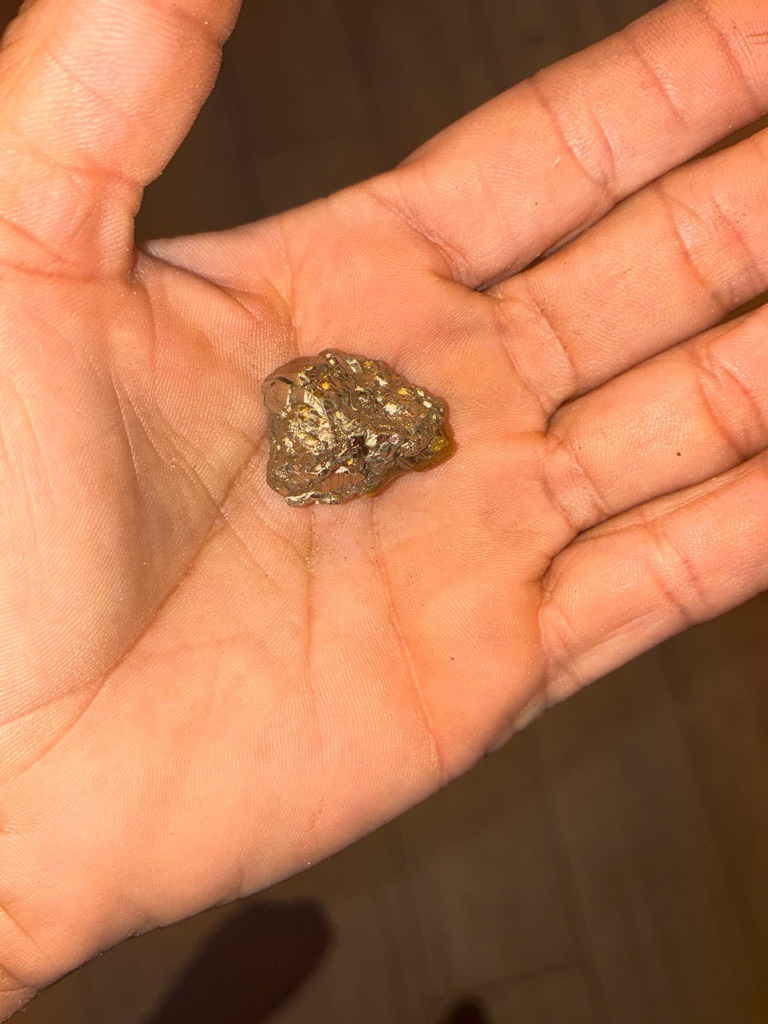
Not a diamond; this specimen is Pyrite (Fool's Gold), an iron sulfide mineral.
Not a diamond; this specimen is Pyrite (Fool's Gold), an iron sulfide mineral. · Raw, unpolished crystal aggregate (cubic crystal habit visible)
Not applicable (rough mineral specimen) Cut
Carat
Not applicable (measured in grams for mineral specimens; estimated 15-25 grams)
Color
Metallic brass-yellow with a bright brassy luster
Clarity
Not applicable (opaque mineral aggregate)
Shape
Raw, unpolished crystal aggregate (cubic crystal habit visible)
Overall Assessment
The specimen is a classic, naturally formed cluster of pyrite crystals displaying characteristic brassy metallic luster and cubic crystal faces, commonly known as fool's gold.
Cut Quality
Not applicable (rough mineral specimen)
Brilliance
Metallic luster with strong reflective flash rather than gemstone brilliance
Fire
None (opaque mineral, lacks the spectral dispersion of transparent gemstones)
Scintillation
Flashes of metallic reflection from crystal faces when moved
Proportions
Irregular crystalline mass, not faceted
Symmetry
Natural crystalline symmetry showing cubic and pyritohedral forms
Polish
Raw and unpolished natural surface with metallic reflection
Fluorescence
Inert (does not fluoresce under standard UV light)
Inclusions
Naturally occurring intergrown mineral matrices and minor quartz/limonite traces
Blemishes
Natural surface tarnish, oxidation, and striations characteristic of pyrite cubes
Origin
Global distribution; commonly found in hydrothermal veins, sedimentary rocks, and coal deposits worldwide.
Treatment Detection
None (completely natural raw mineral specimen)
Estimated Value
Low commercial value ($10 - $30 USD depending on specimen quality and locality)
Certification Estimate
Gemological laboratories do not issue diamond certificates for pyrite; identified via standard mineralogical testing.
Investment Potential
Low (primarily collected as a decorative mineral or educational specimen rather than an investment asset)
Similar Diamonds
None (visually resembles gold to untrained observers, hence 'Fool's Gold', but completely distinct from diamond)
Setting Suggestions
Wire-wrapped in sterling silver or copper for artisan jewelry, or displayed raw in mineral collections
Care & Maintenance
Keep dry and away from moisture; pyrite can oxidize and degrade ('pyrite disease') in humid environments.
Interesting Facts
Pyrite gets its name from the Greek word 'pyr', meaning fire, because it strikes sparks against steel.