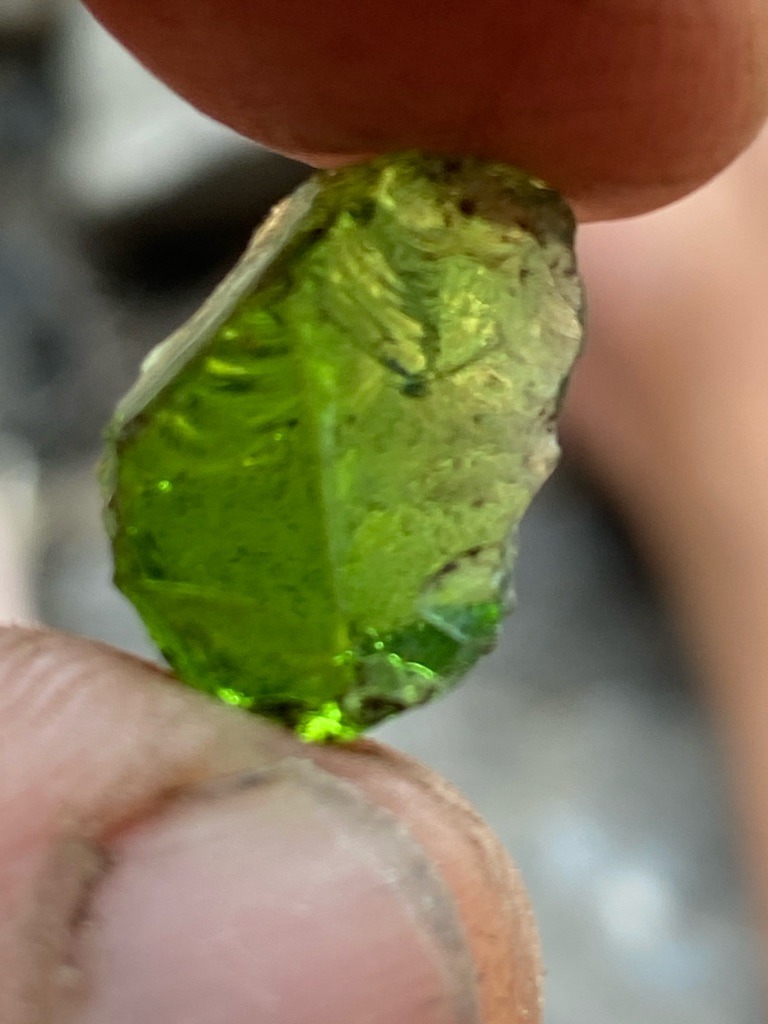
Not a diamond; this is a rough green gemstone, likely Peridot or rough green glass/slag, given the characteristic olive-green color and conchoidal fracture pattern.
Not a diamond; this is a rough green gemstone, likely Peridot or rough green glass/slag, given the characteristic olive-green color and conchoidal fracture pattern. · Rough / Uncut, irregular rounded crystal fragment
Not Applicable (Uncut rough specimen) Cut
Carat
Estimated 3.50 to 5.00 carats based on visual proportions relative to human fingers.
Color
Natural Fancy Vivid Olive-Green
Clarity
Included (SI2 to I1 equivalent due to visible internal fractures and surface fissures)
Shape
Rough / Uncut, irregular rounded crystal fragment
Overall Assessment
The specimen presented is not a diamond, but rather a rough green gemstone—most consistent with peridot (olivine) or a similar glassy mineral. It exhibits natural fracture patterns and a vibrant olive-green hue, making it an interesting mineral specimen rather than a commercially valuable diamond.
Cut Quality
Not Applicable (Uncut rough specimen)
Brilliance
Low to moderate due to rough unpolished surfaces
Fire
Low dispersion typical of raw peridot or similar silicate minerals
Scintillation
Poor due to lack of faceted surfaces
Proportions
Irregular raw crystal proportions with no standard pavilion or crown angles
Symmetry
Asymmetrical natural crystal form
Polish
Unpolished, natural rough surface textures and conchoidal fracture ripples
Fluorescence
Inert to faint
Inclusions
Internal fracture planes, stress cracks, and minor mineral inclusions visible
Blemishes
Surface pitting, natural etching, and rough edges
Origin
Likely alluvial deposit origin, common for rough peridot or similar green minerals found in volcanic regions.
Treatment Detection
No signs of enhancement or artificial treatment observed; appears completely natural.
Estimated Value
Low commercial value in rough specimen form, approximately $20 to $100 depending on exact mineral composition and purity.
Certification Estimate
Gemological laboratories such as GIA or IGI would issue an identification report rather than a standard diamond grading report, confirming it as Peridot (Olivine).
Investment Potential
Very low; collector specimens of rough peridot typically appreciate slowly and are valued more for mineralogical study than financial investment.
Similar Diamonds
None, as green diamonds of this shade are extremely rare (usually irradiated or colored by natural radiation, whereas this is clearly a non-diamond silicate mineral).
Setting Suggestions
Wire-wrapped pendant setting or custom organic bezel setting to preserve the raw, natural aesthetic if polished or stabilized.
Care & Maintenance
Store separately from harder gemstones to prevent scratching; avoid ultrasonic cleaners and harsh chemicals due to susceptibility to acids and thermal shock.
Interesting Facts
Peridot, the likely material shown, is one of the few gemstones that occurs in only one color (olive green) and can sometimes be found in meteorites (pallasites).