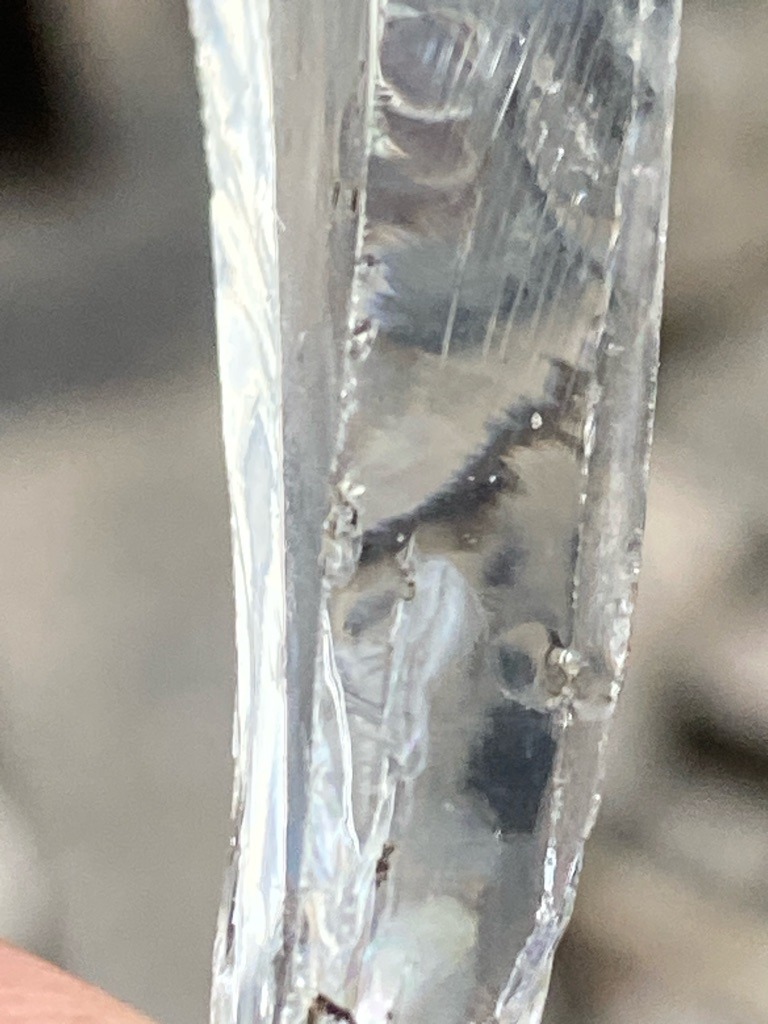
Not a diamond; this appears to be a natural icicle or transparent crystal formation containing trapped air bubbles and impurities.
Not a diamond; this appears to be a natural icicle or transparent crystal formation containing trapped air bubbles and impurities. · Irregular columnar / natural elongated growth form
Not applicable (natural formation, unpolished raw material) Cut
Carat
Not applicable (icicle / non-gemstone material)
Color
Colorless (translucent to transparent with dark internal particulate inclusions)
Clarity
Included heavily with internal gas bubbles, fractures, and particulate matter
Shape
Irregular columnar / natural elongated growth form
Overall Assessment
The specimen shown is a natural icicle rather than a diamond or gemstone. While displaying interesting internal fracture and bubble patterns that mimic mineral inclusions, its ephemeral nature and composition of frozen water mean it holds no gemological or monetary value.
Cut Quality
Not applicable (natural formation, unpolished raw material)
Brilliance
Low to moderate vitreous luster along un-melted fracture planes
Fire
Negligible dispersion due to lack of optical facets
Scintillation
Poor, highly dependent on ambient light striking natural facets and fractures
Proportions
Elongated irregular crystal structure with varying thickness
Symmetry
Natural asymmetric growth
Polish
Raw natural surface texture
Fluorescence
Unknown / Not tested
Inclusions
Prominent dark particulate clouds, internal fractures, and micro-air bubbles visible throughout the matrix
Blemishes
Surface irregularities, melting artifacts, and natural etching marks
Origin
Naturally occurring atmospheric or ground-water frozen water ice
Treatment Detection
None applied; purely natural environmental phenomenon
Estimated Value
Zero commercial value as a gemstone
Certification Estimate
Not eligible for standard diamond grading laboratories (GIA, AGS, IGI)
Investment Potential
None as an investment asset
Similar Diamonds
None, as this is water ice rather than crystalline carbon
Setting Suggestions
Not suitable for jewelry settings due to low melting point and fragility
Care & Maintenance
Keep below freezing temperatures to prevent melting and evaporation
Interesting Facts
Icicles form when water dripping from an object freezes progressively as more water drips onto it, often trapping air and creating fascinating internal structural patterns resembling mineral inclusions