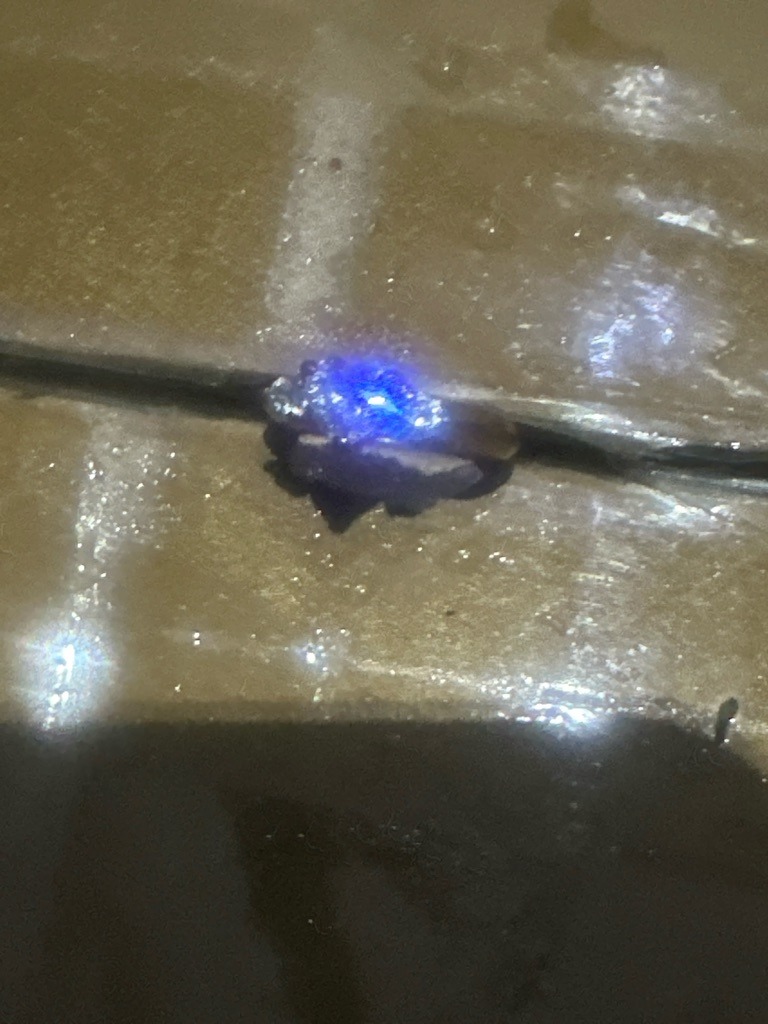
Unable to definitively determine diamond type from visual inspection under intense blue lighting; appears to be a mounted ring featuring a central stone with high refractive properties, potentially Moissanite or a treated/fluorescent diamond.
Unable to definitively determine diamond type from visual inspection under intense blue lighting; appears to be a mounted ring featuring a central stone with high refractive properties, potentially Moissanite or a treated/fluorescent diamond. · Round Brilliant (estimated from typical mounting styles, though exact faceting is obscured by glare)
Not possible to grade accurately from this angle and lighting; appears to exhibit high reflectivity. Cut
Carat
Estimated between 0.50 to 1.00 carat based on standard ring proportions, though exact measurements are impossible without unmounting.
Color
Obscured by intense blue light emission (possible strong fluorescence or optical lighting effect); estimated near-colorless (G-J) if natural, but requires physical testing.
Clarity
Unable to assess due to image blur and strong glare from the light source.
Shape
Round Brilliant (estimated from typical mounting styles, though exact faceting is obscured by glare)
Overall Assessment
The image captures a ring under heavy glare and intense blue illumination, severely limiting gemological analysis. Physical inspection with specialized diamond testers, loupes, and spectrometers is strongly recommended for accurate evaluation.
Cut Quality
Not possible to grade accurately from this angle and lighting; appears to exhibit high reflectivity.
Brilliance
High brightness observed, heavily amplified by a direct light source or fluorescence.
Fire
Dispersive fire is largely masked by the dominant blue light emission.
Scintillation
Sparkle pattern is disrupted by camera overexposure and intense localized lighting.
Proportions
Standard standard round brilliant proportions assumed, but precise table, depth, and angles cannot be measured.
Symmetry
Not assessable due to photographic blur and glare.
Polish
Not assessable due to photographic constraints.
Fluorescence
Very Strong Blue (indicated by the intense blue luminescence emanating directly from the stone under lighting conditions).
Inclusions
Not visible at this resolution and lighting condition.
Blemishes
Not visible.
Origin
Unknown; requires advanced spectroscopy to determine natural vs. lab-grown origin.
Treatment Detection
Cannot be determined without microscopic and spectroscopic examination.
Estimated Value
Value highly variable pending gemological testing; ranges widely depending on whether the stone is natural, lab-grown, or an alternative simulant like moissanite.
Certification Estimate
Requires professional laboratory analysis (GIA, IGI) to determine authenticity and grading.
Investment Potential
Low to moderate for general jewelry pieces; diamond jewelry typically depreciates post-purchase unless exceptional quality.
Similar Diamonds
Standard round brilliant cut diamonds with strong blue fluorescence.
Setting Suggestions
Classic prong or solitaire setting in white gold or platinum to complement high-brilliance stones.
Care & Maintenance
Clean regularly with warm soapy water and a soft-bristled brush; avoid harsh chemicals and store separately to prevent scratching.
Interesting Facts
Strong blue fluorescence occurs in approximately 25-35% of all diamonds when exposed to UV light, sometimes giving lower color grades a more face-up colorless appearance.