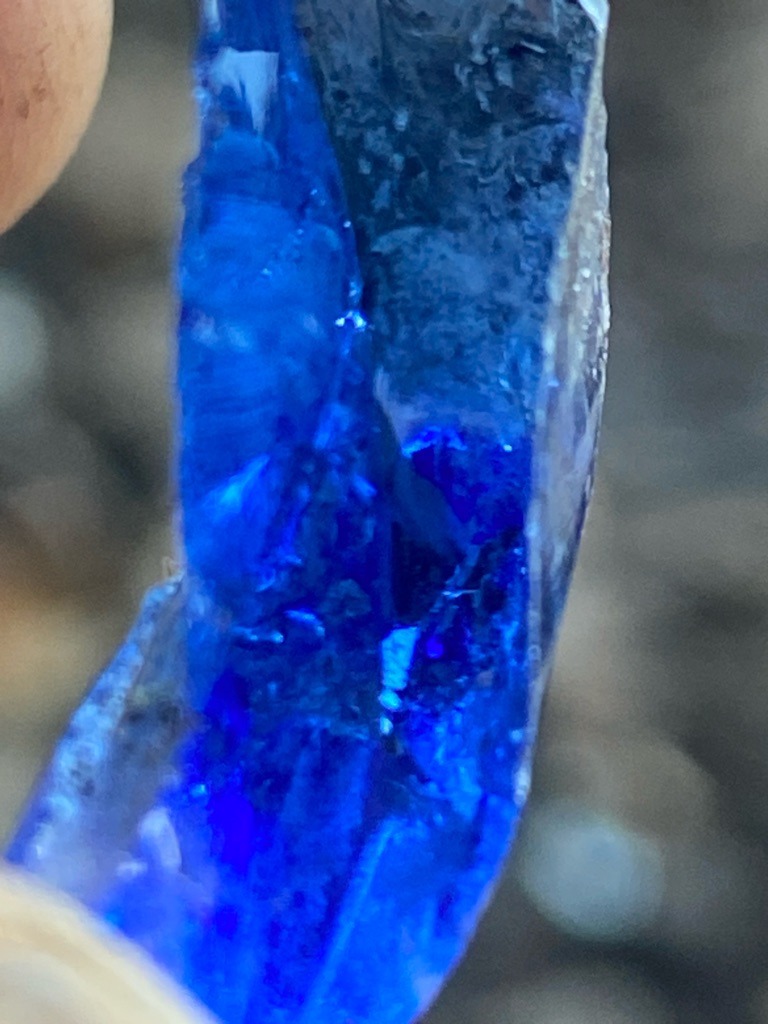
Not a diamond; this is a raw, unpolished, vibrant blue mineral specimen, likely synthetic glass or a low-grade corundum/spinel, but visually consistent with cobalt-doped glass or rough lapis/slag.
Not a diamond; this is a raw, unpolished, vibrant blue mineral specimen, likely synthetic glass or a low-grade corundum/spinel, but visually consistent with cobalt-doped glass or rough lapis/slag. · Uncut, raw, irregular rough crystal fragment with conchoidal fracture patterns.
Not applicable (Rough specimen, un faceted). Cut
Carat
Estimated 15-25 carats based on visual proportions.
Color
Vivid deep royal blue (Fancy Deep Blue equivalent if gemstone classification applied).
Clarity
I3 (Included) due to massive internal fractures, inclusions, and lack of transparency in zones.
Shape
Uncut, raw, irregular rough crystal fragment with conchoidal fracture patterns.
Overall Assessment
The specimen shown in the image is not a diamond. It is a vibrant blue, raw, irregularly fractured mineral or glass chunk characterized by high saturation, deep internal fissures, and an unpolished rough state.
Cut Quality
Not applicable (Rough specimen, un faceted).
Brilliance
Low to moderate vitreous luster restricted by internal opacity and fracturing.
Fire
Minimal to none, typical of strongly saturated colored raw minerals rather than dispersive diamond.
Scintillation
Poor, restricted to surface reflections on uneven fracture faces.
Proportions
Not applicable for rough stones (no standard table, depth, or pavilion angles).
Symmetry
Asymmetrical, completely natural or fractured rough form.
Polish
Raw, unpolished matrix with natural fracture surfaces.
Fluorescence
Cannot be definitively determined without UV testing, likely inert to moderate depending on material composition.
Inclusions
Heavy internal fracturing, internal stress cracks, cloudy cloud-like zones, and localized opaque spots.
Blemishes
Rough surface pitting, natural cleavage lines, and conchoidal break marks.
Origin
Unknown, likely synthetic or artisanal rough mineral collection.
Treatment Detection
Visual signs suggest raw state, potentially cobalt coating or flux-grown if synthetic, requires advanced spectroscopy (FTIR/Raman) for verification.
Estimated Value
Minimal nominal value ($10 - $50 USD) as a rough mineral specimen or decorative stone.
Certification Estimate
Not eligible for major diamond grading labs (GIA, AGS, IGI) as it is not a diamond; would require gemological laboratory testing (e.g., GIA Identification Report) to confirm species.
Investment Potential
None; decorative or specimen value only.
Similar Diamonds
None, as diamonds do not naturally occur in this vivid cobalt-blue rough crystal habit without intense laboratory treatment or irradiation.
Setting Suggestions
Wire-wrapped pendant setting or custom organic bezel setting if polished into a cabochon.
Care & Maintenance
Store separately to prevent scratching other stones; avoid harsh chemical cleaners and ultrasonic baths due to internal fractures.
Interesting Facts
Vivid blue rough stones are frequently mistaken for precious sapphires or blue diamonds, though true fancy deep blue natural diamonds are among the rarest gems on Earth.