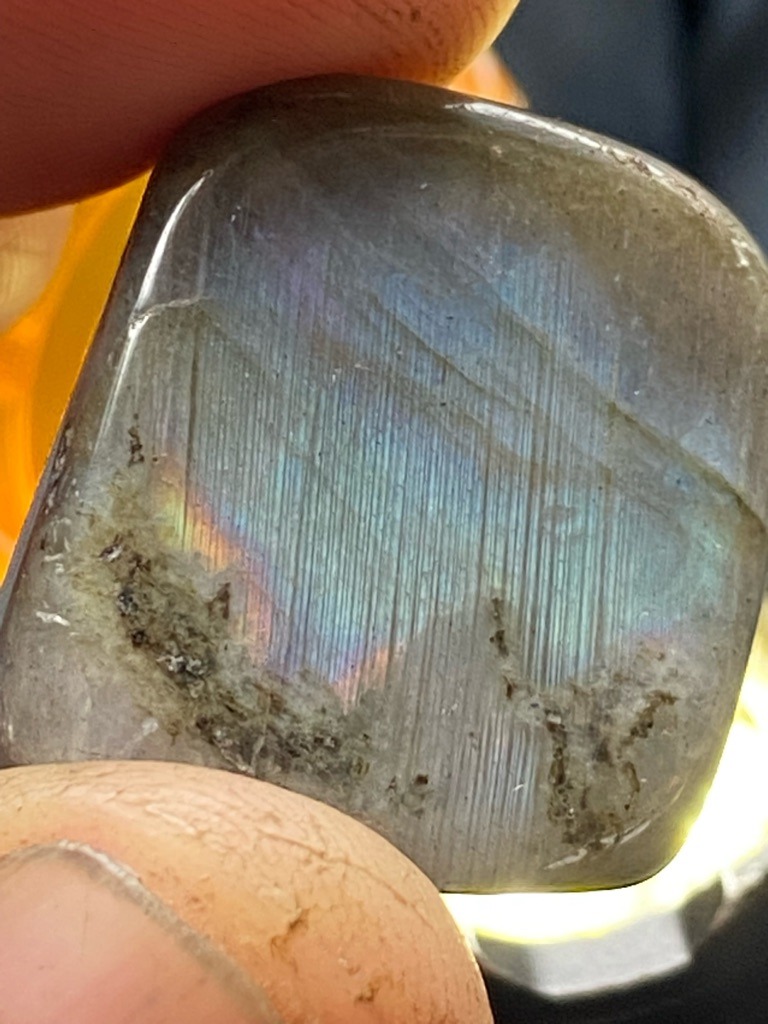
Not a diamond; this is Labradorite, a feldspar mineral exhibiting labradorescence.
Not a diamond; this is Labradorite, a feldspar mineral exhibiting labradorescence. · Irregular tumbled cushion shape
Not applicable; tumbled and polished cabochon-style stone, not a diamond cut. Cut
Carat
Not applicable as this is a gemstone mineral, not a faceted diamond.
Color
Not applicable; exhibits grey body color with multicolored iridescence (labradorescence).
Clarity
Included, displaying internal fractures, twinning planes, and mineral inclusions typical of feldspar.
Shape
Irregular tumbled cushion shape
Overall Assessment
This is a natural specimen of labradorite displaying characteristic labradorescence and twinning lines, completely distinct from any diamond.
Cut Quality
Not applicable; tumbled and polished cabochon-style stone, not a diamond cut.
Brilliance
Limited brilliance; features schiller effect (labradorescence) rather than standard diamond brilliance.
Fire
Displays spectral flashes of color (blue, green, yellow, orange) known as labradorescence, not traditional fire.
Scintillation
Dynamic play-of-color shifting across the surface as the angle of light changes.
Proportions
N/A for cabochon stones
Symmetry
Asymmetrical tumbled stone
Polish
Good overall polish with natural surface pitting and grain lines visible
Fluorescence
Not applicable
Inclusions
Strong polysynthetic twinning planes, natural fractures, and dark mineral inclusions.
Blemishes
Surface scratches, pitting, and natural cleavage lines.
Origin
Commonly found in Canada (Labrador), Madagascar, Finland, and Australia.
Treatment Detection
No treatments detected; natural untreated feldspar.
Estimated Value
Low commercial value ($10 to $50 depending on size and quality of the flash).
Certification Estimate
Not certified by standard diamond grading labs (GIA, AGS). Colored stone reports may be issued by institutions like GIA or GRS.
Investment Potential
None; considered a decorative and ornamental mineral rather than an investment-grade gemstone.
Similar Diamonds
None, as this is a feldspar mineral and not a diamond or diamond simulants.
Setting Suggestions
Best set in artisan bezel settings using sterling silver or yellow gold to complement the earthy tones.
Care & Maintenance
Avoid harsh chemicals, ultrasonic cleaners, and sudden temperature changes due to distinct cleavage planes.
Interesting Facts
Labradorite is famous for its optical phenomenon called labradorescence, caused by light diffraction in lamellar intergrowths.