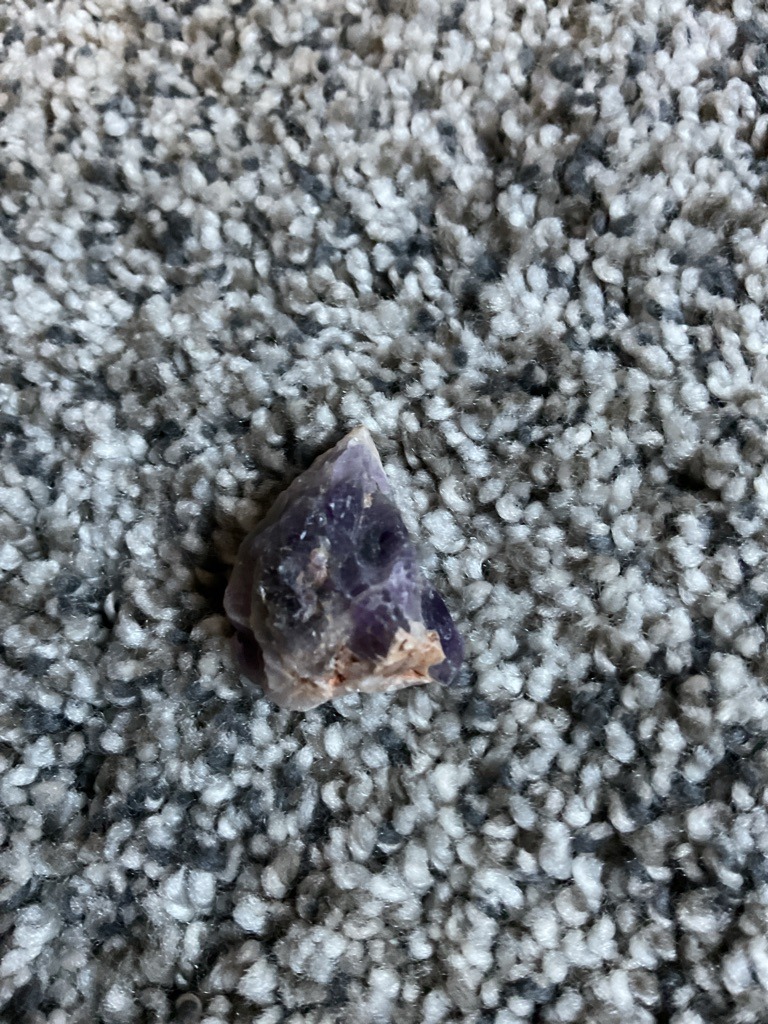
The specimen in the image is not a diamond; it appears to be a natural mineral, most likely Amethyst (quartz variety).
The specimen in the image is not a diamond; it appears to be a natural mineral, most likely Amethyst (quartz variety). · Rough / Raw crystalline form; no faceting or cut shape applied.
None; raw mineral specimen. Cut
Carat
Estimated at 3.0 - 5.0 carats based on size relative to carpet fibers.
Color
N/A for diamond scales. Displays a medium to dark purple hue consistent with Amethyst.
Clarity
Translucent to semi-opaque with significant internal fractures and cloudiness.
Shape
Rough / Raw crystalline form; no faceting or cut shape applied.
Overall Assessment
This is a small, rough piece of natural amethyst quartz rather than a diamond. It lacks the refractive index, hardness, and crystal habit of a diamond.
Cut Quality
None; raw mineral specimen.
Brilliance
Low; characteristic of unpolished quartz.
Fire
None visible in raw state.
Scintillation
Minimal dull reflections from cleavage planes.
Proportions
Irregular natural crystal structure.
Symmetry
N/A (Raw state).
Polish
N/A (Unpolished natural surface).
Fluorescence
Usually inert or weak under UV for this mineral type.
Inclusions
Heavy internal fracturing, color zoning, and possible hematite or goethite speckling.
Blemishes
Natural rough surface with matrix remnants (tan/white material at the base).
Origin
Commonly sourced from Brazil, Uruguay, or Africa.
Treatment Detection
None apparent; appears to be an untreated natural specimen.
Estimated Value
Minimal market value; approximately $0.50 - $2.00 as a small rough specimen.
Certification Estimate
Unlikely to be certified as a gemstone unless faceted. Identified as common quartz.
Investment Potential
None; quartz is abundant and this specimen lacks collector-grade size or termination.
Similar Diamonds
None; this does not share optical or physical properties with diamonds.
Setting Suggestions
Best kept as a specimen or wire-wrapped for craft jewelry.
Care & Maintenance
Avoid heavy impact as quartz is brittle (Mohs 7). Clean with warm soapy water.
Interesting Facts
The name amethyst comes from the Greek word 'amethystos', meaning 'not intoxicated'.