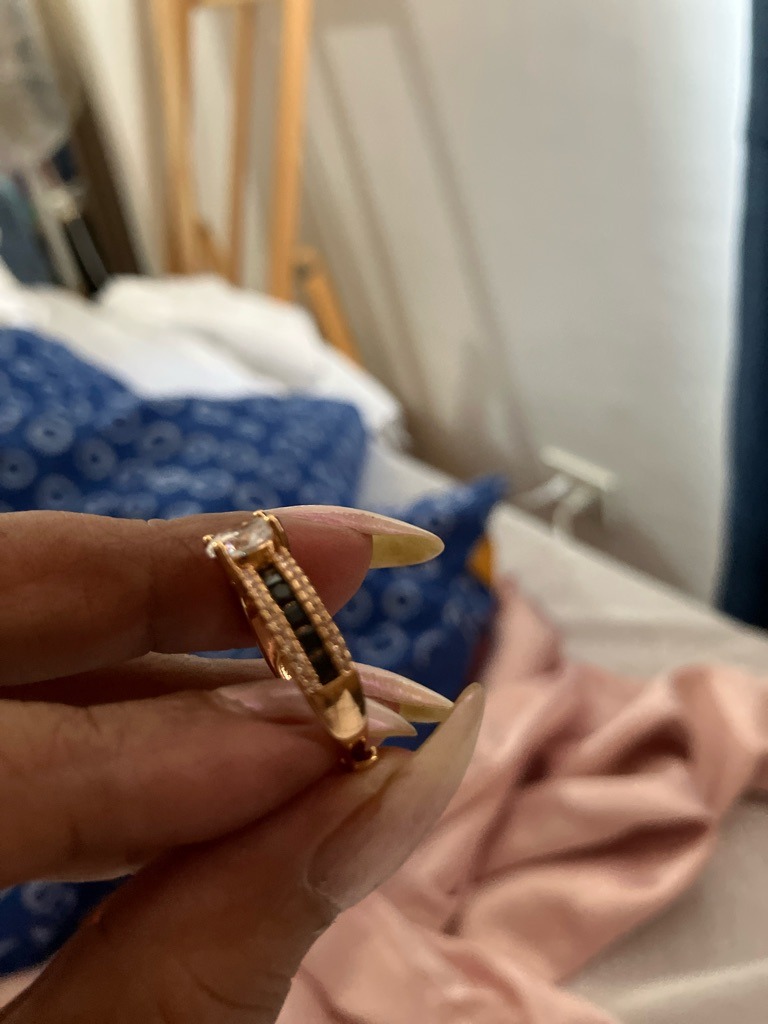
Likely Moissanite or High-Quality Cubic Zirconia
Likely Moissanite or High-Quality Cubic Zirconia · Emerald Cut or Radiant Cut
Very Good Cut
Carat
Estimated 1.5 to 2.0 carats
Color
D-E (Colorless range)
Clarity
Eye-clean, likely equivalent to VVS1 or VVS2
Shape
Emerald Cut or Radiant Cut
Overall Assessment
The stone presents as a high-quality colorless simulant, possibly moissanite, set in a contemporary decorative ring. It offers high visual impact with significant fire and brilliance.
Cut Quality
Very Good
Brilliance
High (exhibiting sharp white light return typical of diamond simulants)
Fire
Strong (visible rainbow dispersion, often more pronounced in moissanite)
Scintillation
Moderate to High; rectangular flash pattern
Proportions
Elongated rectangular profile with a flat table; depth appears shallow to medium for this cut type
Symmetry
Good (visible through side profile and facet alignment)
Polish
Good
Fluorescence
None visible in standard lighting
Inclusions
No visible inclusions at this magnification; appears internally clean
Blemishes
Minor surface wear consistent with jewelry settings; no major chips
Origin
Synthetic/Laboratory-created
Treatment Detection
None detected; likely an as-grown simulant
Estimated Value
$50 - $400 USD (based on the likelihood of it being a simulant in a gold-plated or low-karat setting)
Certification Estimate
GRA (if moissanite) or IGI; estimated 'Ideal' for cut if lab-grown
Investment Potential
Low (fashion jewelry / ornamental value)
Similar Diamonds
Charles & Colvard Forever One Moissanite; Lab-Grown Emerald Cut Diamonds
Setting Suggestions
Currently in a rose gold or yellow gold pavé bridge setting; looks best in 14k White Gold or Platinum to enhance the colorless stone
Care & Maintenance
Clean with warm soapy water and a soft brush; avoid harsh chemicals which can damage the metal plating
Interesting Facts
Emerald cuts are known as 'hall of mirrors' cuts because of their long, step-cut facets