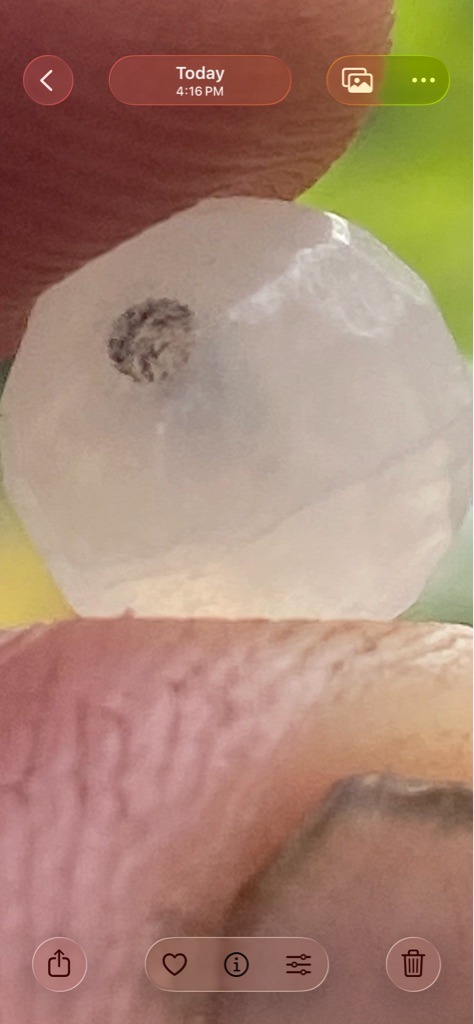
Natural (Rough or heavily included diamond crystal)
Natural (Rough or heavily included diamond crystal) · Irregular / Raw Crystal / Dodecahedron-like
Poor / Uncut / Natural Rough Cut
Carat
Estimated 0.50 to 1.00 carat based on visual context
Color
K-M (Off-white / tinted yellow or greyish)
Clarity
I3 (Included heavily with a large prominent internal inclusion)
Shape
Irregular / Raw Crystal / Dodecahedron-like
Overall Assessment
This appears to be a natural, low-quality rough diamond or diamond crystal featuring a prominent dark inclusion and raw surfaces, making it more suitable as a mineral specimen than a polished gemstone
Cut Quality
Poor / Uncut / Natural Rough
Brilliance
Very low due to opacity, heavy inclusions, and lack of standard faceting
Fire
Minimal to none due to lack of precision cuts and severe internal obstacles
Scintillation
Negligible due to rough surface and heavy internal clouding
Proportions
Non-standard raw crystal proportions, high depth percentage due to untutored natural state
Symmetry
Poor / Natural asymmetric crystal form
Polish
Raw / Natural crystal face texture with rough facets
Fluorescence
Unable to determine without UV testing (Likely Medium to Strong Blue)
Inclusions
Large prominent dark cloud or feather cluster inclusion visible near the surface
Blemishes
Natural surface trigons, roughness, and pitting typical of rough diamond crystals
Origin
Natural alluvial or primary kimberlitic pipe deposit origin
Treatment Detection
No signs of enhancement or treatment; completely untreated natural state
Estimated Value
Nominal value (Industrial or mineral specimen value, typically under $50-$100)
Certification Estimate
GIA or similar major labs would grade this as Industrial Grade or Natural Rough Diamond Specimen
Investment Potential
Low investment potential for jewelry use; strictly valued as a geological specimen or raw curiosity
Similar Diamonds
Industrial-grade boart, low-quality natural rough diamond crystals, or uncut mineral specimens
Setting Suggestions
Best kept in its raw form as a mineral specimen, wire-wrapped pendant, or organic rustic jewelry setting
Care & Maintenance
Avoid harsh chemicals and ultrasonic cleaners; store safely to prevent damage to fragile raw edges and inclusions
Interesting Facts
Rough diamonds often display natural triangular growth marks called trigons on their crystal faces, formed deep within the Earth's mantle under intense pressure and temperature