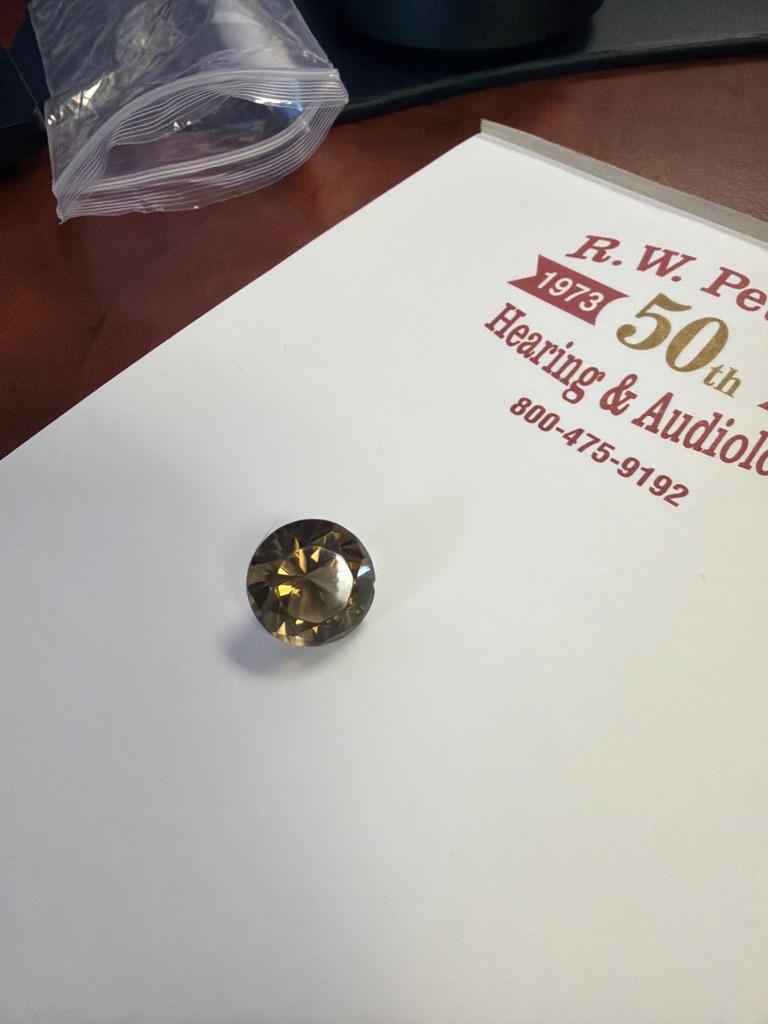
Smoky Quartz (Often misidentified or used as a diamond simulant in costume jewelry; visually exhibits brown coloration atypical of traditional diamonds, though brown 'champagne' diamonds exist naturally)
Smoky Quartz (Often misidentified or used as a diamond simulant in costume jewelry; visually exhibits brown coloration atypical of traditional diamonds, though brown 'champagne' diamonds exist naturally) · Round Brilliant
Good to Very Good (Standard faceted pavilion and crown, displaying distinct broad facets) Cut
Carat
Estimated 3.00 to 4.50 carats based on visual proportions against standard sizing
Color
Natural Fancy Dark Brown / Smoky
Clarity
VS1 (Very Slightly Included - appears generally eye-clean with high transparency)
Shape
Round Brilliant
Overall Assessment
The specimen displayed is a well-cut, large round gemstone (likely smoky quartz rather than a true diamond) exhibiting a deep brownish hue, good clarity, and standard brilliance suited for fashion or statement jewelry
Cut Quality
Good to Very Good (Standard faceted pavilion and crown, displaying distinct broad facets)
Brilliance
Moderate white light return, limited by the darker body color absorption
Fire
Low dispersion (quartz has a lower refractive index than diamond, approximately 1.54 vs 2.42)
Scintillation
Good flash effect across large bezel and star facets
Proportions
Standard deep pavilion with a moderate table percentage, typical of colored quartz cuts to maximize rich body color
Symmetry
Good (Facet alignment is generally uniform, though culet and star facets show minor variance)
Polish
Good (Smooth facet junctions with minor surface abrasion visible under magnification)
Fluorescence
None to Faint
Inclusions
Minor pinpoint inclusions and faint internal veiling typical of natural quartz varieties
Blemishes
Faint natural surface scratches along girdle edges
Origin
Natural quartz is globally abundant; major sources include Brazil, Madagascar, and the United States
Treatment Detection
No obvious signs of artificial irradiation or fracture filling, though routine heat enhancement is common in commercial quartz
Estimated Value
Low to Moderate ($50 - $200 USD depending on whether it is natural smoky quartz or treated glass/synthetic quartz)
Certification Estimate
GIA Colored Stone Identification Report (if gemstone) or standard trade grading
Investment Potential
Low investment potential as colored quartz is a semi-precious gemstone with high commercial availability
Similar Diamonds
Champagne or cognac colored natural diamonds (though significantly higher in value and refractive brilliance)
Setting Suggestions
Yellow gold or rose gold prong settings to complement the rich earthy brown tones
Care & Maintenance
Clean with warm soapy water and a soft brush; avoid harsh chemicals, ultrasonic cleaners, and sudden temperature drops
Interesting Facts
Smoky quartz gets its natural brown color from free silicon formed when natural radiation emitted from surrounding rock acts on aluminum impurities within the quartz crystal lattice