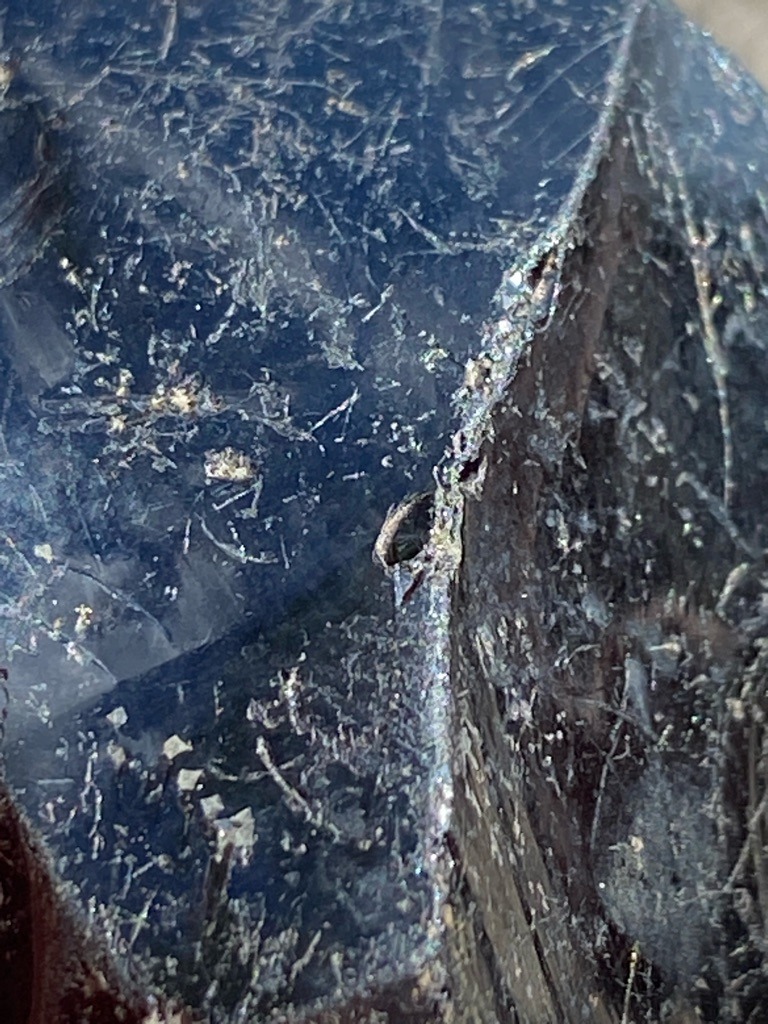
Not a diamond; appears to be a mineral specimen, possibly raw corundum, tourmaline, or a weathered dark stone matrix with inclusions.
Not a diamond; appears to be a mineral specimen, possibly raw corundum, tourmaline, or a weathered dark stone matrix with inclusions. · Rough, uncut, irregular natural crystal form
Not applicable (uncut rough) Cut
Carat
Not applicable for faceted diamonds; estimated substantial weight as a rough specimen
Color
Opaque dark blue to black
Clarity
Included / Opaque
Shape
Rough, uncut, irregular natural crystal form
Overall Assessment
The uploaded image does not depict a polished or cut diamond. Instead, it shows a close-up of a rough, dark, heavily included mineral specimen with complex surface textures and internal needles.
Cut Quality
Not applicable (uncut rough)
Brilliance
None due to opaque nature and lack of facets
Fire
None
Scintillation
None
Proportions
Not applicable
Symmetry
Natural crystal symmetry, irregular due to fracture
Polish
Unpolished, natural rough surface texture
Fluorescence
Unknown without UV testing
Inclusions
Heavy internal needle-like inclusions, fractures, and foreign mineral matrices visible
Blemishes
Surface scratches, weathering, rough patches, and natural etch channels
Origin
Natural rough mineral matrix, likely metamorphic or pegmatitic environment
Treatment Detection
No obvious enhancements, appears completely natural and untreated
Estimated Value
Nominal mineral specimen value, dependent on exact mineral identification and collector market
Certification Estimate
Gemological laboratories would issue an identification report rather than a diamond grading report (e.g., GIA colored stone or mineral report)
Investment Potential
Low as an investment, primarily of educational or mineral-collecting interest
Similar Diamonds
None (this is not a diamond)
Setting Suggestions
Display as a raw mineral specimen rather than jewelry mounting
Care & Maintenance
Keep dry, avoid harsh chemical cleaners, store securely to prevent matrix crumbling
Interesting Facts
Rough mineral specimens often show natural growth lines and mineral inclusions that tell the geological history of their formation