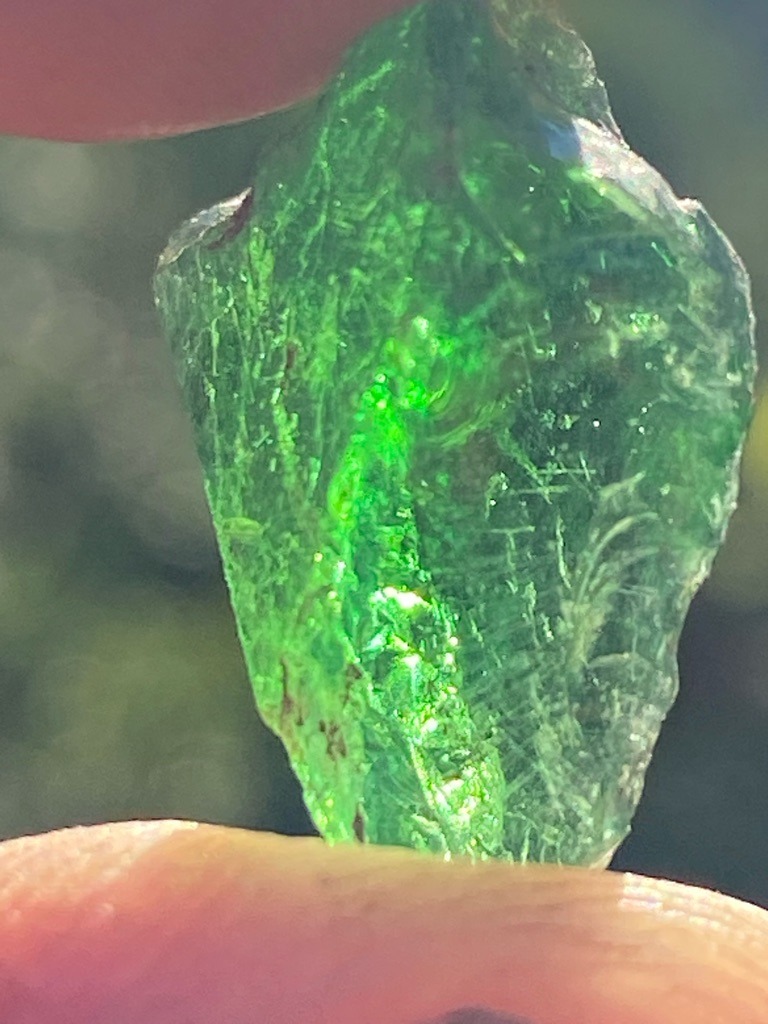
Not a diamond; this specimen appears to be green glass or slag, possibly colored with chromium or copper, exhibiting conchoidal fracture patterns.
Not a diamond; this specimen appears to be green glass or slag, possibly colored with chromium or copper, exhibiting conchoidal fracture patterns. · Raw, unpolished, irregular fragment with natural or broken conchoidal surfaces
Not applicable (uncut raw fragment) Cut
Carat
Cannot be precisely determined without volume and density measurements, but visually estimated at roughly 10-15 carats equivalent volume.
Color
Vivid Fancy Green (Saturation is high, likely artificial or non-gem mineral origin)
Clarity
Included (shows numerous internal bubbles, flow lines, and stress fractures typical of glass)
Shape
Raw, unpolished, irregular fragment with natural or broken conchoidal surfaces
Overall Assessment
This specimen is a vibrant green rough fragment, most likely glass or slag, rather than a genuine diamond or precious gemstone. Its internal bubble structures and fracture patterns clearly distinguish it from natural crystalline minerals.
Cut Quality
Not applicable (uncut raw fragment)
Brilliance
Low to moderate vitreous luster, lacks true diamond dispersion and internal reflection
Fire
Minimal to none; lacks the high refractive index and dispersion of a diamond
Scintillation
Poor, due to lack of facet geometry and presence of internal diffusion
Proportions
N/A - Irregular rough fragment
Symmetry
Asymmetrical due to random fracture and breakage
Polish
None (rough surface texture)
Fluorescence
Unknown without UV testing, though some green glasses exhibit inert or weak fluorescence.
Inclusions
Gas bubbles, swirl marks, and internal linear stress fractures characteristic of manufactured glass
Blemishes
Surface chips, rough edges, and uneven texture
Origin
Man-made glass / industrial or decorative cullet
Treatment Detection
Colored glass composition with visible internal melt/flow features
Estimated Value
Minimal (novelty or ornamental value only, typically under $5)
Certification Estimate
Cannot be certified as a diamond by standard gemological laboratories (GIA, IGI, etc.); would be identified as glass upon testing.
Investment Potential
None as a gemstone or investment asset
Similar Diamonds
None, as this is visually and compositionally not a diamond
Setting Suggestions
Wire-wrapping or bezel setting if used for craft or costume jewelry purposes
Care & Maintenance
Standard cleaning with mild soap and warm water; avoid harsh impacts as glass is brittle
Interesting Facts
Green glass is frequently mistaken for rough emerald, green tourmaline, or colored diamond by untrained observers due to its striking color and vitreous appearance.